



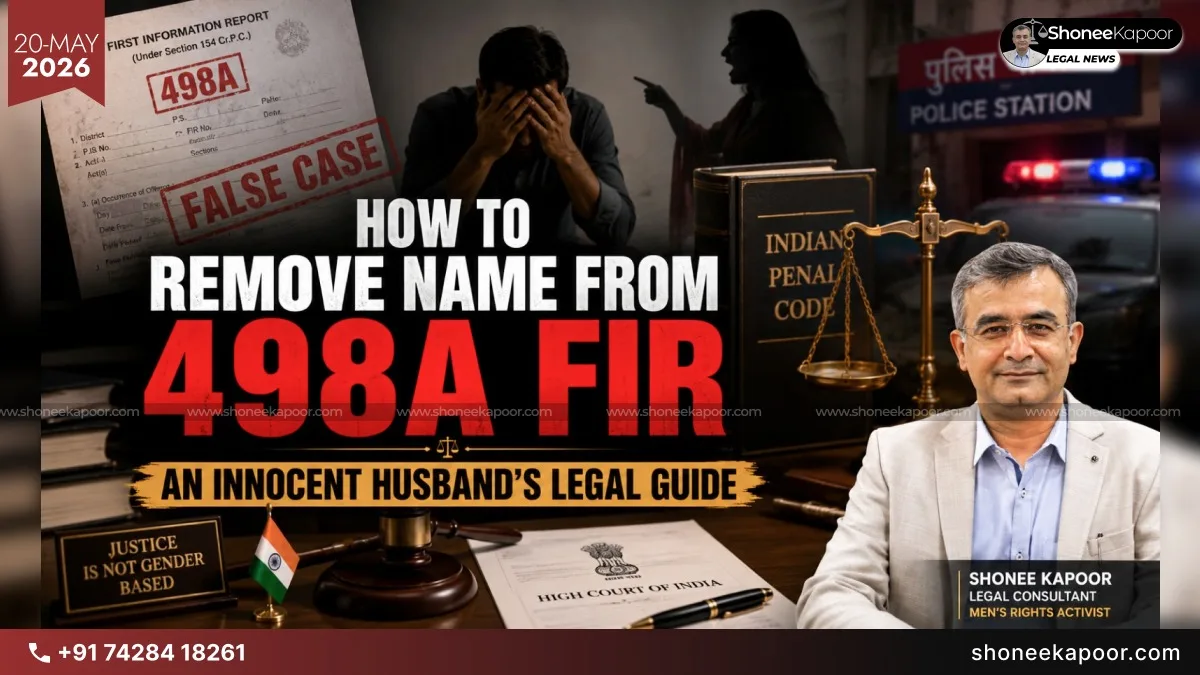
A false 498A FIR can destroy a man’s reputation, career, and family before trial even begins. This legal guide explains how innocent husbands can challenge vague allegations, seek FIR quashing, and legally remove their names using Supreme Court-backed remedies.
NEW DELHI: A 498A FIR is not just a police case. For an innocent husband, it becomes a weapon of fear, arrest threats, social humiliation, career damage, passport problems, family pressure, and settlement blackmail.
But the law is clear: a name in the FIR is not proof of guilt. If the allegations are vague, impossible, retaliatory, delayed, or unsupported by material, the High Court can remove your name by quashing the FIR or proceedings.
Section 498A IPC punishes cruelty by the husband or his relatives, with imprisonment up to three years and fine. “Cruelty” means conduct likely to drive the woman to suicide or cause grave injury, or harassment linked with unlawful demand for property or valuable security.
After the new criminal laws, the equivalent provision is Section 85 BNS, while cruelty is defined under Section 86 BNS. For older FIRs, Section 498A IPC still applies depending on the date of offence.
CAN A HUSBAND’S NAME BE REMOVED FROM A 498A FIR?
Yes, but not by simply requesting the police to “delete” the name. In serious matrimonial FIRs, the practical legal remedy is usually:
- High Court quashing petition under Section 482 CrPC for old procedure cases, or Section 528 BNSS after the new criminal procedure law.
- Article 226 writ petition in suitable cases.
- Discharge application after charge-sheet, if the case has reached the trial court.
- Closure report / cancellation report by police, if investigation itself finds no case.
- Settlement-based quashing, where both parties settle and the complainant supports quashing.
Section 482 CrPC preserves the inherent power of the High Court to prevent abuse of process and secure the ends of justice.
THE BIGGEST MISTAKE INNOCENT HUSBANDS MAKE
Most men panic after FIR and start running for compromise. That is the trap. First, read the FIR like a judge:
- Is there a specific date?
- Is there a specific dowry demand?
- Is there a specific act of cruelty?
- Is there medical proof?
- Is there independent evidence?
- Is the FIR filed after divorce notice, maintenance case, custody dispute, or refusal to pay money?
- Are all family members casually named?
If the FIR only says “husband and family harassed me for dowry” without details, it is weak. Criminal law does not run on slogans. It runs on ingredients, evidence, and prima facie material.
SUPREME COURT ON 498A MISUSE: WHAT HELPS THE HUSBAND?
The Supreme Court has repeatedly warned that 498A should not become a tool for personal vendetta. In a 2024 judgment, the Court observed that vague and generalised allegations during matrimonial conflict, if not scrutinised, encourage misuse and arm-twisting tactics. The Court held that proceedings used as a weapon in personal discord can amount to abuse of process.
In another 2025 Supreme Court judgment, the Court quashed FIR and charge-sheet where it found the FIR vexatious and apparently filed with an ulterior motive after the husband had filed divorce proceedings.
In August 2025, the Supreme Court again quashed proceedings against a father-in-law where continuation of criminal proceedings against family members, especially without specific and proximate allegations, served no legitimate purpose and only prolonged bitterness.
BEST GROUNDS TO REMOVE NAME FROM 498A FIR
1. Vague And Omnibus Allegations
If the FIR names the husband, parents, sisters, brothers, and relatives without individual roles, this is a strong ground. Courts repeatedly hold that relatives cannot be prosecuted merely because they are related to the husband.
2. FIR Filed As Counterblast
If the 498A FIR comes after divorce notice, restitution petition, custody dispute, maintenance resistance, or settlement refusal, show the chronology. Timing can expose motive.
3. No Ingredient Of Cruelty
Every domestic quarrel is not 498A. Disagreement, incompatibility, ego clash, normal marital discord, or refusal to obey unreasonable demands cannot automatically become criminal cruelty.
4. Delay In Complaint
A delayed FIR is not automatically false, but unexplained delay weakens the prosecution story, especially where serious allegations were never reported earlier.
5. No Medical, Documentary Or Independent Support
If there are allegations of assault, miscarriage, confinement, or severe cruelty but no medical record, no timely complaint, and no independent witness, the High Court can examine whether continuation is abuse of process.
6. Separate Residence
If husband’s relatives were living separately, or the husband himself was posted elsewhere, location evidence can be decisive.
7. Settlement Between Parties
498A is non-compoundable in many jurisdictions unless state amendment applies, but High Courts and the Supreme Court can quash matrimonial criminal proceedings on settlement in appropriate cases to secure justice.
DOCUMENTS NEEDED FOR 498A QUASHING
Keep these ready before filing:
- FIR copy
- Complaint copy, if separate from FIR
- 41A notice / arrest notice, if issued
- Charge-sheet, if filed
- Marriage documents
- Divorce petition / maintenance case / custody case chronology
- WhatsApp chats, emails, call records, bank records
- Proof of separate residence
- Employment posting proof
- Medical contradictions, if any
- Settlement deed and complainant affidavit, if matter is settled
COURTROOM REALITY: WHAT THE JUDGE LOOKS AT
The High Court normally asks:
Where is the specific allegation?
If the FIR has only general accusations, quashing becomes stronger.
What is the role of this accused?
A husband’s name is treated more seriously than distant relatives, but even against the husband, the FIR must disclose legally recognised cruelty.
Was the FIR retaliatory?
If filed after divorce or other litigation, the court examines motive.
Will trial serve justice or become punishment?
The Supreme Court has said that criminal law should not be used as harassment, and quashing is essential in appropriate cases to uphold fairness.
PRACTICAL STRATEGY FOR INNOCENT HUSBANDS
Do not abscond. Do not threaten the complainant. Do not create emotional WhatsApp evidence. Do not pay cash without written settlement. Do not rely only on police assurances.
First secure protection from arrest, comply with 41A notice, prepare chronology, collect contradictions, and then decide whether to file quashing before charge-sheet or after charge-sheet. In many cases, waiting for charge-sheet gives better material. In some cases, immediate quashing is necessary to stop abuse.
CONCLUSION
An innocent husband can remove his name from a false 498A FIR, but only with facts, documents, chronology, and correct legal strategy.
The High Court is not a complaint counter. It will not quash merely because the husband says he is innocent. But where the FIR is vague, retaliatory, delayed, exaggerated, or unsupported by evidence, the law gives a powerful remedy.
A false 498A case is not the end of life. It is a legal battle. Fight it with evidence, not emotion.
FAQs
Yes. He can approach the High Court for quashing if the FIR lacks specific allegations, is retaliatory, or does not disclose ingredients of cruelty.
Yes. The High Court can quash before charge-sheet in appropriate cases, but the facts must clearly show abuse of process.
No. Settlement is one ground. Even without settlement, courts can quash false, vague, or malicious 498A proceedings.
Police may file a closure report or not charge-sheet you if evidence is absent, but formal quashing usually requires High Court intervention.
The strongest ground is absence of specific allegations showing cruelty or dowry-linked harassment, especially when the FIR appears to be a counterblast.

Leave A Comment