
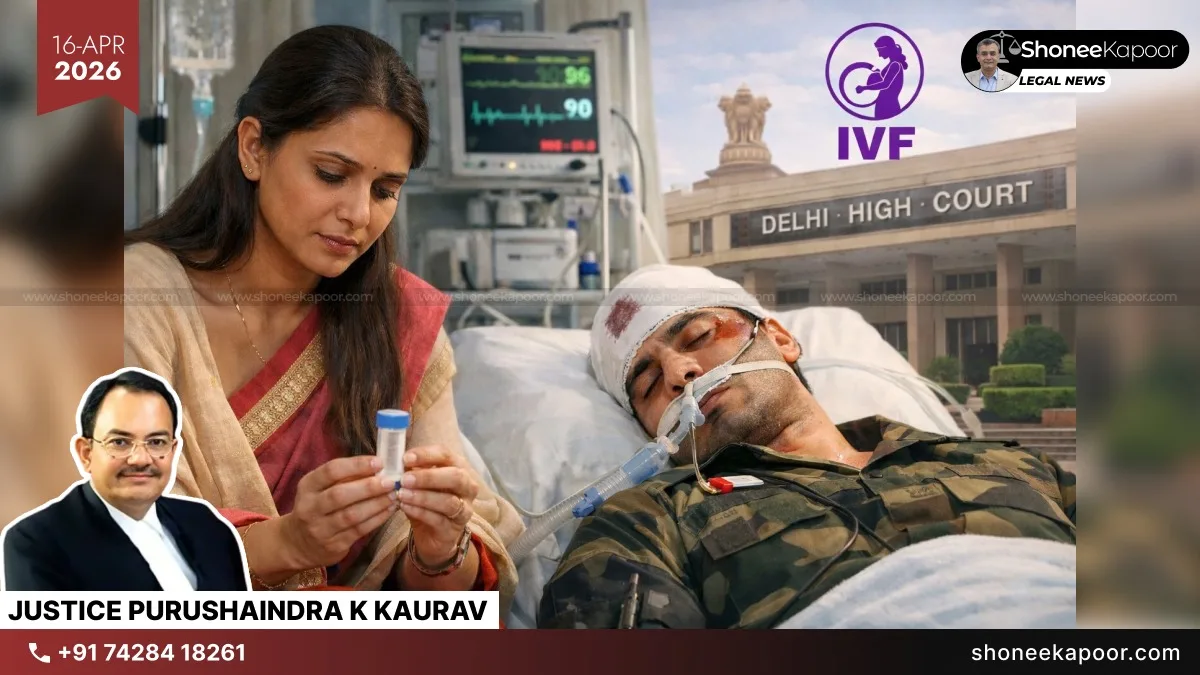
Does the right to parenthood and reproductive choice continue even when the husband loses decision-making capacity?
The Delhi High Court held that there is no legal bar on posthumous or incapacitated reproduction if prior consent is evident.
NEW DELHI: The Delhi High Court, in a judgment dated 13 April 2026, delivered by Justice Purushaindra Kumar Kaurav, dealt with a sensitive legal issue involving IVF and consent where the husband was in a vegetative state. The Court examined whether strict legal requirements should override the couple’s earlier decision to have a child.
The case started when a wife approached the Court after her husband, an Army personnel, suffered a severe brain injury and went into a persistent vegetative state. Before this unfortunate incident, the couple had already decided to have a child through IVF and had even started the process.
After the accident, the husband became incapable of giving fresh written consent, which created a legal hurdle under the Assisted Reproductive Technology law, forcing the wife to seek permission from the Court to continue the process.
The Court analysed the provisions of the Assisted Reproductive Technology law and clarified that although written consent is generally required, such procedural rules cannot be applied blindly when fundamental rights are at stake.
Explaining the objective of the law, the Court observed:
“For addressing the issues of reproductive health where assisted reproductive technology is required for becoming a parent or for freezing gametes, embryos, embryonic tissues for further use due to infertility, disease or social or medical concerns and for regulation and supervision of research and development and for matters connected therewith or incidental thereto”
The Court made it clear that procedure should support justice and not defeat it, stating:
“Procedure is indeed the handmaiden of justice”
It emphasized that reproductive autonomy is part of the right to life under Article 21 and must be protected through a liberal interpretation of the law.
On the uncertainty of medical outcomes, the Court made a broader observation:
“Whether or not the petitioner herein, and her husband, Mr. Kumar, are to beget a child, is not in human hands. It is destiny that determines whether or not the fortune of parenthood shall get bestowed upon persons.”
While discussing settled legal position, the Court reiterated:
“There is no prohibition against posthumous reproduction if the consent of the sperm owner or egg owner can be demonstrated.”
Referring to international legal reasoning, the Court highlighted that even when a person cannot give consent due to medical condition, their earlier intention must be respected.
It noted that if a couple had already planned to have a child and had taken steps towards it, the law should not block that intention merely because of an unforeseen tragedy.
The Court explained that the process of reproduction through IVF is not a single step but a continuous journey.
Once a person has consciously started that process, it logically includes both preservation and later use of reproductive material, and the law should recognize this continuity rather than treating each step in isolation.
The Court affirmed the legality of such medical action:
“It was lawful for a doctor to retrieve his gametes and lawful for those gametes to be stored both before and after his death”
Based on these principles, the Court concluded that earlier participation in IVF treatment reflects valid consent, and the absence of fresh written consent due to medical incapacity cannot be used to deny the right to parenthood.
The ruling reinforces that fundamental rights, dignity, and intent will prevail over rigid procedural technicalities, while also leaving open an important legal question — whether such an interpretation will be equally applied if a man seeks similar relief in a reversed situation.
Explanatory Table: Laws & Provisions Involved
| Law / Provision | Purpose | How Applied in This Case |
| Assisted Reproductive Technology (Regulation) Act, 2021 – Section 22(1) | Mandates written informed consent before IVF procedures | Court held this is procedural and cannot override prior consent already given through conduct (starting IVF) |
| Assisted Reproductive Technology (Regulation) Act, 2021 – Section 22(2) | Requires written consent for cryopreservation in case of incapacity or death | Relaxed due to exceptional facts; incapacity cannot defeat reproductive rights |
| Constitution of India – Article 21 | Guarantees right to life, dignity, and personal liberty | Interpreted to include reproductive autonomy and right to motherhood |
| X v. Principal Secretary, Health Dept., GNCTD (2023) 9 SCC 433 | Recognizes reproductive choice as a fundamental right | Used to support liberal interpretation of ART Act in favour of the petitioner |
| Gurvinder Singh v. State (NCT of Delhi), 2024 SCC OnLine Del 6902 | Clarifies no legal prohibition on posthumous reproduction if consent exists | Applied to justify inferred consent in absence of written consent |
| Simi Rajan v. Union of India (Kerala High Court, 2026) | Allowed gamete extraction when consent could not be obtained due to medical condition | Used as persuasive precedent for allowing sperm retrieval |
| Y v. A Healthcare NHS Trust (UK, 2018) | Recognizes prior intention for reproduction even without express consent at later stage | Used to emphasize importance of intention and continuity of IVF process |
Case Details
- Case Title: Ms. X v. Union of India & Ors.
- Court: Delhi High Court
- Case Number: W.P.(C) 4469/2026
- Date of Judgment: 13 April 2026
- Bench: Justice Purushaindra Kumar Kaurav
- Neutral Citation: 2026:DHC:3086
- Counsels:
- For Petitioner: Mr. Arjeet Gaur, Mr. Atul Yadav, Mr. Jasbir Singh Balhara, Mr. Sidarth Yadav, Mr. Prince Sharma, Mr. Subhan Singh Sejwal, Mr. Saurabh Bharti, Mr. Mayank Dev, Mr. Pawan Yadav, Ms. Kiran, Ms. Himanshi, Mr. Himanshu Dutt, and Ms. Deepshikha
- For Respondents: Mr. Ayush Gaur (SPC), Ms. Riddhi Kapoor, Mr. Harshit Joshi (Government Pleader)
Key Takeaways
- Reproductive rights are being interpreted very broadly, where even absence of written consent is being overlooked based on presumed intention.
- Courts are increasingly prioritising subjective intent over clear statutory safeguards, which can create scope for misuse in future disputes.
- The principle that “procedure is secondary to rights” may weaken legal protections that exist to prevent unauthorized use of a person’s body or genetic material.
- There is a clear risk of gender imbalance, as similar relief may not be equally accessible or interpreted in favour of men in reversed situations.
- Such interpretations raise serious concerns about consent, bodily autonomy, and legal certainty, especially when the individual is incapable of expressing their will.
This Could Change Your Case-Get FREE Legal Advice-Click Here!
Disclaimer: The views and opinions expressed in this article are those of the Indian courts and do not necessarily reflect the official policy or position of “ShoneeKapoor.com” or its affiliates. This article is intended for informational and educational purposes only. The content provided is not legal advice, and viewers should not act upon this information without seeking professional counsel. Viewer discretion is advised.
