
Can a man remain legally bound to a marriage even after years of living separately with no real marital life?
The Jharkhand High Court held that long separation alone is not enough for divorce unless grave cruelty is proved.
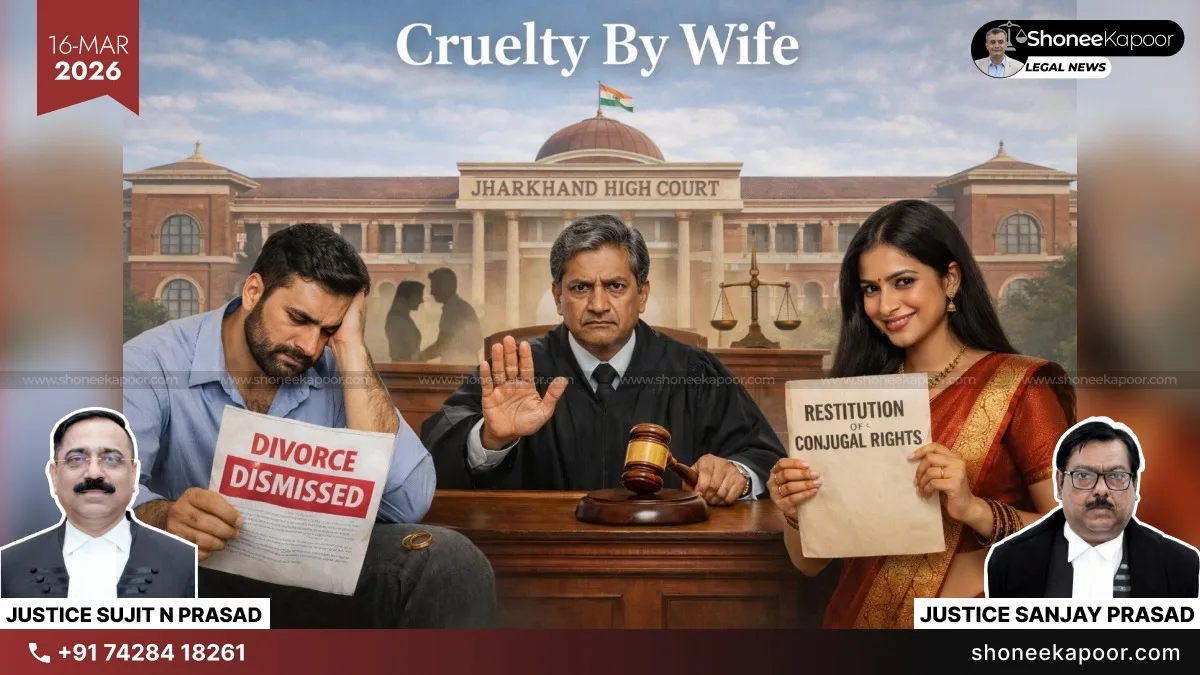
The Jharkhand High Court, led by Hon’ble Justice Sujit Narayan Prasad and Hon’ble Justice Sanjay Prasad, dismissed the husband’s appeal for divorce and upheld the wife’s right to restitution of conjugal rights.
The case initiated when the husband filed a divorce petition under the Hindu Marriage Act, claiming cruelty and desertion. At the same time, the wife filed a separate case seeking restitution of conjugal rights, asking the Court to direct the husband to resume marital life. The Family Court dismissed the husband’s divorce plea and allowed the wife’s petition, after which the husband approached the High Court in appeal.
The husband argued that his wife refused to live with him and stayed separately for years despite an earlier court decree directing her to resume matrimonial life. He claimed this long separation and refusal amounted to cruelty and sought dissolution of marriage. However, the Court carefully examined the evidence and found inconsistencies in his claims.
The Court noted that the husband himself admitted visiting his wife and maintaining physical relations during this period. This weakened his claim that there was complete breakdown of marriage or absence of cohabitation. The Court also considered practical difficulties, as both parties were government employees posted in different states.
Importantly, the Court observed that cruelty must meet a high legal threshold. It relied on settled law and held that “cruelty” must be serious enough to make it impossible for spouses to live together, rather than being based on ordinary marital disagreements.
The judgment clarified that “perverse” findings mean decisions that are unsupported by evidence or against the law, stating: “perverse finding” means a finding which is not only against the weight of evidence but is altogether against the evidence itself.
On the issue of cruelty, the Court emphasized that “cruelty” depends on facts of each case and includes both mental and physical aspects. It reiterated that:“the categories of cruelty are not closed” and each case must be assessed individually.
Further, the Court highlighted that:
“The conduct complained of must be “grave” and “weighty” and trivial irritations and normal wear and tear of marriage would not constitute mental cruelty”.
Applying these principles, the Court concluded that the husband failed to prove cruelty. It held that occasional cohabitation and ongoing contact showed that the marriage had not completely broken down in the legal sense.
The Court also accepted the wife’s stand that she was willing to continue the marriage but could not relocate due to her government job. It observed that such practical realities cannot be ignored while deciding matrimonial disputes.
Ultimately, the Court dismissed the husband’s appeal and upheld the order directing restitution of conjugal rights, effectively forcing continuation of the marriage.
Explanatory Table: Laws And Sections Involved
| Law / Section | Purpose | How Applied In This Case |
| Section 19, Family Courts Act, 1984 | Appeal against Family Court judgment | Husband filed appeals before High Court |
| Section 9, Hindu Marriage Act, 1955 | Restitution of Conjugal Rights | Wife sought direction to resume marriage |
| Section 13(1)(i-a), Hindu Marriage Act, 1955 | Divorce on ground of cruelty | Husband sought divorce |
| Section 13(1-A)(ii), Hindu Marriage Act, 1955 | Divorce after non-compliance of restitution decree | Husband relied on prior decree |
| Section 23(1)(a), Hindu Marriage Act, 1955 | Petitioner cannot take advantage of own wrong | Wife argued husband cannot misuse law |
| Section 376 IPC | Rape allegation | Earlier criminal case mentioned in pleadings |
| Section 493 IPC | Deceitful cohabitation by false marriage belief | Mentioned in earlier criminal proceedings |
Case Details
- Case Title: Mr. Pawan Kumar Das vs Mrs. Fulmuni Marandi
- Court: Jharkhand High Court
- Connected Matters: F.A. No. 223 of 2023 and F.A. No. 175 of 2023
- Case Type: First Appeals filed under Section 19 of the Family Courts Act, 1984
- Neutral Citation: 2026:JHHC:10398-DB
- Date of Judgment: 10.04.2026
- Bench:
- Hon’ble Mr. Justice Sujit Narayan Prasad
- Hon’ble Mr. Justice Sanjay Prasad
- Counsels:
- For Appellant: Mr. Rajeeva Sharma, Mr. Om Prakash, Mr. Ritesh Kumar, Advocates
- For Respondent: Mr. Aman Ali, Advocate
Key Takeaways
- Long separation of several years is still not enough for a man to get divorce unless he proves very high level of “cruelty”.
- Occasional meetings or physical relations can be used against men to deny breakdown of marriage.
- Courts place a heavy burden on men to prove cruelty, treating normal marital disputes as “wear and tear”.
- Financial, emotional, and career hardships faced by men during prolonged separation often receive limited legal weight.
- Men can remain trapped in prolonged litigation even when the marriage has effectively ended in reality.
This Could Change Your Case-Get FREE Legal Advice-Click Here!
Disclaimer: The views and opinions expressed in this article are those of the Indian courts and do not necessarily reflect the official policy or position of “ShoneeKapoor.com” or its affiliates. This article is intended for informational and educational purposes only. The content provided is not legal advice, and viewers should not act upon this information without seeking professional counsel. Viewer discretion is advised.
