
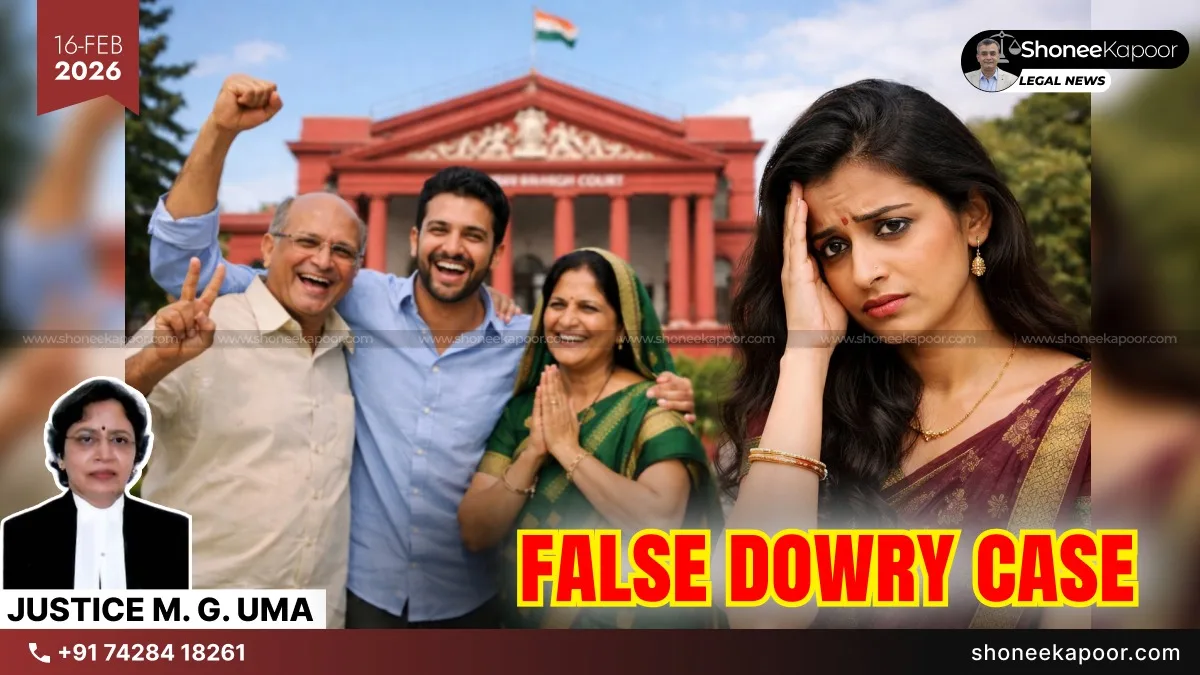
The Karnataka High Court 498A quash Case after finding no prima facie material to support the dowry allegations. It noted that the wife’s family financial records did not back the claimed payments and held that continuing the case would be an abuse of process.
Dowry Claims Fail: The Karnataka High Court, through Justice M. G. Uma, quashed criminal proceedings against a husband and his family in a 498A and dowry case, holding that the complaint was an abuse of process of law.
The Court found that the allegations were general, unsupported, and filed after matrimonial disputes had escalated.
The marriage took place in March 2020. Within months, disputes arose. The husband had already issued a legal notice seeking divorce and had filed prior complaints before the wife lodged the dowry case. Surprisingly, in her earlier reply notice and statement before the police, there were no allegations of dowry demand or cruelty. These accusations appeared only later in the formal complaint.
The wife alleged a demand of ₹10 lakhs, 1 kg of gold, and 2 kg of silver, claiming that part of it had been paid. However, documents showed that her parents were beneficiaries of government welfare schemes meant for economically weaker sections and held a BPL card. The Court noted that there was no material to show the source of such large payments.
The Court relied on Supreme Court principles and reproduced key observations. It quoted:
“If a person is made to face a criminal trial on some general and sweeping allegations without bringing on record any specific instances of criminal conduct, it is nothing but abuse of the process of the court.”
The Court further referred to the Supreme Court’s warning that:
“If the Court is convinced by the fact that the involvement by the complainant of her husband and his close relatives is with an oblique motive then even if the FIR and the chargesheet disclose the commission of a cognizable offence the Court with a view to doing substantial justice should read in between the lines the oblique motive of the complainant and take a pragmatic view of the matter.”
On misuse of law in matrimonial disputes, the judgment reproduced:
“Making vague and generalised allegations during matrimonial conflicts, if not scrutinized, will lead to the misuse of legal processes and an encouragement for use of arm twisting tactics by a wife and/or her family.”
Highlighting exaggerated dowry claims, the Court quoted:
“Now-a-days, exorbitant claims are made about the amount spent on marriage and other ceremonies and on dowry and gifts. In some cases claim is made of spending crores of rupees on dowry without disclosing the source of income and how funds flowed.”
On arrest safeguards, the judgment reproduced:
“All the State Governments to instruct its police officers not to automatically arrest when a case under Section 498-A IPC is registered but to satisfy themselves about the necessity for arrest.”
The Court made it clear that the purpose of the guidelines is to ensure that police officers do not make unnecessary arrests and that Magistrates do not grant detention in a routine or mechanical manner.
After carefully reviewing the sequence of events, the financial status of the complainant’s family, the earlier complaints filed by the husband, and the absence of basic supporting material, the Court concluded that the case had been initiated with mala fide intention. It found that continuing the prosecution would amount to abuse of the legal process and accordingly quashed the entire criminal proceedings against all the petitioners.
Explanatory Table: Laws And Sections Involved
| Law and Section | Purpose | How Applied in This Case |
| Section 498A IPC | Cruelty by husband or relatives | Alleged dowry harassment |
| Section 406 IPC | Criminal breach of trust | Alleged misuse of dowry articles |
| Section 504 IPC | Intentional insult | Alleged abusive conduct |
| Section 506 IPC | Criminal intimidation | Alleged threats |
| Section 149 IPC | Common object liability | Family members implicated |
| Section 3, Dowry Prohibition Act | Punishes giving/taking dowry | Dowry payment allegation |
| Section 4, Dowry Prohibition Act | Punishes dowry demand | Additional demand claim |
| Section 41 Cr.P.C. | Regulates arrest without warrant | Arrest scrutinized |
| Section 41A Cr.P.C. | Notice instead of arrest | Guideline referenced |
| Section 482 Cr.P.C. | High Court inherent powers | Used to quash case |
| Dowry Prohibition Rules, 1985 | List of presents requirement | Source of dowry questioned |
Case Details
- Case Title: Petitioners vs. State of Karnataka
- Case No.: Criminal Petition No. 7331 of 2021
- Court: High Court of Karnataka at Bengaluru
- Bench: Hon’ble Mrs. Justice M. G. Uma
- Date of Judgment: 19 January 2026
- Neutral Citation: 2026:KHC:2726
- Counsels:
- For Petitioners: Sri Angad Kamath, Advocate; Sri Vishakh Hegde, Advocate
- For State: Smt. Sowmya R., High Court Government Plead
Key Takeaways
- Courts are now clearly stating that vague and sweeping 498A allegations cannot be allowed to ruin an entire family without solid prima facie material.
- Mechanical arrests in matrimonial disputes are being strongly discouraged; liberty cannot be sacrificed merely because an FIR is registered.
- Financial claims in dowry cases must withstand basic scrutiny, especially when the background facts contradict exaggerated allegations.
- Prior conduct, timeline of events, and suppression of material facts can expose mala fide intention behind criminal complaints.
- Section 482 Cr.P.C. remains a powerful safeguard for innocent husbands and family members facing abuse of criminal law in matrimonial conflicts.
This Could Change Your Case-Get FREE Legal Advice-Click Here!
Disclaimer: The views and opinions expressed in this article are those of the Indian courts and do not necessarily reflect the official policy or position of “ShoneeKapoor.com” or its affiliates. This article is intended for informational and educational purposes only. The content provided is not legal advice, and viewers should not act upon this information without seeking professional counsel. Viewer discretion is advised.

Highly appreciated observation of High Court in disecting each thread of the allegation and reaching at the brilliant conclusions. The wife should have been punished under perjury to give a message to society also. Mischief mongers must be trapped and punished especially for highly educated ones.
Thank you for your support.
Where a party knowingly makes false statements on oath, it attracts Sections 191–193 IPC (now Sections 227–229 BNS, 2023) relating to giving and fabricating false evidence. Prosecution can be initiated by the concerned court under Section 340 CrPC (now Section 379 BNSS, 2023) if the court is satisfied that deliberate falsehood was committed.