
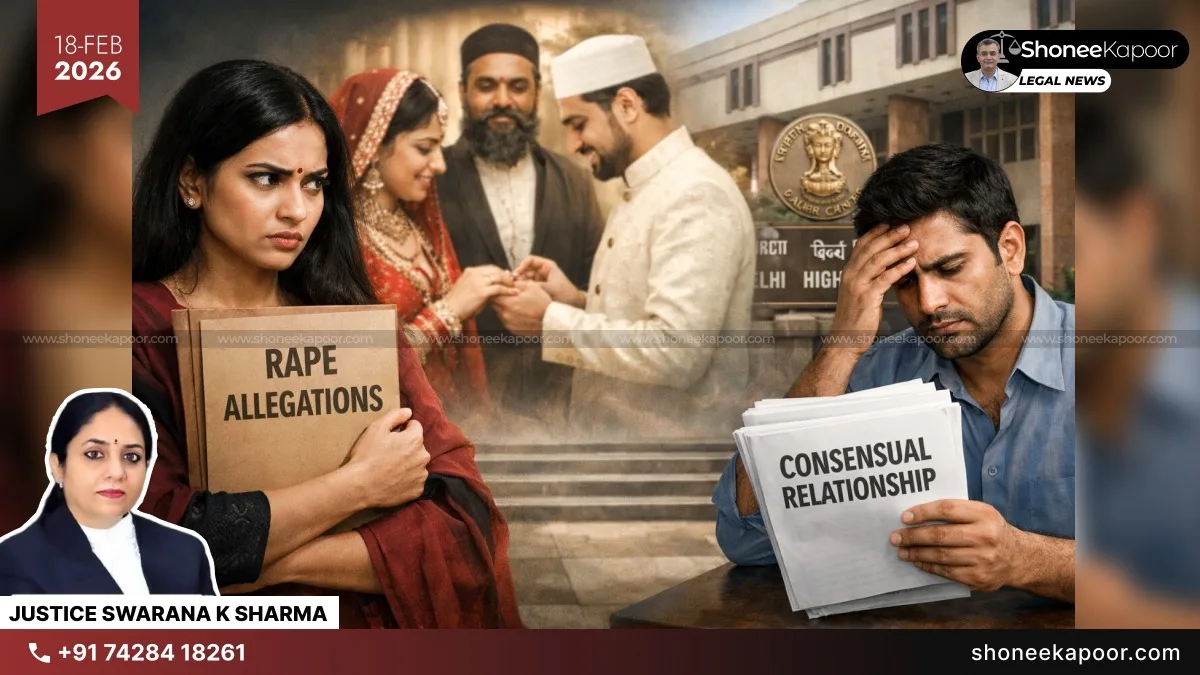
After nearly 11 years of an open, adult relationship, criminal charges were invoked when the relationship collapsed. The Delhi High Court has now drawn a sharp line – criminal law cannot be used to rewrite the past after informed consent was consciously given.
Consensual Relationship Not Rape: Justice Dr Swarana Kanta Sharma of the Delhi High Court dismissed a revision petition filed by a woman advocate and upheld the Sessions Court’s decision to discharge the accused from serious charges, including rape, deceitful marriage, wrongful confinement and criminal intimidation. The Court made it clear that criminal law cannot be used to settle scores after a relationship fails.
The FIR was filed in 2022, alleging sexual exploitation since 2011 on the grounds of misrepresentation of religion and marital status. However, during discharge proceedings, a Nikahnama dated 14.12.2012 was verified, along with the Qazi’s statement.
Independent witnesses confirmed that the woman had been living with the accused as his wife since 2012. Her Aadhaar and Voter ID, issued years before the FIR, reflected her address as “c/o Irshad Ali Khan” and recorded him as her husband.
The Court noted that the relationship continued openly for nearly eleven years, during which the prosecutrix completed her law degree, enrolled as an advocate and regularly attended court. No complaint was made for over a decade.
Justice Sharma observed:
“Criminal law must remain a shield for the vulnerable, not a weapon in the hands of the disenchanted.”
The Court further stated:
“Consent, when freely given with full awareness of material facts and sustained over a considerable period, cannot be retrospectively withdrawn so as to convert a consensual relationship into a criminal offence merely because the relationship has broken down.”
It also held:
“Criminal law cannot be permitted to become an instrument of retaliation, pressure, or personal vendetta arising out of a relationship that has irretrievably broken down. Its object is not to penalise disappointment or failed expectations, but to punish conduct that is inherently criminal.”
Finding no prima facie material for offences under Sections 376, 377, 493 or 495 IPC, the Court upheld the discharge. However, since medical records showed a fracture injury, the trial will proceed under Sections 323 and 325 IPC.
The High Court concluded that there was no illegality in the discharge order and reaffirmed that criminal proceedings cannot rewrite a long, voluntary relationship after it ends.
Explanatory Table: Laws And Sections Involved
| Law / Section | Purpose | How Applied in This Case |
| Section 376(2)(n) IPC | Punishes repeated rape | Court found no prima facie material due to long consensual relationship; accused discharged |
| Section 377 IPC | Punishes unnatural sexual offences | No specific evidence; discharged |
| Section 493 IPC | Protects woman from deceitful belief of lawful marriage | Court held no deception proved; Nikahnama and records showed knowledge; discharged |
| Section 495 IPC | Punishes concealment of prior marriage while marrying again | No concealment established; discharged |
| Section 354D IPC | Punishes stalking | Not supported by material; discharged |
| Section 341 IPC | Punishes wrongful restraint | Allegations vague and unsupported; discharged |
| Section 342 IPC | Punishes wrongful confinement | No specific dates or evidence; discharged |
| Section 506 IPC | Punishes criminal intimidation | No concrete threats proved; discharged |
| Section 506/34 IPC | Criminal intimidation with common intention | No overt acts shown by co-accused; discharged |
| Section 201 IPC | Punishes destruction of evidence | No proof of disappearance of evidence; discharged |
| Section 323 IPC | Punishes voluntarily causing hurt | Trial to proceed based on medical injury |
| Section 325 IPC | Punishes causing grievous hurt | Fracture injury supported prima facie case; trial to continue |
| Section 161 CrPC | Police recording of witness statement | Prosecutrix statements considered during investigation |
| Section 164 CrPC | Magistrate recording of statement | Statement examined while assessing allegations |
| Section 91 CrPC | Power to summon documents or evidence | Notices issued for mobile devices; no incriminating material found |
Case Details
- Case Title: MS A v. State & Ors.
- Case Number: CRL.REV.P. 1008/2024 & CRL.M.A. 23405/2024
- Court: High Court of Delhi at New Delhi
- Bench: Hon’ble Dr. Justice Swarana Kanta Sharma
- Neutral Citation: 2026:DHC:1382
- Dates:
- Judgment Reserved On: 28.11.2025
- Judgment Pronounced On: 16.02.2026
- Judgment Uploaded On: 17.02.2026
- Counsels:
- For Petitioner: Mr. Nitesh Saini and Dr. Ashwani Bhardwaj, Advocates
- For State: Mr. Naresh Kumar Chahar with Ms. Amisha Dahiya, Advocate with SI Rakhi
- For Respondents (R-2 to R-4): Mr. M. Rais Farooqui and Mr. M. Asad Beig, Advocates
Key Takeaways
- An 11-year open relationship, supported by documents and public conduct, cannot be suddenly labelled as rape after the relationship turns sour.
- Consent given knowingly and continued for years cannot be retrospectively withdrawn to create criminal liability.
- False or exaggerated allegations in failed relationships dilute the seriousness of genuine cases and burden the justice system.
- Courts are increasingly scrutinising long-delayed FIRs and documentary evidence before allowing men to face trial for grave charges.
- Criminal law must protect real victims, but it must not be misused as a tool of pressure, revenge, or negotiation after a breakup.
This Could Change Your Case-Get FREE Legal Advice-Click Here!
Disclaimer: The views and opinions expressed in this article are those of the Indian courts and do not necessarily reflect the official policy or position of “ShoneeKapoor.com” or its affiliates. This article is intended for informational and educational purposes only. The content provided is not legal advice, and viewers should not act upon this information without seeking professional counsel. Viewer discretion is advised.
