
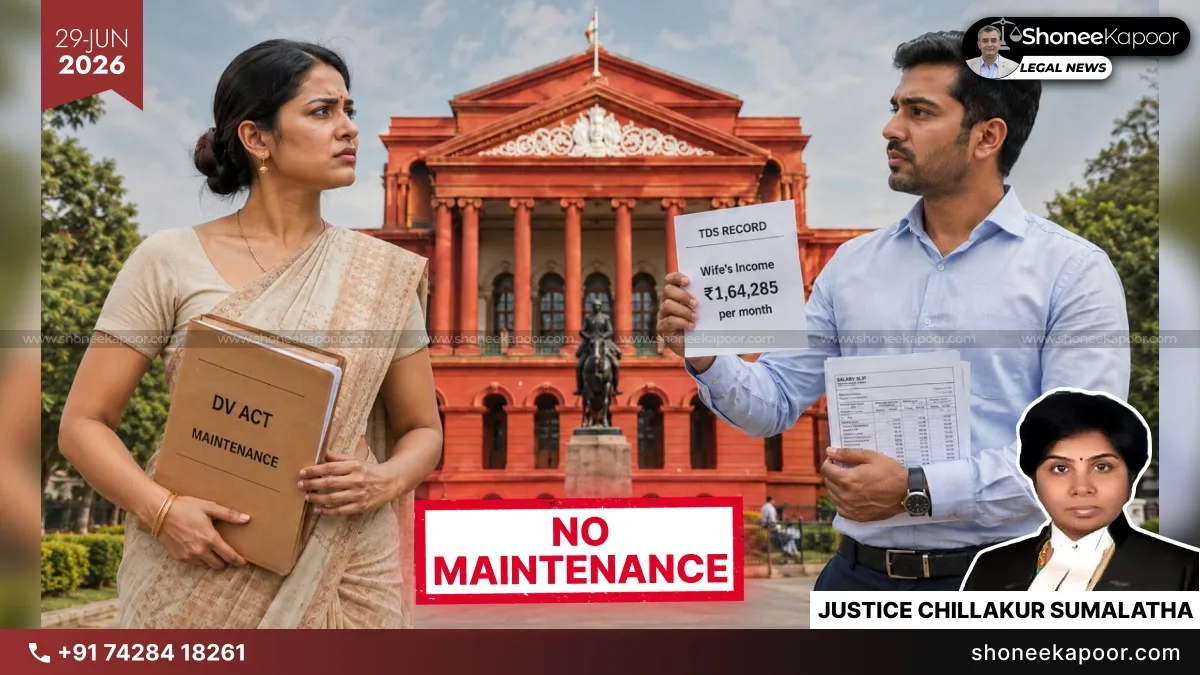
Karnataka High Court delivered an important reminder that maintenance law cannot become financial punishment for husbands when the wife is already earning enough. How long will husbands be treated as default paymasters?
BENGALURU: The Karnataka High Court, through Hon’ble Dr. Justice Chillakur Sumalatha, has set aside an interim maintenance order passed against a husband in a domestic violence case, after finding that the wife was financially independent and earning more than him.
The wife had filed a case under the Protection of Women from Domestic Violence Act, 2005 and had sought maintenance from her husband. The trial court directed the husband to pay ₹20,000 per month as interim maintenance. Aggrieved by this order, the husband approached the High Court.
The husband argued that the marriage had taken place in 2024 and the wife had lived with him only for about two months. He also submitted that his monthly income was around ₹57,000 to ₹60,000, while the wife was earning much more than him.
Before the High Court, it came on record that the wife had admitted her monthly income as ₹1,00,000. The TDS record also showed her salary as ₹1,64,285 per month for certain months. The husband’s salary, on the other hand, was much lower.
The wife claimed that she had marriage-related loans and debts to repay. But the High Court noted that she had not produced proper details of the alleged loans, EMIs, amount borrowed, or balance amount payable.
The Court found that the trial court had considered the husband’s income but had ignored the wife’s income. On this point, the High Court observed:
“The Trial Court did not consider the income of respondent No.1/wife at all.”
The High Court said that when the wife herself had disclosed her income, the trial court should have examined it before deciding whether she was entitled to interim maintenance.
The Court made an important observation that maintenance cannot be granted in a routine manner only because the applicant is a wife. It observed:
“Only because a woman more particularly a wife files a petition invoking the provisions of Domestic Violence Act or the provisions of Hindu Adoption and Maintenance Act or the provisions contained in the Code of Criminal Procedure, where the right to claim maintenance is recognized, the Courts cannot straight away pass an order awarding some amount towards maintenance payable by the husband.”
The Court further clarified that if a wife is financially sound, earning more than the husband, and has no child-related liability, then courts should not grant maintenance merely on the idea that a husband must maintain his wife.
Explaining the real test for maintenance, the Court held:
“It should be borne in mind that only when it is shown that the wife has no financial sources to maintain herself according to the standards of her husband, then only Courts are required to award maintenance either interim or final.”
In this case, the High Court found that the wife was earning more than the husband and was capable of maintaining herself. The Court noted:
“With her admitted income that is ₹1,00,000/- she can maintain herself.”
The Court therefore held that there was no need to direct the husband to pay maintenance. The High Court allowed the husband’s petition and set aside the interim maintenance order passed by the Mysuru court.
EXPLANATORY TABLE: LAWS AND SECTIONS INVOLVED
| Law / Section | Purpose | Role In This Case |
| Article 227, Constitution of India | Gives High Courts supervisory power over lower courts and tribunals. | Husband used Article 227 to challenge the JMFC Mysuru order granting ₹20,000 interim maintenance. |
| Protection of Women from Domestic Violence Act, 2005 | Law meant to protect women from domestic violence and provide civil reliefs like protection, residence, maintenance and compensation. | Wife filed proceedings under this Act against husband and his family members. |
| Section 12, DV Act | Allows an aggrieved woman to file an application before Magistrate seeking relief under the DV Act. | Main DV case was filed by wife under this provision. |
| Section 18, DV Act | Protection order; court can restrain domestic violence, threats, contact or harassment. | Wife sought protection-type reliefs against respondents. |
| Section 19, DV Act | Residence order; court can provide right of residence or alternate accommodation/rent. | Wife sought suitable residence or rent for accommodation. |
| Section 20, DV Act | Monetary relief; court can grant expenses and maintenance. | Wife claimed monthly maintenance from husband. |
| Section 21, DV Act | Custody order for children. | Mentioned in wife’s petition, though the couple had no children in this case. |
| Section 22, DV Act | Compensation and damages for mental torture and emotional distress. | Wife sought compensation for alleged mental and emotional agony. |
| Section 23(1), DV Act | Allows Magistrate to pass interim orders during pendency of DV proceedings. | Trial court passed interim maintenance order under this provision. |
| Hindu Adoption and Maintenance Act | Recognizes maintenance rights under Hindu personal law. | High Court referred to it while explaining that maintenance cannot be granted automatically. |
| Code of Criminal Procedure / CrPC | Criminal procedure law; includes provisions where maintenance rights are recognized. | High Court mentioned CrPC to clarify that even where maintenance is recognized, courts must examine real financial need. |
CASE DETAILS
- Case Title: Husband vs. Wife & Others
- Court: High Court of Karnataka at Bengaluru
- Case Number: Writ Petition No. 2327 of 2026 (GM-FC)
- Neutral Citation: 2026:KHC:30140
- Date of Order: 18 June 2026
- Bench / Judge: Hon’ble Dr. Justice Chillakur Sumalatha
- Counsels:
- For Petitioner: Sri Devaraj M., Advocate
- For Respondent No. 1: Sri Somarjuna V. M., Advocate
KEY TAKEAWAYS
- Maintenance cannot be granted automatically just because a wife files a DV case or claims maintenance from husband.
- Court must examine the income, liabilities and real financial position of both husband and wife before passing any maintenance order.
- Here, wife admitted earning ₹1,00,000 per month, while husband was earning around ₹60,000, yet trial court ignored her income.
- Vague claims of marriage loans or debts cannot justify maintenance unless proper proof of loan, EMI and pending liability is shown.
- This order gives a clear message: a financially sound wife cannot make a lower-earning husband her permanent ATM in the name of maintenance.
This Could Change Your Case-Get FREE Legal Advice-Click Here!
Disclaimer: The views and opinions expressed in this article are those of the Indian courts and do not necessarily reflect the official policy or position of “ShoneeKapoor.com” or its affiliates. This article is intended for informational and educational purposes only. The content provided is not legal advice, and viewers should not act upon this information without seeking professional counsel. Viewer discretion is advised.
