
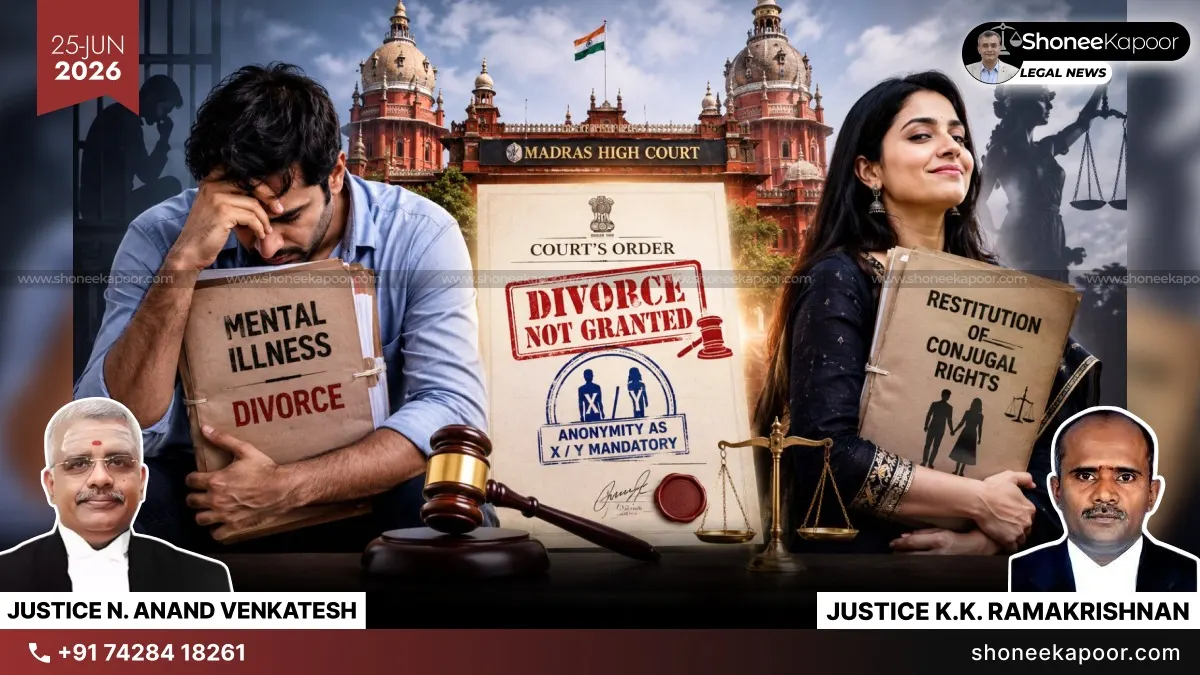
The Madras High Court has said couples alleging mental illness in matrimonial disputes must be protected as “X” and “Y,” shielding them from public stigma and social damage. But beneath the privacy angle lies a bigger question: when intimate allegations enter court, who really pays the lifelong reputational price?
CHENNAI: The Madras High Court, through Justices N. Anand Venkatesh and K.K. Ramakrishnan, has given an important ruling on privacy in matrimonial cases involving allegations of mental illness. The Court said that such couples should be referred to as “X” and “Y” or by similar anonymous descriptions, so that their names, addresses and identity are not exposed in public.
The case came from a husband’s appeal against the Family Court order refusing divorce. The husband claimed that after marriage, doctors found that his wife had schizophrenia and that this condition was hidden from him before marriage. He also alleged abnormal behaviour and said this amounted to cruelty under the Hindu Marriage Act.
The wife denied the allegation. She said she was not suffering from schizophrenia and claimed that the allegation was made only to avoid marital responsibilities. She also said the couple had lived together after marriage, gone on honeymoon and conceived a child before the dispute started.
The High Court noted that public allegations of mental illness can seriously damage a person’s life. It observed:
“Matrimonial litigation involving allegations of schizophrenia or any other serious mental disorder, whether ultimately proved or disproved, casts a long shadow upon their dignity, privacy, reputation, and the social acceptance.”
The Court further said such public disclosure can cause-
“Psychological injury, social ostracism, enduring emotional trauma and lifelong stigma, which can legitimately be avoided.”
Because of this, the Court directed anonymity in such sensitive matrimonial cases.
On divorce, the Court said schizophrenia or mental illness is not an automatic ground to end marriage. The spouse seeking divorce must prove the illness with strong medical evidence and must also show that the condition is so serious that married life has become impossible.
The Court held:
“Mere abnormal conduct, eccentricity, or isolated symptoms, without further aggravating circumstances affecting matrimonial life, would not constitute a valid ground for divorce under Section 13(1)(iii) of the Hindu Marriage Act.”
In this case, the Court found no conclusive medical proof that the wife had schizophrenia before or at the time of marriage. It also noted that she completed her M.Tech degree and answered coherently during four days of cross-examination, which showed her mental stability.
The Madras High Court dismissed the husband’s appeal and upheld the Family Court’s order refusing divorce and granting restitution of conjugal rights to the wife.
EXPLANATORY TABLE: LAWS AND SECTIONS INVOLVED
| Law / Section | Purpose | How It Applied In This Case |
| Hindu Marriage Act, 1955 – Section 5(ii) | Mental capacity for valid marriage | Used to examine fitness for marriage and procreation |
| Hindu Marriage Act, 1955 – Section 13(1)(i-a) | Divorce on cruelty | Husband alleged mental cruelty |
| Hindu Marriage Act, 1955 – Section 13(1)(iii) | Divorce for serious mental disorder | Main ground: alleged schizophrenia |
| Hindu Marriage Act, 1955 – Section 28 | Appeal provision | Used for appeal from Family Court order |
| Family Courts Act, 1984 – Section 19(1) | Appeal from Family Court | Basis for Civil Miscellaneous Appeals |
| Constitution of India – Article 227 | High Court supervision | Used for Civil Revision Petitions |
| Restitution of Conjugal Rights | Resume marital cohabitation | Wife’s plea was allowed |
| Return of Jewellery / Gold Articles | Recovery of marital articles | Issue in connected revision petitions |
| Return of Mangalsutra | Return of marriage ornament | Wife challenged this part of order |
| Anonymity / Privacy Principle | Protect identity in sensitive cases | Court directed X/Y anonymity in mental illness matrimonial cases |
CASE DETAILS
- Case Title: Husband vs. Wife
- Court: Madurai Bench of Madras High Court
- Case No.: C.M.A.(MD).Nos.696 and 697 of 2024 and C.R.P.(MD).Nos.2029 and 3231 of 2023 & 2086 of 2024
- Neutral Citation: 2026:MHC:2123
- Date Of Judgment: 15.06.2026
- Bench: Justice N. Anand Venkatesh | Justice K. K. Ramakrishnan
- Counsel:
- For Husband: Mr. M. Ajmal Khan, Senior Advocate for Mr. M. Mohammed Ibram Saibu
- For Wife: Mr. H. Laxmi Shankar for Mr. A. Senthil Kumar
KEY TAKEAWAYS
- Husband’s fear may be real, but court will still ask for proof, not panic.
- A man trapped in a broken marriage cannot win on suspicion; he needs solid medical evidence.
- Mental illness allegations are sensitive, because one wrong claim can destroy either spouse’s life.
- Anonymity as X/Y is necessary because one allegation can destroy dignity, reputation and future life.
- Men must document everything. In matrimonial cases, vulnerability without evidence becomes helplessness.
This Could Change Your Case-Get FREE Legal Advice-Click Here!
Disclaimer: The views and opinions expressed in this article are those of the Indian courts and do not necessarily reflect the official policy or position of “ShoneeKapoor.com” or its affiliates. This article is intended for informational and educational purposes only. The content provided is not legal advice, and viewers should not act upon this information without seeking professional counsel. Viewer discretion is advised.
