
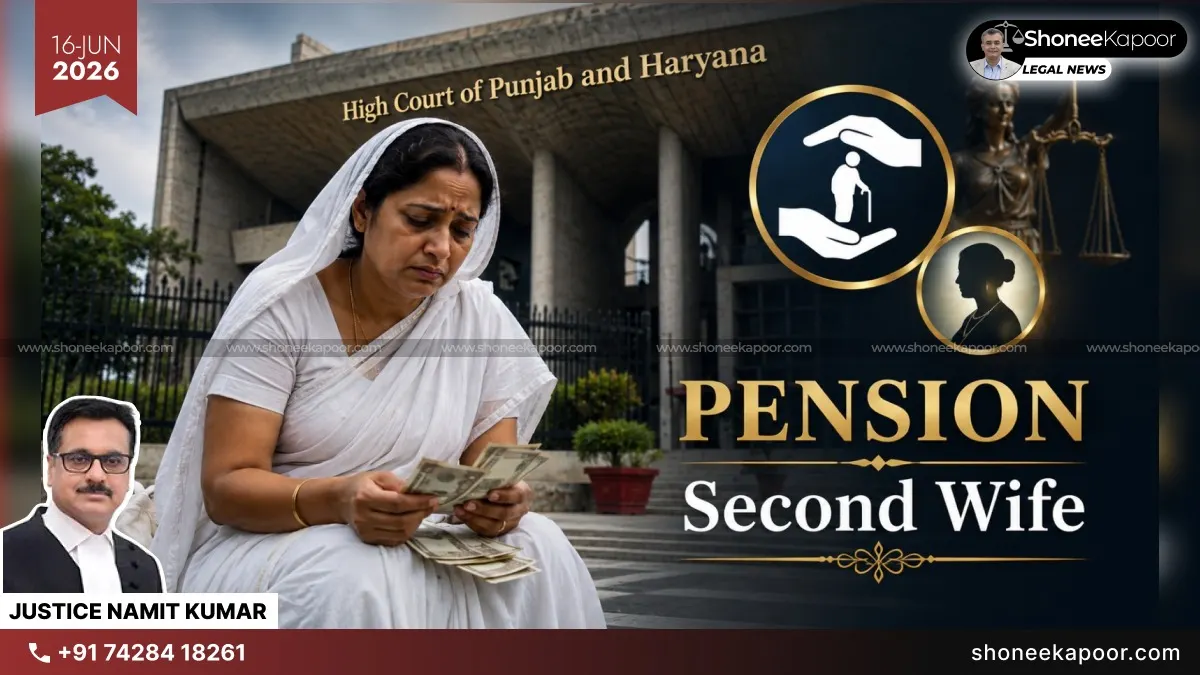
She was called the “second wife” and given only half the pension. But can the government keep the remaining money when no other legal claimant exists? The Punjab and Haryana High Court answered this question and protected the family’s rightful entitlement.
CHANDIGARH: The Punjab and Haryana High Court, led by Justice Namit Kumar, has ruled that a woman cannot be denied full family pension merely because she was the “second wife” of a deceased government employee if she is the only surviving eligible claimant. The Court held that in such situations, the surviving widow is entitled to receive 100% family pension.
The case involved Manjit Kaur, whose husband, Parshotam Lal Puri, retired as District Treasury Officer, Gurdaspur, in 1996 and passed away on November 14, 2011. His first wife had died in 1980. He later married Manjit Kaur in 1992. After his death, the authorities issued a Pension Payment Order in 2015 but granted her only 50% family pension, mentioning that she was the “second wife of retiree.”
Manjit Kaur repeatedly approached the authorities seeking full pension, pointing out that the first wife had died decades earlier and there were no eligible minor children from the first marriage. However, her request was rejected through a memo dated May 25, 2022, based on Notes 1 and 2 below Rule 6.17(4) of the Punjab Civil Services Rules.
The High Court found that these provisions apply only when multiple eligible claimants exist at the same time. Since the deceased employee was survived by only one widow and there were no eligible minor children from the earlier marriage, the rules for dividing pension had no application.
The Court reproduced the relevant provisions:
“Note 1 – When a Government employee is survived by more than one widow, the pension will be paid to them in equal shares. On the death of a widow, her share of the pension will become payable to her eligible minor child, if at the time of her death, a widow leaves no eligible minor child, the payment of her share of the pension will cease.
Note 2 – Where a Government employee is survived by a widow but has left behind an eligible minor child from another wife, the eligible minor child will be paid the share of pension which the mother would have received if she had been alive at the time of the death of the Government employee.”
Relying on its earlier Division Bench judgment in State of Punjab v. Harpal Kaur, the Court reiterated that family pension belongs to the legal heirs of the deceased employee and the State cannot withhold any portion simply because one possible claimant no longer exists. Pension is meant to support the family left behind, not to create an unintended saving for the government.
Justice Namit Kumar observed:
“The rule for apportionment applies when there are multiple eligible claimants at the same time. In the present case, due to non- availability of any minor child from the first wife, who had already died before the marriage of the petitioner, the petitioner is the only eligible claimant. As such, if the interpretation given by the respondents is accepted, it would lead to absurd and unjust consequence of the State misappropriating a part of the family pension meant for the deceased’s family, which is contrary to the spirit and purpose of the Family Pension Scheme.”
The Court further reaffirmed the earlier view that:
“The family pension is an estate of the legal heirs of the deceased employee. The apportionment of the family pension of a deceased employee is not the business of the State.”
Allowing the petition, the High Court set aside the memo dated May 25, 2022, and directed the authorities to grant Manjit Kaur full family pension from November 14, 2011, along with arrears and interest at 6% per annum within three months.
EXPLANATORY TABLE OF LAWS AND PROVISIONS
| LAW / PROVISION | WHAT IT SAYS | HOW IT APPLIED IN THIS CASE |
| Articles 226 & 227 of the Constitution of India | Give High Courts power to issue writs and supervise authorities. | Manjit Kaur approached the High Court challenging the memo denying her full pension. |
| Rule 6.17(4), Punjab Civil Services Rules, Volume II | Governs payment of family pension to dependents of deceased government employees. | Authorities relied on this rule to restrict her pension to 50%. |
| Note 1 below Rule 6.17(4) | If multiple widows survive, pension is divided equally. If a widow dies, her share goes to her eligible minor child. If there is no eligible minor child, that share ceases. | The Court held this Note did not apply because there was only one surviving widow at the employee’s death. |
| Note 2 below Rule 6.17(4) | Eligible minor children from another wife can receive the share their mother would have received. | The Court held this Note was inapplicable because there was no eligible minor child from the first marriage. |
| Punjab Finance Department Clarification dated 24.10.2006 | Administrative clarification relied upon by authorities regarding pension apportionment. | The Court found that reliance on this clarification was misplaced in the facts of this case. |
| State of Punjab v. Harpal Kaur, LPA No.1434 of 2014 (01.09.2014) | Held that the State cannot retain any portion of family pension after another claimant ceases to be eligible. | Relied upon heavily by Justice Namit Kumar to grant full pension. |
| Ram Dulari v. State of Haryana & Others, CWP No.3359 of 2008 (03.07.2009) | Held that a sole surviving widow becomes entitled to full family pension once other claimants cease to be eligible. | Cited in Harpal Kaur and followed indirectly in this case. |
| Hindu Succession Act, 1956 | Governs succession rights of legal heirs. | Earlier precedent observed that rights in family pension devolve among legal heirs and are not to be appropriated by the State. |
CASE DETAILS
- Case Title: Manjit Kaur v. State of Punjab and Others
- Case Number: CWP-21124-2023
- Court: High Court of Punjab and Haryana at Chandigarh
- Bench: Hon’ble Mr. Justice Namit Kumar
- Date of Decision: 22 May 2026
- Neutral Citation: 2026:PHHC:080215
COUNSELS
- For the Petitioner: Mr. R.K. Arora, Senior Advocate; Assisted by Mr. Prabhat K. Jalbera, Advocate
- For Respondents No.1 to 3 (State): Mr. Satnampreet Singh Chauhan, Deputy Advocate General, Punjab
- For Respondent No.4: Mr. Brijesh Mittal, Advocate – Through video conferencing
KEY TAKEAWAYS
- A man legally remarried after losing his first wife, yet after his death, his family was forced into years of litigation because authorities reduced his widow to the label of “second wife.”
- Bureaucratic interpretation cannot override facts. There was only one eligible dependent, but the State still withheld half the pension meant for the deceased employee’s family.
- Family pension is earned through a lifetime of service. Governments cannot treat it as money to be saved by exploiting technicalities.
- Widows of deceased men should not be made to fight legal battles for benefits already earned by their husbands through decades of public service.
- This judgment reinforces that pension belongs to the legal heirs of the deceased employee—not to the State’s treasury through arbitrary interpretations.
This Could Change Your Case-Get FREE Legal Advice-Click Here!
Disclaimer: The views and opinions expressed in this article are those of the Indian courts and do not necessarily reflect the official policy or position of “ShoneeKapoor.com” or its affiliates. This article is intended for informational and educational purposes only. The content provided is not legal advice, and viewers should not act upon this information without seeking professional counsel. Viewer discretion is advised.
