
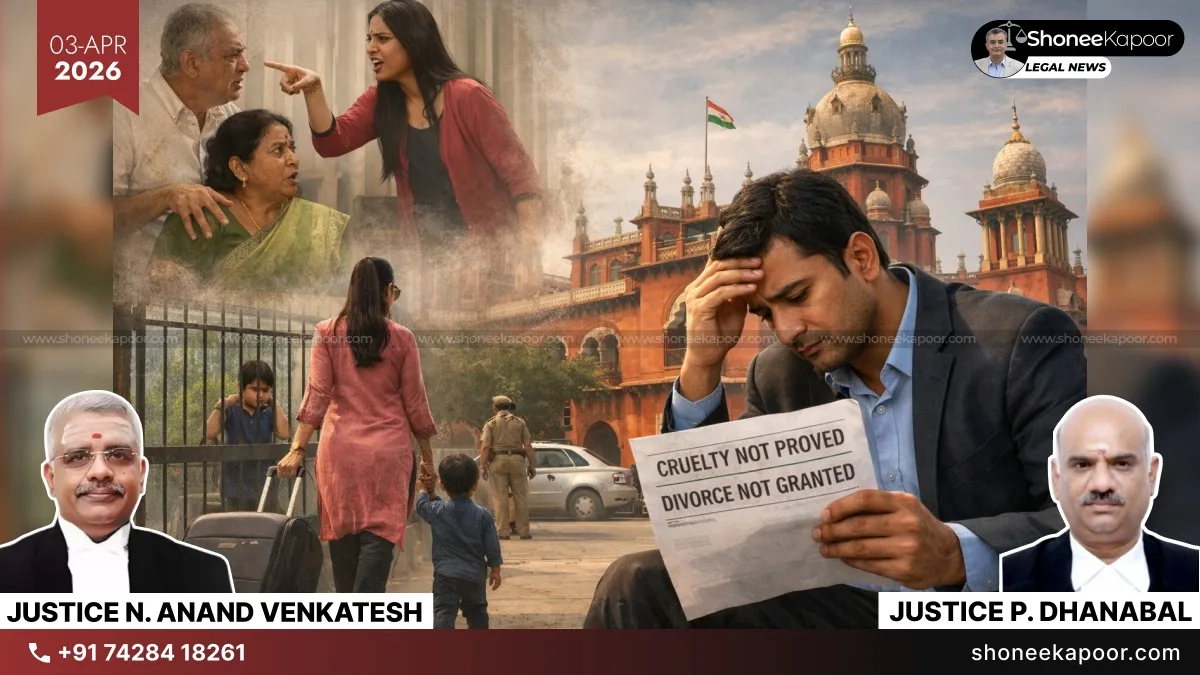
Madras High Court refuses divorce citing lack of cruelty in early marital disputes — Does the law ignore a husband’s mental suffering by calling serious marital issues “adjustment problems”?
MADURAI: In a recent judgment from the Madurai Bench of the Madras High Court, Justice N. Anand Venkatesh and Justice P. Dhanabal dismissed a husband’s appeal seeking divorce, making it clear that ordinary disagreements in marriage cannot be treated as legal cruelty.
The case involved a husband who approached the court claiming cruelty after his wife left the matrimonial home within a few months of marriage and stayed with her parents. He alleged that during their short stay together, she spoke ill of him, disrespected his parents, left the matrimonial home without justification, refused to return despite efforts, and even after the birth of the child, did not inform or invite him to see the child.
Based on these grounds of mental cruelty, he filed for divorce under Section 13(1)(i-a) of the Hindu Marriage Act.
However, the wife strongly opposed these claims and filed a counterclaim seeking restitution of conjugal rights. She alleged that she was the one subjected to neglect and mistreatment, and despite all issues, she was willing to continue the marriage for the sake of their child.
The Family Court had earlier dismissed the husband’s divorce petition and allowed the wife’s plea to restore marital life. Challenging this, the husband filed a single appeal before the High Court.
At the very beginning, the High Court raised a critical legal issue and questioned:
“How a single appeal is maintainable as against two distinct reliefs that were granted by the family Court – one by rejecting the divorce petition and the other allowing the counter claim and granting the relief of restitution of conjugal rights.”
The judges made it clear that a counter claim is independent in nature. They further clarified that even if a common judgment is passed, separate appeals are required, stating that:
“Appeal must be filed independently as against the dismissal of the divorce petition and allowing counter claim by rejecting the relief of restitution of conjugal rights.”
On merits, the court carefully analysed whether the husband had actually proved cruelty. It noted that the couple lived together only for a very short time and their issues were more about adjustment problems rather than serious misconduct.
Importantly, the court rejected the argument that allegations made by the wife in her reply could itself become a ground for cruelty. The judges clearly stated that:
“The cause of action for filing the divorce petition alone can be taken into consideration, and what stand was taken in the counter will not create a new cause of action for the appellant.”
In one of the most important observations, the court explained the real meaning of cruelty in marriage and held that:
“The bickering that takes place between a husband and wife, and more particularly during the initial stage of marriage, is a common phenomenon that invariably takes place in every marriage relationship.”
The judges emphasized that marriage requires effort and patience, stating that:
“A stable relationship of a husband and wife is a long drawn process that requires patience and lot of adjustment.”
This judgment shows the narrow interpretation of cruelty, where even separation, denial of access to one’s child, and continued refusal to cohabit may still not meet the legal threshold.
With these observations, the High Court dismissed the appeal, reinforcing that minor marital conflicts cannot be exaggerated into legal cruelty, while also highlighting the legal and procedural hurdles men face in matrimonial disputes.
Explanatory Table: Laws And Sections Involved
| Law / Section | Meaning in Simple Terms | How It Was Used in This Case |
| Section 13(1)(i-a), Hindu Marriage Act | Allows divorce on the ground of cruelty (physical or mental) | Husband filed for divorce claiming wife’s conduct amounted to mental cruelty |
| Section 9, Hindu Marriage Act (Restitution of Conjugal Rights) | Court can order spouse to resume cohabitation if one leaves without valid reason | Wife used this to seek return to matrimonial life |
| Section 19, Family Courts Act | Provides right to appeal against Family Court orders | Husband filed appeal under this provision |
| Concept of Counter Claim | A separate claim filed by respondent within same case | Wife filed independent claim for restitution of conjugal rights |
| Appellate Procedure Principle | Separate appeals needed for separate reliefs | Court held one appeal cannot challenge both divorce rejection and restitution order |
Case Details
- Case Title: Husband vs Wife
- Case Number: CMA(MD) No. 899 of 2023
- Court: Madurai Bench of Madras High Court
- Date of Judgment: 12.03.2026
- Bench: Justice N. Anand Venkatesh | Justice P. Dhanabal
- Counsels:
- For Appellant: M/s A. Mohan
- For Respondent: Mr. S. Premkumar
Key Takeaways
- Courts continue to set a very high threshold for “cruelty,” ignoring everyday mental harassment faced by husbands.
- Even desertion, denial of access to child, and disrespect to family may not be enough for a man to get divorce.
- Restitution of conjugal rights is still being used against men despite clear marital breakdown.
- Legal technicalities like filing separate appeals can become additional hurdles for men seeking relief.
- Overall, the system prioritises preservation of marriage over the lived reality of men facing one-sided suffering.
This Could Change Your Case-Get FREE Legal Advice-Click Here!
Disclaimer: The views and opinions expressed in this article are those of the Indian courts and do not necessarily reflect the official policy or position of “ShoneeKapoor.com” or its affiliates. This article is intended for informational and educational purposes only. The content provided is not legal advice, and viewers should not act upon this information without seeking professional counsel. Viewer discretion is advised.
