
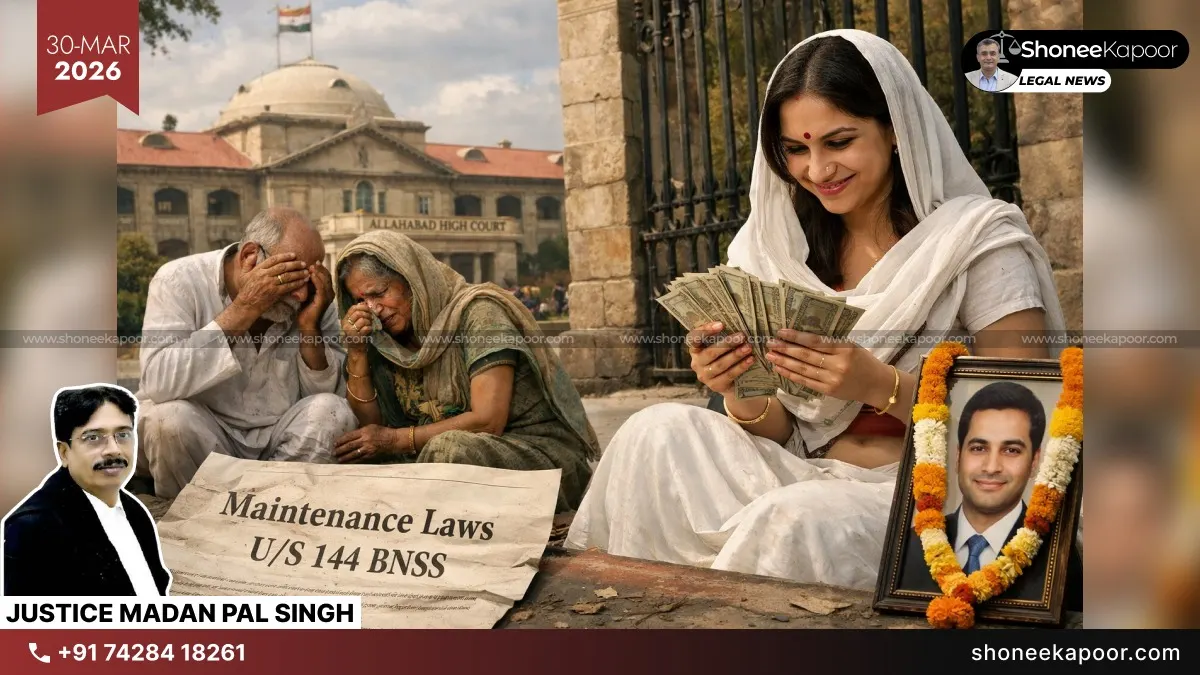
Can law ignore aged parents while benefits remain with daughter-in-law after husband’s death? Allahabad High Court draws a strict line on Maintenance Laws U/S 144 BNSS – what it says raises bigger questions on fairness.
PRAYAGRAJ: The Allahabad High Court has held that a daughter-in-law is not legally bound to provide maintenance to her parents-in-law under Section 125 of the Criminal Procedure Code or Section 144 of the Bharatiya Nagarik Suraksha Sanhita (BNSS).
The case came before Justice Madan Pal Singh, where an elderly couple filed a plea seeking maintenance from their daughter-in-law after the death of their son. They challenged an earlier order of the Family Court in Agra, which had already rejected their claim.
The High Court explained that the right to claim maintenance is strictly based on law and only applies to specific categories of people clearly mentioned in the statute. Parents-in-law are not included in that list.
The Court clearly stated:
“The legislature, in its wisdom, has not included parents-in-law within the ambit of the said provision. In other words, it is not the scheme of the legislature to fasten liability of maintenance upon a daughter-in-law towards her parents-in-law under the said provision.”
The elderly parents argued that they were dependent on their son during his lifetime and are now left without support. They also claimed that their daughter-in-law, who works as a Constable in the Uttar Pradesh Police, has a stable income and has received all benefits after their son’s death.
They further tried to argue that even if not legally written, a moral responsibility should be treated as a legal duty.
However, the Court rejected this argument and made it clear that emotional or moral expectations cannot be enforced through courts unless the law specifically provides for it. The Court emphasized that legal liability cannot be created based on sympathy or assumptions.
The Court also noted that there was no proof that the daughter-in-law got her job on compassionate grounds, which could have created a different context.
Additionally, the Court clarified that issues related to inheritance or rights over the deceased son’s property cannot be decided in maintenance proceedings, as those are separate legal matters.
After examining all facts, the High Court found no error in the Family Court’s earlier decision and dismissed the plea.
Explanatory Table Of Laws & Sections Involved
| Law / Section | Full Name | What It Covers | Key Legal Position in This Case |
| Section 144 BNSS | Bharatiya Nagarik Suraksha Sanhita, 2023 | Provides right to claim maintenance for specified dependents | Court held parents-in-law are not included, so no legal claim |
| Section 125 CrPC | Code of Criminal Procedure, 1973 | Maintenance for wife, children, and parents | Only applies to listed categories, not in-laws |
| Summary Maintenance Proceedings | Procedural concept under CrPC/BNSS | Quick relief mechanism for dependents | Cannot decide complex issues like property or succession |
| Compassionate Appointment (Contextual) | Employment given after death of employee | Can sometimes create dependency-based obligations | Court found no evidence of such appointment here |
| Succession Law (General Reference) | Property rights after death | Determines inheritance of deceased’s assets | Court clarified this issue is separate and not relevant here |
Case Details
- Case Title: Rakesh Kumar And Another vs State of U.P. and Another
- Case Number: Criminal Revision No. – 6502 of 2025
- Court: High Court of Judicature at Allahabad
- Bench: Hon’ble Madan Pal Singh, J.
- Date of Judgment: February 4, 2026
- Neutral Citation: 2026:AHC:24683
Counsels
- Counsel for Revisionists: Monika Pal
- Counsel for Opposite Party: G.A., Rajesh Kumar Yadav
Key Takeaways
- Law protects only “defined beneficiaries” — parents-in-law are deliberately excluded, exposing a structural gap against elderly parents of men.
- A daughter-in-law can retain financial benefits after a man’s death while his dependent parents are left legally unprotected.
- Courts refuse to convert moral obligation into legal duty — effectively abandoning aged parents who relied on their son.
- Maintenance laws remain one-directional — obligations flow toward wife/children, not toward the man’s parents after his death.
- This judgment reinforces a systemic bias where a man’s family has zero enforceable rights despite dependency and contribution.
This Could Change Your Case-Get FREE Legal Advice-Click Here!
Disclaimer: The views and opinions expressed in this article are those of the Indian courts and do not necessarily reflect the official policy or position of “ShoneeKapoor.com” or its affiliates. This article is intended for informational and educational purposes only. The content provided is not legal advice, and viewers should not act upon this information without seeking professional counsel. Viewer discretion is advised.
