
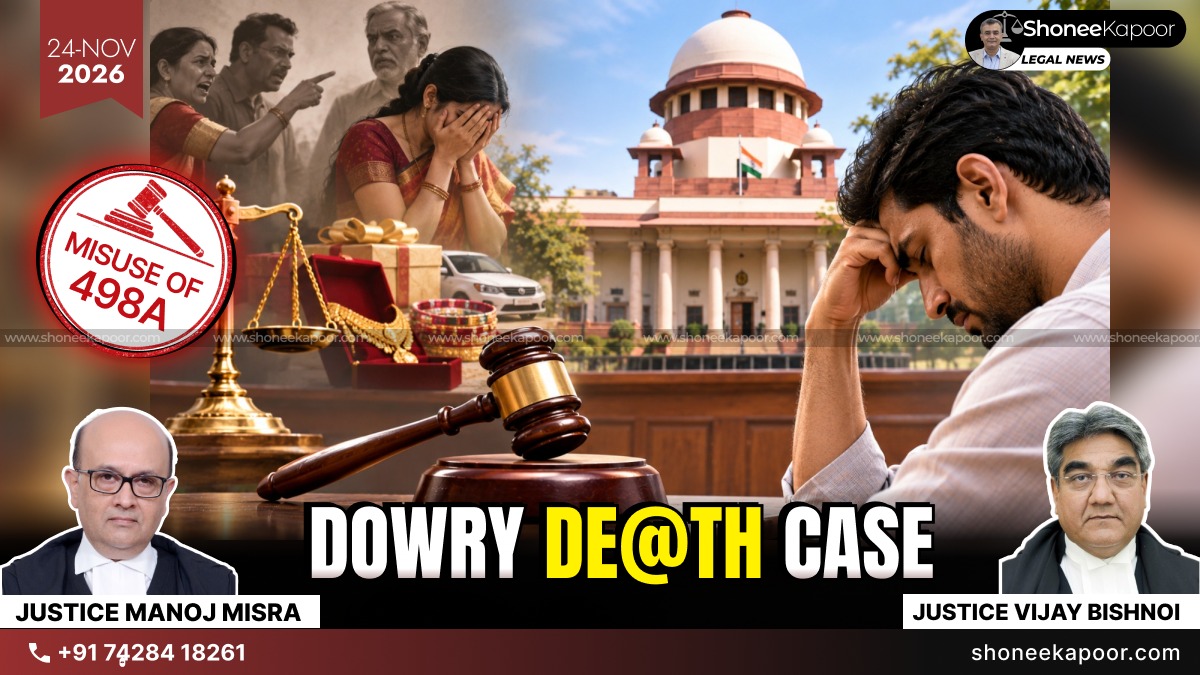
498A IPC | Capacity To Pay Dowry Is Relevant In Assessing Harassment Allegations: Supreme Court Upholds Acquittal Of Husband & Family

Curated by NEWS DESK
Editorial DeskNEW DELHI: The Supreme Court has upheld the acquittal of a husband and his relatives in a dowry death and cruelty case under Sections 304B and 498A IPC, after finding that the prosecution failed to establish dowry-related harassment through reliable evidence.
A Bench comprising Justice Manoj Misra and Justice Vijay Bishnoi passed the order on November 19, 2026, while dismissing an appeal against the Delhi High Court’s decision affirming the acquittal.
The Trial Court had found inconsistencies in the prosecution evidence regarding the alleged dowry demands. It also considered the financial condition of the deceased woman’s family, whose only earning member was her brother, earning Rs. 2,300 per month.
The husband initially suspected that his wife was pregnant before marriage and had approached the court seeking matrimonial relief. However, the petition was later withdrawn, their differences were resolved, and they had two more children during the marriage.
Following the acquittal, the complainant approached the Delhi High Court. The State had not filed any appeal challenging the acquittal.
The High Court found that none of the three family witnesses had mentioned any dowry demand at the time of marriage. Documents prepared during an earlier panchayat meeting to resolve their matrimonial disputes also contained no reference to dowry demands.
Before the Supreme Court, the complainant argued that the lower courts had wrongly rejected the deceased’s mother’s testimony and overlooked certain evidence regarding her injuries.
The accused opposed the appeal, submitting that both courts had properly examined the evidence and that the medical findings did not establish any injury apart from burn injuries.
The Supreme Court clarified that a woman's death within seven years of marriage does not automatically justify raising a legal presumption against her husband or in-laws. The necessary statutory conditions must first be established.
Read Also:- Bombay High Court: Taunting Wife for Dark Skin Not Cruelty Under Section 498A IPC
The Court further explained that the financial inability of a woman's family to fulfil an alleged dowry demand is relevant when examining the credibility of such allegations, although it cannot independently justify rejecting them.
Questioning the circumstances surrounding the alleged demand, the Court observed:
“Why would a person raise a demand when he knows that the person to whom demand is made has no capacity to fulfil it.”
The Supreme Court found no legal infirmity in the assessment of evidence by the lower courts and held that the requirements for raising a presumption under Sections 113A and 113B of the Indian Evidence Act were not established.
Accordingly, the Supreme Court dismissed the appeal, ending the proceedings before it, pending since 2015, and maintaining the acquittal of the husband and his relatives.
EXPLANATORY TABLE OF LAWS AND SECTIONS
| Law / Section | What It Means | Application In This Case |
|---|---|---|
| Section 498A IPC | Punishment for cruelty towards a married woman by her husband or his relatives. | Acquittal upheld due to insufficient reliable evidence. |
| Section 304B IPC | Punishment for dowry death where statutory conditions are established. | Dowry-related harassment soon before death was not proved. |
| Section 306 IPC | Punishment for abetment of suicide. | The Court found the earlier matrimonial differences insufficient to raise the necessary presumption under Section 113A. |
| Section 113A, Indian Evidence Act, 1872 | Permits a presumption of abetment of suicide by a married woman when specified conditions are established. | Necessary conditions for raising the presumption were not established. |
| Section 113B, Indian Evidence Act, 1872 | Provides for a presumption of dowry death once the necessary foundational facts are proved. | The presumption could not be invoked because dowry-related harassment soon before death was not established. |
CASE DETAILS
| Particular | Details |
|---|---|
| Case Title | Neeraj Kumar Versus Suraj Prakash & Ors. |
| Court | Supreme Court of India |
| Bench | Justice Manoj Misra and Justice Vijay Bishnoi |
| Order Date | November 19, 2026 |
| Case Number | Criminal Appeal No. 1074/2015 |
| Appellant | Neeraj Kumar |
| Respondents | Suraj Prakash & Others |
| Appellant’s Counsel | Abinash Kumar Mishra, AOR |
| Respondents’ Counsel | Rajesh Mahajan, Senior Advocate; M.L. Yadav, Advocate; Mukesh Kumar, Advocate; Srajan Shankar Kulshreshtha, Advocate; Adya Nanda, Advocate; Vishwa Pal Singh, AOR |
| Original Charges | Sections 304B and 498A IPC |
| Trial Court | Additional Sessions Judge |
| High Court | Delhi High Court |
| Interlocutory Application | IA No. 13074/2015 — Exemption from filing official translation |
| Final Decision | Appeal dismissed; acquittal of husband and relatives upheld |
KEY TAKEAWAYS
- Mere Dowry Allegations Are Not Proof: Criminal liability must be established through credible evidence.
- Dowry Death Presumption Is Not Automatic: Death within seven years of marriage alone cannot establish guilt.
- Financial Capacity Matters: The complainant’s financial condition is relevant when assessing alleged dowry demands.
- Marital Disputes Do Not Establish Criminal Guilt: Matrimonial differences alone cannot prove criminal cruelty or abetment.
- Men Deserve Fair Trials: Husbands and their families must not face conviction based on unsubstantiated allegations.
Share Your Thoughts
Comments are moderated before publication.