
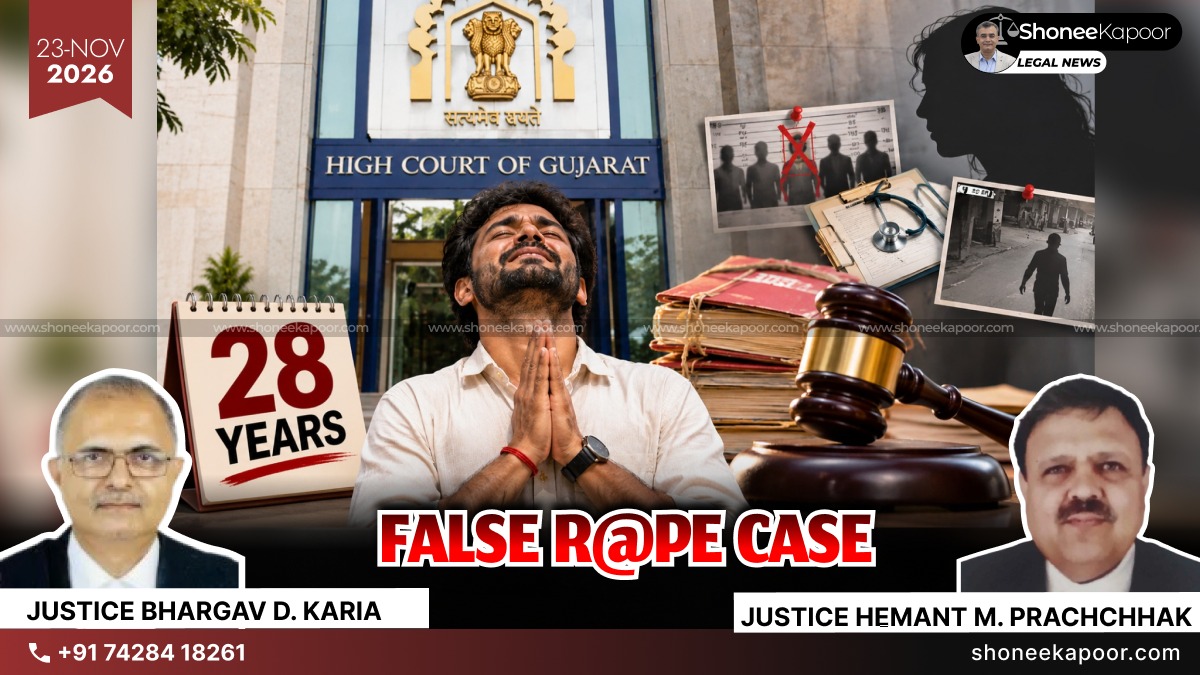
28 Years Later, Man Acquitted In Rape Case: Gujarat High Court Finds Serious Gaps In Prosecution Evidence & Test Identification Parade

Curated by NEWS DESK
Editorial DeskGUJARAT: The Gujarat High Court has upheld the acquittal of a man in a decades-old sexual offence case, citing serious weaknesses in the prosecution's evidence, including a faulty Test Identification Parade (TIP), inconsistent medical history and lack of reliable evidence connecting him to the alleged crime.
A Division Bench of Justice Bhargav D. Karia and Justice Hemant M. Prachchhak dismissed the State Government's appeal against the trial court's 1998 acquittal order.
The High Court examined whether the accused was properly identified and whether the prosecution proved his involvement beyond reasonable doubt.
The Bench observed:
"So far as the identification of the accused is concerned, the same creates serious doubt."
The Court noted that the Investigating Officer had failed to follow the prescribed procedure during the identification parade. The Executive Magistrate also failed to comply with mandatory legal requirements.
The medical evidence raised further doubts. According to the examining doctor, the victim had stated that her injuries resulted from falling while playing, without mentioning the alleged incident reported by her father.
An independent witness also confirmed that the victim had given the same explanation for her injuries.
The High Court further examined the serological report and found that investigators had not collected blood samples from either the victim or the accused, leaving a significant gap in the prosecution's evidence.
The Bench stated:
"Consequently, the prosecution has failed to establish the necessary link connecting the accused with the alleged crime and has also failed to prove his involvement in the alleged offence beyond reasonable doubt."
The Court found that the trial court had properly examined the witness statements and given sufficient reasons for rejecting the prosecution's case.
It further noted that the prosecution had failed to establish any fundamental fact through independent evidence connecting the accused with the crime in question.
The High Court also considered the delay in registering the FIR, contradictions in the medical evidence and irregularities in the identification procedure.
The victim had not disclosed the alleged offence while providing her medical history to two doctors, further weakening the prosecution's version.
Highlighting the procedural lapses, the Bench observed:
"In the absence of any clinching evidence against the accused, the prosecution has failed to prove the charges for the alleged offences beyond reasonable doubt."
Accordingly, the Gujarat High Court dismissed the State's appeal and upheld the man's acquittal, finding no sufficient grounds to interfere with the trial court's decision.
EXPLANATORY TABLE OF LAWS AND SECTIONS
| Law / Section | What It Means | Application In This Case |
|---|---|---|
| Section 363, IPC | Punishment for kidnapping. | Relevant to the alleged kidnapping of the minor. |
| Section 376, IPC | Punishment for rape. | Relevant to the alleged sexual offence. |
| Section 378, CrPC, 1973 | Provides for appeals against acquittal. | State challenged the 1998 acquittal. |
| Section 313, CrPC, 1973 | Allows the accused to explain circumstances appearing in prosecution evidence. | Accused denied the allegations. |
| Section 9, Indian Evidence Act, 1872 | Covers facts relevant to establishing identity. | Relevant to the disputed Test Identification Parade. |
CASE DETAILS
| Particular | Details |
|---|---|
| Case Title | State of Gujarat v. P |
| Court | Gujarat High Court |
| Bench | Justice Bhargav D. Karia and Justice Hemant M. Prachchhak |
| Case Number | Criminal Appeal No. 500 of 1998 |
| Trial Court Order | 31 January 1998 |
| Counsel for the State | Mr. Utkarsh Sharma, Additional Public Prosecutor |
| Counsel for the Accused | Dr. Hardik K. Raval, Advocate |
| Final Decision | State's appeal dismissed; acquittal upheld |
KEY TAKEAWAYS
- 28 Years Fighting a Rape Case: Despite being acquitted in 1998, the man faced nearly three more decades of criminal litigation.
- Faulty Identification Parade: Investigators failed to follow mandatory procedures, raising serious doubts about whether the accused was correctly identified.
- Medical Evidence Contradicted Allegations: The victim reportedly attributed her injuries to a fall while playing, weakening the prosecution's case.
- Prosecution Failed to Prove Guilt: No reliable forensic or independent evidence established the man's involvement beyond reasonable doubt.
- Acquitted, Yet Dragged Through Decades: The State's appeal kept the criminal case alive for nearly 28 years despite serious evidentiary gaps. Who accounts for the years an accused man loses fighting for his innocence?
Share Your Thoughts
Comments are moderated before publication.