
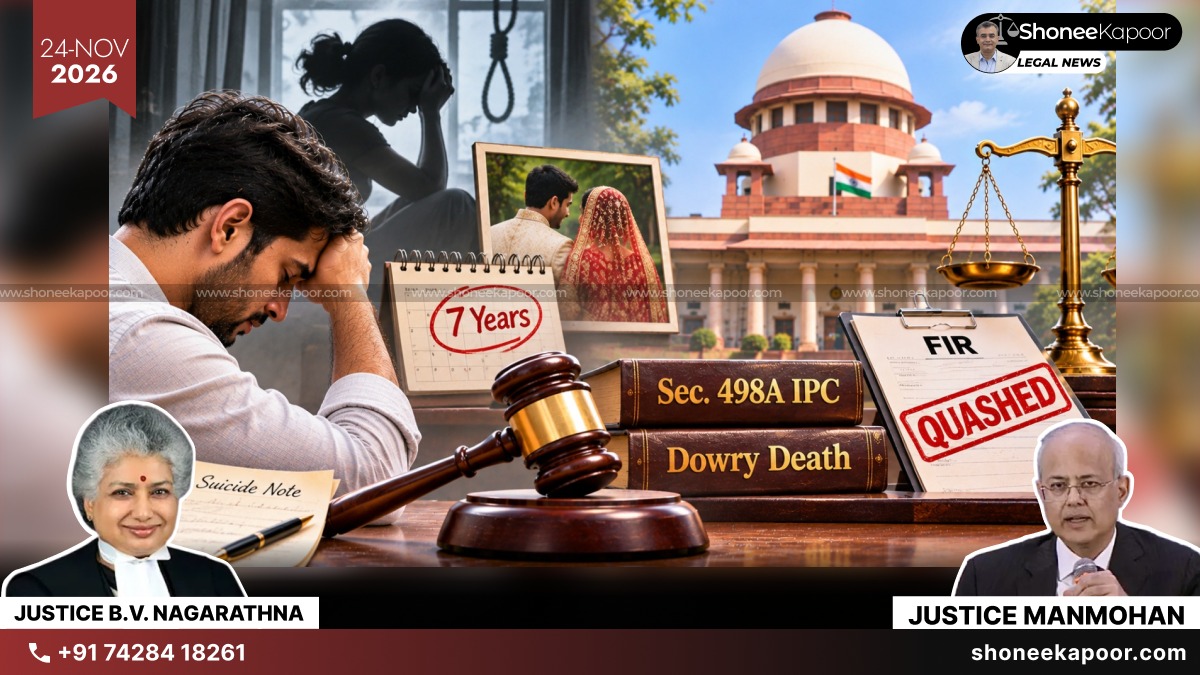
Husband Faces 498A IPC & Dowry Death Case In India After Wife’s Suicide In Canada? Supreme Court Quashes Proceedings

Curated by NEWS DESK
Editorial DeskNEW DELHI: The Supreme Court has quashed a dowry death and cruelty case against a husband following his wife's suicide in Canada, finding no reliable material connecting the alleged dowry demands or harassment with her death.
A Bench comprising Justice B.V. Nagarathna and Justice Manmohan, on November 2, 2026, set aside the Bombay High Court's order refusing to quash the criminal proceedings against the husband.
The couple married on January 3, 2021, according to Hindu customs and shifted to Toronto, Canada, on February 28, 2022.
On June 11, 2023, the wife died by suicide. In her handwritten suicide note, she expressed distress over her inability to find employment and described herself as “stupid and useless”. The note did not mention any dowry demand or harassment by her husband.
On June 30, 2023, the woman's father lodged an FIR against the husband, his parents and sister, alleging dowry demands, physical abuse, mental cruelty and extramarital affairs.
The Canadian authorities found no signs of struggle or foul play. CCTV footage confirmed that the husband was not at home when the incident occurred. The Toronto Police closed its investigation against him on January 8, 2024.
However, the Bombay High Court quashed the proceedings against his parents and sister but denied relief to the husband. Subsequently, a chargesheet was filed and non-bailable warrants were issued against him.
The husband challenged the decision before the Supreme Court, which granted him interim protection from coercive action on August 11, 2025.
The Supreme Court noted that no dowry complaint had been made during the woman's lifetime. It further observed that customary wedding and Diwali gifts could not automatically be treated as dowry without supporting evidence of an unlawful demand.
Regarding the exchange of gifts, the Court observed:
“To taint this exchange between the parties with a criminal colour”
The Court also examined the alleged payment of Rs. 1 lakh by the woman's brother to the husband. The transaction coincided with the booking of her flight tickets from Canada to India. Insufficient material existed to establish that the money was demanded as dowry.
The allegations that the husband called his wife “stupid” and “useless” were also found insufficient, in the circumstances of the case, to establish criminal cruelty.
The Court observed:
“Mere general allegations of harassment, without specifics against such persons, would not suffice to continue criminal proceedings.”
Relying on the principles laid down in State of Haryana vs. Bhajan Lal, the Supreme Court emphasised that the inherent powers of High Courts must be exercised to prevent unwarranted prosecution and abuse of the judicial process.
The Bench recognised the grief of the deceased woman's family but clarified that criminal proceedings against a husband cannot continue without material establishing his involvement in the alleged offences.
Accordingly, the Supreme Court allowed the husband's appeal and quashed FIR No. 212/2023 and all consequential criminal proceedings, bringing an end to the prosecution against him after more than three years.
EXPLANATORY TABLE OF LAWS AND SECTIONS
| Law / Section | What It Means | Application In This Case |
|---|---|---|
| Section 304B IPC | Punishment for dowry death. | Dowry-related harassment soon before death was not established. |
| Section 321 IPC | Defines voluntarily causing hurt. | Sufficient supporting material was absent. |
| Section 323 IPC | Punishment for voluntarily causing hurt. | Allegations of physical abuse were insufficient. |
| Section 334 IPC | Voluntarily causing hurt on grave and sudden provocation. | Referred to in the statutory text of Section 323 IPC. |
| Section 498A IPC | Punishment for cruelty by a husband or his relatives. | Statutory ingredients of cruelty were not established. |
| Section 503 IPC | Defines criminal intimidation. | Allegations did not establish the necessary ingredients. |
| Section 504 IPC | Intentional insult intended to provoke a breach of peace. | Alleged verbal abuse was insufficient. |
| Section 34 IPC | Criminal liability for acts committed with common intention. | Proceedings involving the alleged joint liability were quashed. |
| Section 2, Dowry Prohibition Act, 1961 | Defines dowry. | Customary gifts could not automatically be treated as dowry. |
| Section 3, Dowry Prohibition Act, 1961 | Punishment for giving, taking or abetting dowry. | Unlawful exchange of dowry was not established. |
| Section 4, Dowry Prohibition Act, 1961 | Punishment for demanding dowry. | Alleged demands lacked sufficient supporting material. |
| Section 113B, Indian Evidence Act, 1872 | Presumption regarding dowry death. | Foundational requirements for raising the presumption were absent. |
| Section 482 CrPC | Inherent powers of High Courts to prevent abuse of judicial process and secure justice. | Applied while examining the husband's request for quashing. |
CASE DETAILS
| Particular | Details |
|---|---|
| Case Title | P v. State of Maharashtra & Others |
| Court | Supreme Court of India |
| Neutral Citation | 2026 INSC 1183 |
| Bench | Justice B.V. Nagarathna and Justice Manmohan |
| Judgment Authored By | Justice B.V. Nagarathna |
| Judgment Date | November 2, 2026 |
| Case Number | Criminal Appeal of 2026 arising out of SLP (Criminal) No. 12158/2025 |
| Appellant | Piyush S/o Deepak Narlawar |
| Respondents | State of Maharashtra & Others |
| Appellant's Counsel | Bharat Chugh, Adv.; Jai Allagh, Adv.; Mayank Arora, Adv.; Maanish Mohan Chaudhary, Adv.; Pushp Sharma, Adv.; Ekam Bath, Adv.; Saksham Tyagi, Adv.; Sarthak Mittal, Adv.; Abhinav Agrawal, Adv.; Siddharth Jain, AOR |
| Respondents' Counsel | Varad Kilor, Adv.; Siddharth Dharmadhikari, Adv.; Aaditya Aniruddha Pande, AOR; Shrirang B Varma, Adv.; Dr. Arvind S. Avhad, AOR; Rishabh Singh, Adv. |
| FIR Number | 212/2023, dated June 30, 2023 |
| Police Station | Satara Police Station, Aurangabad, Maharashtra |
| High Court | Bombay High Court, Aurangabad Bench |
| High Court Case Number | Criminal Application No. 725/2024 |
| Impugned Order | January 8, 2025 |
| Final Decision | Appeal allowed; FIR and consequential criminal proceedings against the husband quashed. |
KEY TAKEAWAYS
- Dowry Allegations Are Not Proof: Mere accusations cannot justify criminal prosecution.
- Customary Gifts Are Not Dowry: Wedding gifts cannot automatically establish dowry demands.
- Suicide Does Not Establish Husband’s Guilt: Dowry-related harassment must be supported by evidence.
- Marital Disputes Are Not Criminal Cruelty: Every disagreement cannot attract Section 498A IPC.
- Men Deserve Fair Justice: Husbands must not suffer years of prosecution over unsubstantiated allegations.
Share Your Thoughts
Comments are moderated before publication.