
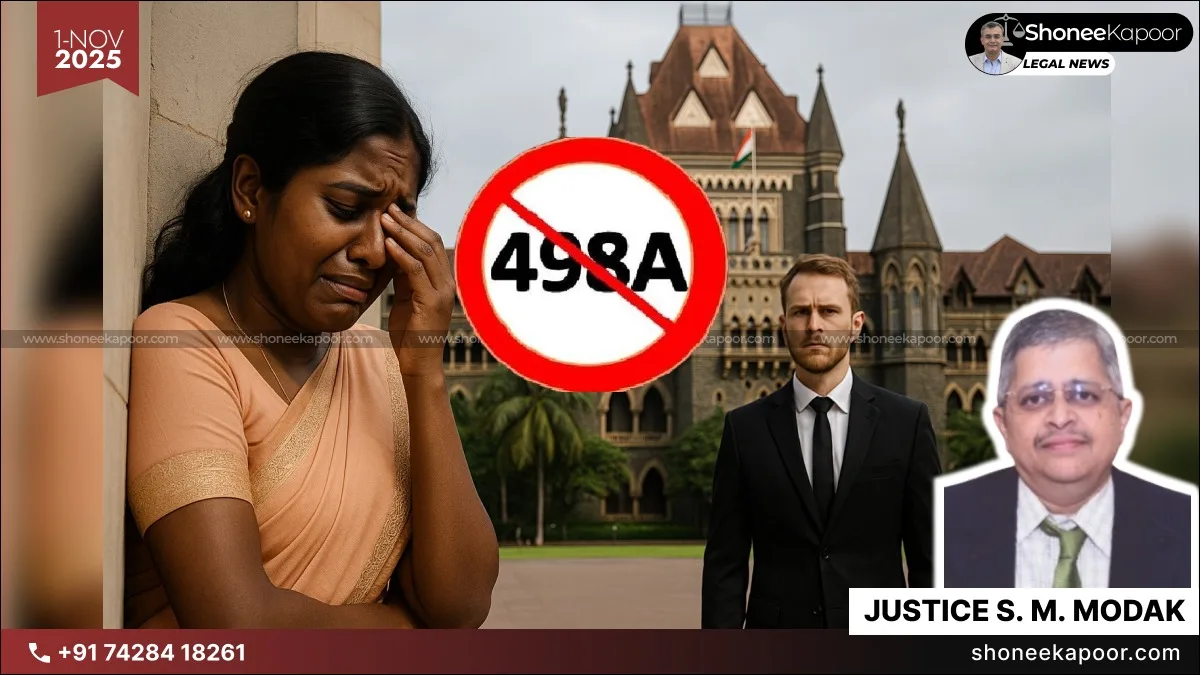
Bombay High Court: Taunting Wife for Dark Skin Not Cruelty Under Section 498A IPC

Written and analysed by Vaibhav Ojha
Head Of Legal CommunicationsThe Bombay High Court ruled that taunting wife for her complexion is not “cruelty” under Section 498A IPC. Justice S.M. Modak set aside the husband’s conviction, finding no strong link between taunts and the woman’s suicide.
MUMBAI: The Bombay High Court, in a recent ruling, made it clear that taunting wife for her dark complexion does not amount to cruelty under Section 498A of the Indian Penal Code (IPC).
The decision came in the case Sadashiv Parbati Rupnawar v. State of Maharashtra, delivered by Justice S. M. Modak on 11th July 2025.
The case involved a man, Sadashiv Parbati Rupnawar, who was earlier convicted by a trial court for allegedly harassing his wife Prema and abetting her suicide. He had been sentenced to one year of rigorous imprisonment under Section 498A IPC (cruelty by husband or relatives) and five years under Section 306 IPC (abetment of suicide). However, the High Court found that the evidence did not justify the conviction.
“In all prosecution examined five witnesses. There are certain admitted documents. They are evidence and documents. With their assistance, I find that the conviction is not supported by the evidence. On record, though Prema was being taunted on account of her complexion, I do not think that it will fall within the explanation to Section 498A of the Indian Penal Code. Even conviction for the offence punishable under Section 306 of the Indian Penal Code cannot be sustained, because the prosecution could not prove the suicide being the outcome of the harassment.”
The couple had married in 1993, and in January 1995, Prema died by suicide by jumping into a well in her village. Her family alleged that she had been taunted and harassed by her husband and father-in-law. The trial court acquitted the father-in-law but convicted the husband.
During the trial, five witnesses were examined — including the mother, relatives of the deceased, and the investigating officer. The main allegation was that the husband taunted Prema for being dark-skinned and often said he didn’t like her and wanted to remarry. Another complaint was that her cooking was not up to the family’s liking.
The High Court noted that such quarrels and domestic disagreements are not of such a severe nature as to push a woman to end her life.
“The accused no. 1 was taunting her by saying she is of black complexion and that he does not like her. Accused no. 1 was telling her he will perform a second marriage.”
“The Accused no. 2 was complaining about capacity of the Prema to prepare food. She was not preparing food properly.”
Justice Modak emphasized that not every marital quarrel becomes a criminal offence and that the law requires proof of cruelty “of such a high degree” that it compels a woman to take an extreme step.
“So what the legislature contemplates is that every dispute, quarrel or altercation arising from the matrimonial life are not criminal offence. It will take colour of criminal law only when there are no alternatives for the wife but to put an end to her life, because of the harassment.”
“I have read the judgment of the trial Court. The trial Court is fully aware about the Explanation-(a) to Section 498-A:- The willful conduct must be of a high degree; however, when the evidence of the three witnesses are considered by the trial Court, there is no finding that the harassment is of high degree. There cannot be such a finding simply for the reason that even if the reasons for harassment are admitted, no case will fall under Section 498-A of the Indian Penal Code. The findings need to be set aside.”
The Court also observed that while there was some harassment, it did not meet the legal threshold to invoke Sections 498A or 306 IPC. The suicide could not be directly linked to the alleged taunts.

“There was harassment, but it was not of that kind of harassment due to which criminal law can be set in motion. The judgment of the trial Court cannot be sustained in the eyes of law. The learned Judge has forgotten the basic principles and ingredients of the Sections.”
Finally, the Bombay High Court set aside the conviction and acquitted the husband, ordering that any fine paid be refunded.
“The Appellant is acquitted for the offence punishable under Section 498-A and Section 306 of the Indian Penal Code. Fine, if any, be returned to the Appellant.”
The judgment reiterates that routine domestic quarrels, taunts, or differences in a marriage — without proof of serious cruelty or instigation — cannot attract criminal liability under Section 498A IPC.
Explanatory Table — All Laws & Sections Mentioned
| Provision | Law / Act | Key Explanation in Simple Words | Relevance in This Case |
| Section 498A | Indian Penal Code (IPC), 1860 | Punishes a husband or his relatives for cruelty toward a wife — includes physical or mental harassment and dowry-related abuse. “Cruelty” must be of such a serious nature that it could drive the woman to suicide or cause grave injury. | The husband was accused of taunting his wife for her dark complexion. The Court ruled that such taunts did not meet the legal threshold of “cruelty.” |
| Section 306 | Indian Penal Code (IPC), 1860 | Deals with abetment of suicide. A person can be punished if they intentionally aid, instigate, or encourage another person to commit suicide. | The wife committed suicide, but the Court found no proof that her husband’s behavior directly abetted it. |
| Section 34 | Indian Penal Code (IPC), 1860 | Applies when a criminal act is done by several people with a shared intent. | Both husband and father-in-law were initially charged together, but the father-in-law was acquitted. |
| Section 113A | Indian Evidence Act, 1872 | Presumption of abetment of suicide of a married woman if she commits suicide within 7 years of marriage and there is evidence of cruelty by her husband or relatives. | Though applicable in theory, the Court held that the evidence of cruelty was too weak to invoke this presumption. |
| Explanation (a) & (b) to Section 498A | Indian Penal Code (IPC) | (a) Covers willful conduct likely to drive a woman to suicide or cause grave injury. (b) Covers harassment for unlawful dowry demands. | The Court observed the case did not fall under either explanation, as the issue was complexion and cooking, not dowry or severe cruelty. |
Case Summary
| Particulars | Details |
| Case Title | Sadashiv Parbati Rupnawar v. The State of Maharashtra |
| Court | High Court of Judicature at Bombay |
| Jurisdiction | Criminal Appellate Jurisdiction |
| Case Number | Criminal Appeal No. 649 of 1998 |
| Bench / Judge | Hon’ble Justice S. M. Modak |
| Date of Judgment | 11th July 2025 |
| Appellant (Accused No. 1) | Sadashiv Parbati Rupnawar — aged 23 years, occupation: shepherd, resident of Jalbavi, Taluka Malshiras, District Solapur |
| Respondent | The State of Maharashtra |
| Counsel for Appellant | Ms. Nasreen S. K. Ayubi, Appointed Advocate |
| Counsel for Respondent-State | Ms. R. S. Tendulkar, Additional Public Prosecutor |
| Trial Court Judgment | Additional Sessions Judge, Satara in Sessions Case No. 66 of 1995 dated 31.07.1998 |
| Trial Court Sentence | Convicted under Section 498A (1 year RI + ₹500 fine) and Section 306 IPC (5 years RI + ₹500 fine) |
| Final High Court Order | Conviction set aside; Appellant acquitted of all charges under Sections 498A and 306 IPC; fine, if paid, to be refunded |
| Date of Upload | 24 July 2025 |
| Case Citation (unofficial) | 2025:BHC-AS:30887 |
Disclaimer: The views and opinions expressed in this article are those of the Indian courts and do not necessarily reflect the official policy or position of “ShoneeKapoor.com” or its affiliates. This article is intended for informational and educational purposes only. The content provided is not legal advice, and viewers should not act upon this information without seeking professional counsel. Viewer discretion is advise.
Related Articles
Can a ‘girlfriend’ of the husband be implicated under Section 498A?
From landmark Supreme Court rulings to ground-level misuse, this article unpacks how Section 498A defines ‘husband’ a...
Share Your Thoughts
Comments are moderated before publication.