
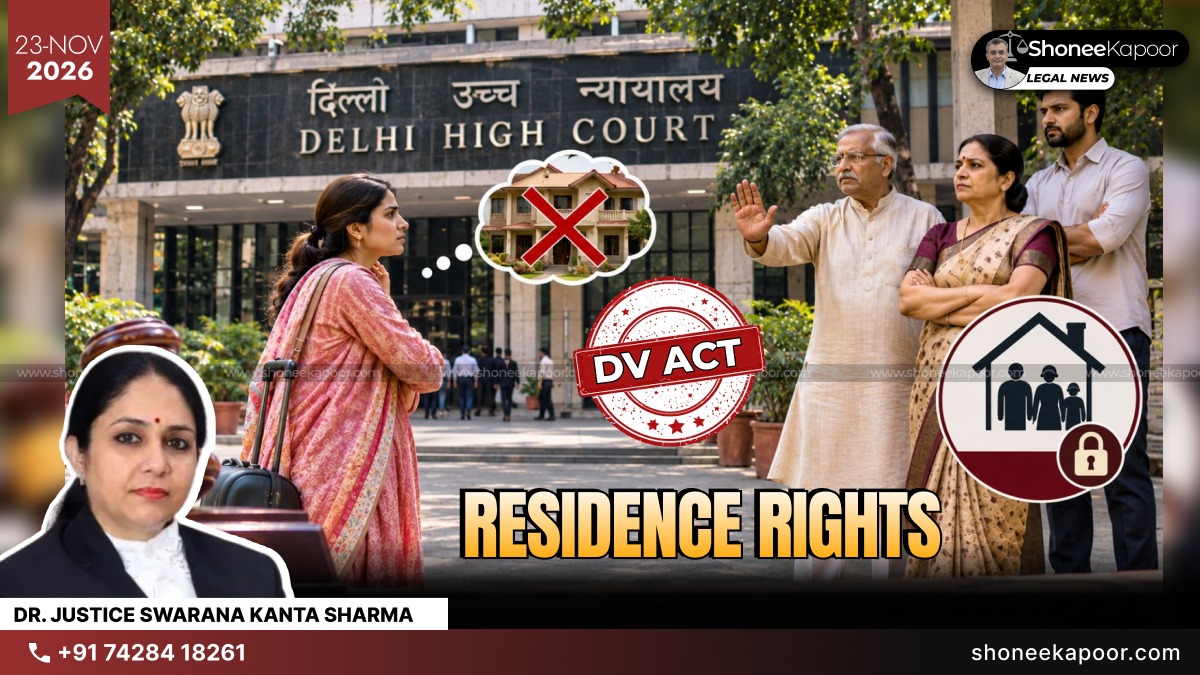
Wife Cannot Claim Absolute Right Of Residence in In-Laws' Property: Delhi High Court Orders Her To Vacate

Curated by NEWS DESK
Editorial DeskNEW DELHI: The Delhi High Court has ruled that a daughter-in-law's right to reside in her matrimonial home is not absolute and does not automatically entitle her to occupy a particular property owned by her in-laws.
Justice Swarana Kanta Sharma upheld an order directing a woman and her son to vacate her elderly in-laws' house, subject to suitable alternative accommodation.
The woman married in 2008 and lived with her husband's parents. The couple has a son born in 2009. Following matrimonial disputes, the husband moved out in 2016.
Read Also:- False DV Cases In India: How Women Use Domestic Violence Act To Pressure Husbands
The woman alleged cruelty and harassment by her husband and in-laws and initiated domestic violence proceedings. Meanwhile, the husband filed a divorce petition. Both cases remain pending.
In 2025, the husband's parents, aged approximately 70 and 64, approached the authorities under the Maintenance and Welfare of Parents and Senior Citizens Act, 2007, seeking the woman's eviction. They alleged harassment, property damage and repeated disturbances.
In December 2025, the District Magistrate refused eviction and directed the parties to occupy separate portions of the property without interfering with each other.
However, on August 6, 2026, the Divisional Commissioner overturned that decision and directed the woman and her son to vacate after receiving alternative accommodation.
The woman challenged this order before the Delhi High Court.
The Court examined the continuing disputes between the parties, including their shared staircase, porch and terrace. It found that their living arrangements had resulted in conflicts over access and basic facilities.
The High Court recognised that senior citizen parents cannot be forced to endure prolonged matrimonial disputes involving their adult children. Their right to peaceful living must also be considered alongside the daughter-in-law's residential protection.
The Court clarified that the Protection of Women from Domestic Violence Act, 2005, protects a woman's right to secure accommodation but does not necessarily guarantee her continued occupation of a specific property belonging to her in-laws.
The High Court found that the earlier direction for alternative accommodation lacked clarity regarding its quality, duration and rental arrangements. It also considered the approximately three-week period allowed for relocation inadequate, particularly because the woman had lived in the property since 2008 and her son was studying in Class 12.
Accordingly, the Court upheld the requirement to vacate while recognising the need for suitable alternative accommodation and reasonable relocation arrangements.
EXPLANATORY TABLE OF LAWS AND SECTIONS
| Law / Section | What It Means | Application In This Case |
|---|---|---|
| Section 17, DV Act, 2005 | Protects a woman's right to reside in a shared household, subject to lawful eviction procedures. | The woman relied on her right to reside in the matrimonial home. |
| Section 19(1)(f), DV Act | Permits suitable alternative accommodation or payment of rent. | Supported the relocation arrangement. |
| Sections 2(s) and 12, DV Act | Define shared household and provide for applications seeking relief. | Relevant to the pending domestic violence proceedings and residence dispute. |
| Sections 2(b), 2(f) and 3, Senior Citizens Act, 2007 | Define maintenance and property, and provide statutory overriding effect. | Relevant to protecting elderly parents and their residence. |
| Rule 22(3), Delhi Senior Citizens Rules, 2009 | Provides a procedure for seeking eviction and appellate relief. | Used by the elderly in-laws to seek eviction. |
| Section 125, CrPC | Provides maintenance for eligible wives, children and parents. | Interim maintenance of ₹30,000 per month was ordered in separate proceedings. |
| Sections 498A, 406 and 34, IPC | Concern matrimonial cruelty, criminal breach of trust and common intention. | Mentioned in separate criminal proceedings between family members. |
| Section 156(3), CrPC | Allows a Magistrate to direct police investigation. | Invoked in proceedings relating to alleged property-document fabrication. |
| Articles 226 and 227, Constitution | Provide High Court writ and supervisory jurisdiction. | Used to challenge the Divisional Commissioner's order. |
| Articles 21 and 41, Constitution | Concern life with dignity and the State's duty relating to public assistance. | Cited in the judgment's discussion of senior citizens' dignity. |
| Order VII Rule 11 and Order XXXIX Rules 1–2, CPC | Concern rejection of plaints and temporary injunctions. | Relevant to the son's separate property litigation. |
CASE DETAILS
| Particular | Details |
|---|---|
| Case Title | Namrata Yadav v. Ramesh Kumar Yadav & Ors. |
| Court | Delhi High Court, New Delhi |
| Bench | Hon'ble Dr. Justice Swarana Kanta Sharma |
| Judgment Date | 19 November 2026 |
| Reserved On | 9 September 2026 |
| Case Number | W.P.(C) 12654/2026 |
| Connected Matters | CAV 418/2026; CM APPL. 58666/2026 |
| CNR Number | DLHC010408992026 |
| Petitioner's Counsel | Senior Advocate Sandeep Sharma, with Advocates Sanjay Rathi, Sarthak Mannan, Viraj, Hitanshu Chhillar, Bhavika Rathi and Jaanvi Rathi |
| Respondents' Counsel | Senior Advocate Mohit Mathur, with Advocates Atul Guleria, Aryan Rakesh, Pratishtha Singh and Vivek Maurya; Advocates Jagdish Chandra, Maanya Saxena and Aishwarya Sinha |
| Earlier Appellate Order | 6 August 2026 |
| Final Decision | Eviction upheld with modified alternative accommodation conditions |
KEY TAKEAWAYS
- No Absolute Right To In-Laws' Property: A daughter-in-law cannot insist on permanently occupying a specific matrimonial home.
- Senior Citizens' Rights Protected: Elderly parents cannot be forced to suffer endless family disputes in their own home.
- Eviction Upheld By Delhi High Court: The daughter-in-law must vacate, subject to suitable alternative accommodation.
- Financial Burden On In-Laws: Elderly parents must bear rent up to ₹35,000 monthly, along with relocation expenses.
- Men's Property Rights Matter: Matrimonial disputes do not automatically override lawful property rights or justify indefinite occupation.
Share Your Thoughts
Comments are moderated before publication.