
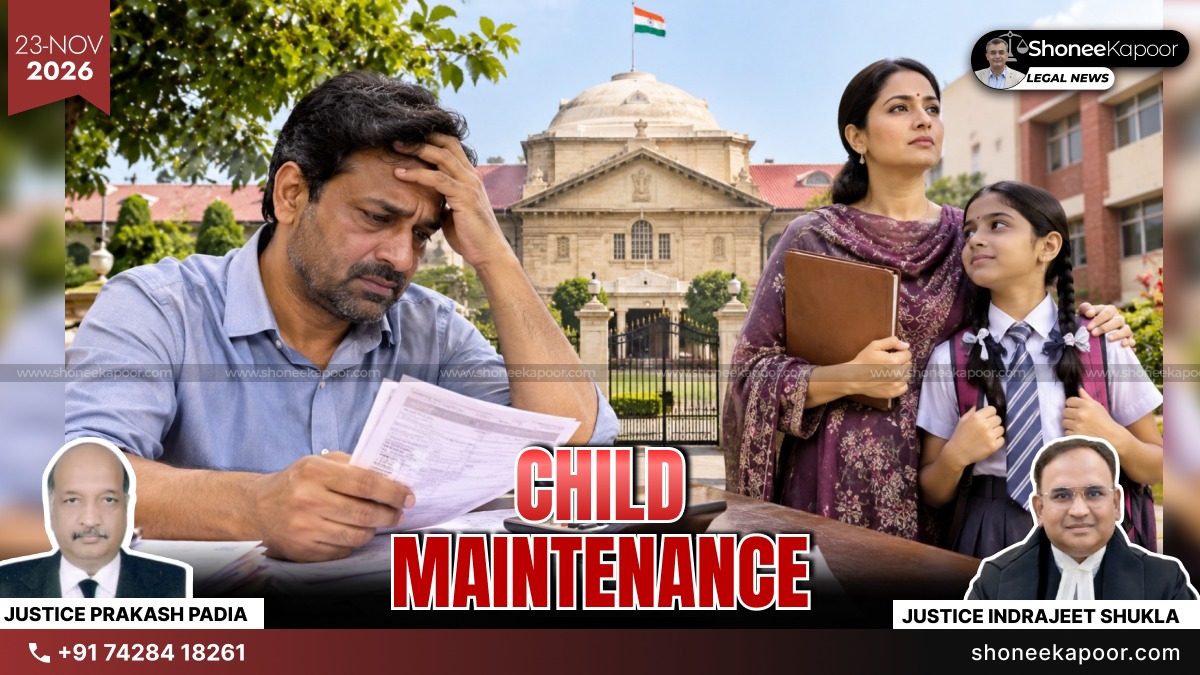
“Father’s Duty To Educate Child Can’t Become A Tool For Oppression”: Allahabad High Court Reduces Maintenance

Curated by NEWS DESK
Editorial DeskUTTAR PRADESH: The Allahabad High Court has held that a father's duty to provide quality education to his child cannot become a tool for financial oppression. The Court emphasised that the financial capacity and socio-economic conditions of both parents must be considered while determining child maintenance.
A Division Bench of Justice Prakash Padia and Justice Indrajeet Shukla partly allowed a father's appeal and reduced his monthly contribution towards his daughter's maintenance and educational expenses from ₹15,000 to ₹12,000.
The couple married on May 3, 2014. After eight years, the husband filed a divorce petition under Section 13(1)(ia) of the Hindu Marriage Act, 1955, alleging cruelty.
During the matrimonial proceedings, the minor daughter, through her mother, sought ₹1 lakh as one-time expenses and ₹35,000 monthly maintenance under Section 26 of the Hindu Marriage Act read with Section 151 CPC.
The application included ₹56,000 towards admission fees for Class IV at a private school in Greater Noida.
The father opposed the demand, stating that he worked as a clerk at an inter college and earned ₹37,504 per month, while the mother worked at a Central School and earned about ₹60,000 per month.
He also claimed responsibility for his elderly parents and unemployed younger brother.
Read Also:- Child Custody Guide: At What Age Can a Child Choose Between Mother and Father in India?
On August 11, 2023, the Trial Court directed the mother to contribute ₹20,000 monthly and the father ₹15,000 towards the child's expenses.
The father challenged the order before the High Court, arguing that his daughter had earlier been eligible for free education at a Central School because she was the single girl child of an employee.
He claimed that the mother shifted their daughter to a private school without sufficient justification, unnecessarily increasing the educational expenses.
The mother opposed the appeal, arguing that the father could not avoid his parental responsibilities. She also referred to his car, loan repayments and alleged lack of clarity regarding his financial position.
After examining the arguments, the High Court observed:
“No doubt father being natural guardian is bestowed with the responsibility imparting education in good and repudiated Alma matter commensurate financial and economic viability but same cannot be made a tool for oppression as right to education is a fundamental right but the socio-economic condition of parents are also to be looked into when it comes for adjudication of courts.”
The Court clarified that both parents are responsible for maintaining their child. It rejected the father's argument that his maintenance obligation would arise only after obtaining custody.
However, the Bench found that the Trial Court had not properly considered the daughter's earlier access to free education or the lack of convincing justification for shifting her to a private school.
The Court further observed:
“The determination of quantum as made by the Trial Court towards maintenance and educational expenses of a child studying in the Sixth Standard does not appear to be reasonable, particularly when the minor respondent was receiving free education at a Central School, and it was the respondent who opted to change the school, without placing any cogent material to demonstrate that the erstwhile school was not meeting the requisite educational standards.”
Considering the father's income, rented accommodation, family responsibilities and financial liabilities, the High Court found the earlier contribution excessive.
Accordingly, the Court reduced the father's monthly contribution to ₹12,000, payable by the seventh day of every month, and directed him to clear outstanding arrears within two months.
The appeal was partly allowed, reaffirming that a child's educational needs must be balanced against the actual financial circumstances of both parents, rather than placing an unreasonable burden on one parent.
EXPLANATORY TABLE OF LAWS AND SECTIONS
| Law / Section | What It Means | Application In This Case |
|---|---|---|
| Section 13(1)(ia), Hindu Marriage Act, 1955 | Allows divorce on grounds of cruelty. | Husband filed a divorce petition alleging cruelty. |
| Section 26, Hindu Marriage Act | Governs custody, maintenance and education of minor children. | Daughter sought monthly maintenance and educational expenses. |
| Section 151 CPC | Recognises the inherent powers of civil courts. | Invoked along with Section 26 for financial relief. |
| Section 19, Family Courts Act, 1984 | Provides for appeals against eligible Family Court orders. | Father challenged the Trial Court's order. |
| Section 20, Hindu Adoptions and Maintenance Act, 1956 | Establishes parental responsibility for maintaining children. | Court considered the financial obligations of both parents. |
| Section 23, Hindu Adoptions and Maintenance Act | Provides factors for determining maintenance amounts. | Relevant to assessing financial capacity and reasonable expenses. |
| Section 6, Hindu Minority and Guardianship Act, 1956 | Deals with natural guardianship of Hindu minors. | Relevant to the father's guardianship argument. |
| Article 15(3), Constitution of India | Permits special legal provisions for women and children. | Discussed in the wider legal analysis. |
CASE DETAILS
| Particular | Details |
|---|---|
| Case Title | Vipin Kumar Nagar v. Smt. Rakhi Taungar |
| Court | Allahabad High Court |
| Bench | Justice Prakash Padia and Justice Indrajeet Shukla |
| Judgment Authored By | Justice Indrajeet Shukla |
| Judgment Date | November 5, 2026 |
| Case Number | First Appeal No. 998 of 2023 |
| Father's Counsel | Advocate Nanhe Lal Tripathi |
| Mother's Counsel | Advocate Anupam Dubey |
| Original Order | August 11, 2023 |
| Original Monthly Contribution | ₹15,000 by father |
| Revised Monthly Contribution | ₹12,000 by father |
| Final Decision | Appeal partly allowed; arrears to be cleared within two months |
KEY TAKEAWAYS
- Father Is Not an Unlimited ATM: A child's education cannot become an excuse to impose unreasonable financial demands on the father.
- Mother's Decision Cannot Burden Father: Shifting a child from free education to an expensive private school requires proper justification.
- Both Parents Are Financially Responsible: A working mother's income must also be considered while deciding child maintenance.
- Father Gets Partial Relief: The Allahabad High Court reduced his monthly contribution from ₹15,000 to ₹12,000 after examining his financial circumstances.
- Maintenance Must Be Fair, Not Oppressive: A father's actual income, liabilities and dependants matter. Parental responsibility cannot mean unlimited financial liability.
Share Your Thoughts
Comments are moderated before publication.