
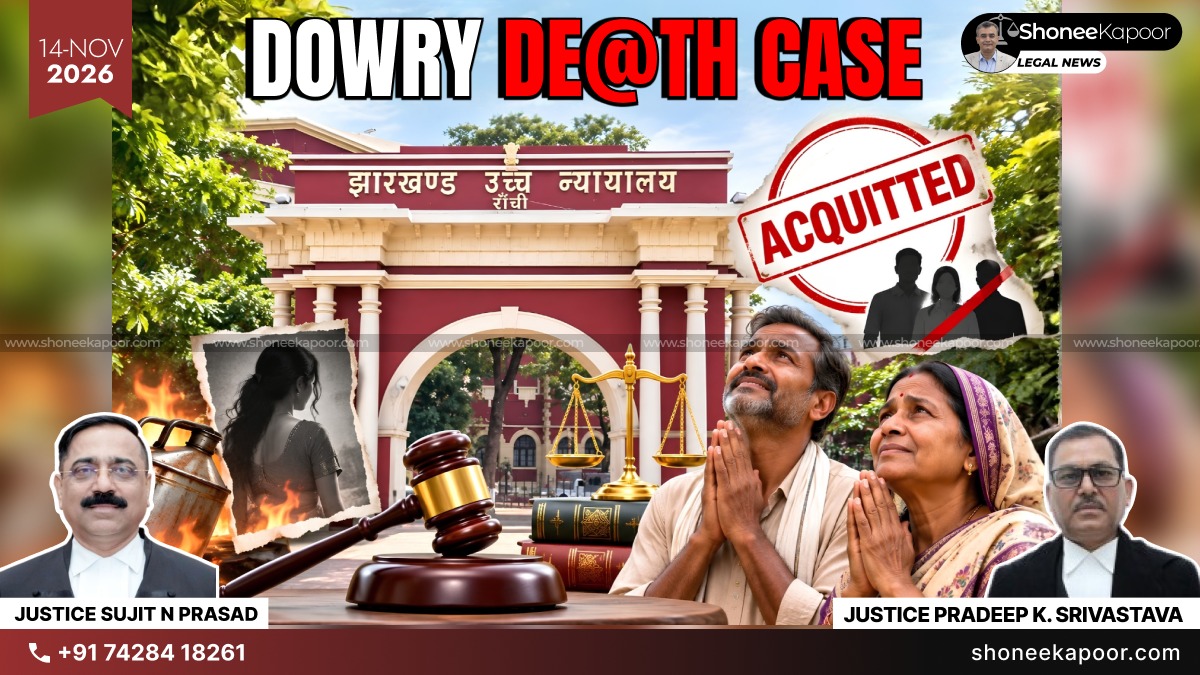
Mere Presence Of Husband's Relatives Does Not Make Them Guilty Of Dowry Death: Jharkhand High Court

Curated by NEWS DESK
Editorial DeskJHARKHAND: The Jharkhand High Court has acquitted two relatives of a husband in a dowry death case, ruling that mere presence at the scene, without evidence of active involvement or specific dowry demands, is insufficient to establish criminal guilt.
A Division Bench of Justice Sujit Narayan Prasad and Justice Pradeep Kumar Srivastava set aside the conviction of Gautam Bauri and Chinta Devi under Section 304-B IPC, granting them the benefit of doubt.
The case concerned the death of Rinku Devi, who married Ratan Bauri in 2010 and died from burn injuries in May 2012, within two years of marriage.
Her mother, Alta Devi, alleged that Rinku's matrimonial family harassed her over demands for ₹50,000 and a motorcycle. She further alleged that on 22 May 2012, Rinku's husband and mother-in-law poured kerosene on her and set her on fire.
Rinku was admitted to Bokaro General Hospital, where she died during treatment.
The prosecution also implicated Gautam Bauri and Chinta Devi. On 13 September 2017, the Trial Court convicted them under Section 304-B IPC and sentenced them to seven years' rigorous imprisonment on 15 September 2017.
The husband was separately sentenced to ten years' rigorous imprisonment. His appeal was dismissed as not pressed on 14 September 2026 after he had completed his sentence.
Read Also:- Presumption in Dowry Death Case in Absence of Specific Allegations
The two relatives challenged their conviction before the High Court.
The High Court explained that Section 304-B IPC requires proof that a woman died under abnormal circumstances within seven years of marriage and was subjected to dowry-related cruelty or harassment soon before her death.
Although Rinku's death satisfied the requirements concerning the nature and timing of death, the Court found no specific allegations of dowry demands or individual acts of harassment against the two appellants.
Their alleged role was limited to witnessing the incident and failing to intervene. The Court also noted that the Trial Court had not invoked Section 34 IPC, relating to common intention, while framing charges or deciding the case.
Considering the possibility that the husband's relatives had been falsely implicated through exaggerated allegations, the High Court observed:
“However, having regard to the nature of their relationships, there being possibility of the appellants having been named by way of exaggeration, we are of the view that the appellants deserve to be given benefit of doubt in that regard in the facts of the present case.”
The Court distinguished the allegations against the husband from the evidence against the two relatives. It held that family relationship, presence at the scene and failure to intervene cannot, by themselves, establish guilt under Section 304-B IPC.
Accordingly, the Jharkhand High Court allowed their criminal appeal, set aside their conviction and acquitted both appellants. As they were already on bail, they were discharged from their bail bond obligations.
EXPLANATORY TABLE OF LAWS AND SECTIONS
| Law / Section | What It Means | Application In This Case |
|---|---|---|
| Section 304-B IPC | Dowry death: deals with an unnatural death within seven years of marriage where dowry-related cruelty or harassment occurred soon before death. | Two relatives acquitted because their individual involvement was not proved beyond reasonable doubt. |
| Section 34 IPC | Joint criminal liability for acts committed in furtherance of common intention. | The Trial Court did not invoke this provision while framing charges or deciding guilt. |
| Section 374(2) CrPC | Provides the right to appeal against certain convictions by a Sessions Court. | Gautam Bauri and Chinta Devi challenged their conviction before the High Court. |
CASE DETAILS
| Particular | Details |
|---|---|
| Case Title | Gautam Bauri and Anr. v. The State of Jharkhand |
| Court | Jharkhand High Court, Ranchi |
| Bench | Justice Sujit Narayan Prasad and Justice Pradeep Kumar Srivastava |
| Judgment Authored By | Justice Sujit Narayan Prasad |
| Neutral Citation | 2026:JHHC:31680-DB |
| Judgment Date | 29 October 2026 |
| Reserved On | 14 September 2026 |
| Case Number | Cr. Appeal No. (SJ) 1790 of 2017 |
| Trial Court Case | Sessions Trial No. 205 of 2014 |
| Trial Court | Additional Sessions Judge-V-cum-F.T.C., Dhanbad |
| Police Station | Nirsa Police Station, Dhanbad |
| Police Case Number | 141 of 2012 |
| G.R. Case Number | 2107 of 2012 |
| Related Husband's Appeal | Cr. Appeal (DB) No. 1876 of 2017 |
| Appellants' Counsel | Advocate Pratiush Lala |
| State Counsel | Bishambhar Shastri, APP |
| Offence | Section 304-B IPC |
| Trial Court Sentence | Seven years' rigorous imprisonment |
| Final Decision | Appeal allowed; both appellants acquitted and discharged from bail bond obligations |
KEY TAKEAWAYS
- Being Husband's Relative Is Not A Crime: Family ties alone cannot establish guilt in a dowry death case.
- Allegations Are Not Evidence: Every accused deserves a fair trial, not automatic conviction based on accusations.
- Exaggerated Claims Can Ruin Lives: Innocent relatives may face years of criminal proceedings over unproven allegations.
- No Collective Punishment ofNOVEMBER Husband's Family: Criminal liability must be proved individually, not presumed because of family relationships.
- Justice After Nine Years: The Jharkhand High Court acquitted two relatives convicted in 2017, granting them the benefit of doubt.
Share Your Thoughts
Comments are moderated before publication.