
Woman Had Her ‘Rapist’s’ Name Tattooed On Her Chest, Travelled With Him, Then Accused Him Of Rape: Delhi High Court Cuts His Sentence 17 Years Later

Curated by NEWS DESK
Editorial DeskIf the girl had the accused man’s name tattooed on her chest, travelled with him to Manali and initially gave a version supporting his case, should he be sent back to jail 17 years later? The Delhi High Court examined whether further imprisonment was still justified.
DELHI: The Delhi High Court has reduced the sentence of a man convicted under Sections 363, 366 and 376 of the Indian Penal Code (IPC) in a 2009 case involving a girl who was about 14 years old at the time. The Court held that the period of imprisonment he had already undergone was sufficient, while keeping the fine imposed by the Trial Court unchanged.
Justice Vimal Kumar Yadav was dealing with an appeal filed by Man. Although the appeal originally challenged both his conviction and sentence, his counsel later restricted the challenge only to the sentence.
The case began when the girl went missing from her home on 15 June 2009. An FIR under Section 363 IPC was registered on 17 June 2009. During this period, she had travelled with the appellant to Connaught Place and then Manali, before both returned to Delhi.
The appellant claimed that she had voluntarily accompanied him. Significantly, the High Court noted that the girl’s initial version before the medical authorities on 17 June 2009 was in line with the appellant’s version. A police statement recorded on the same day in the presence of her mother was also not against him.
However, she later changed her stand. Her statement under Section 164 CrPC was recorded on 26 June 2009, after which she maintained allegations against the appellant.
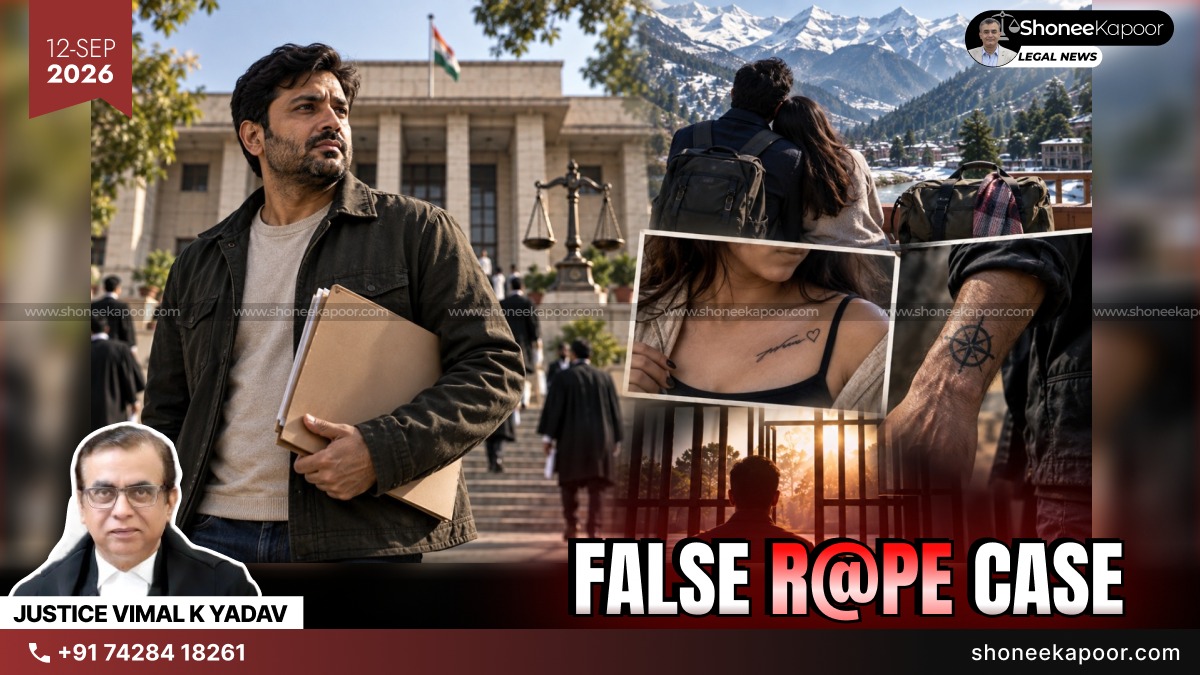
The Court also considered several circumstances surrounding their relationship. The girl had the appellant’s name tattooed on her chest, while she admitted that the appellant had her name tattooed on his hand. The Court also noted that she had travelled with him and had not raised an alarm or protest during the journey.
The High Court observed that several questions arising from these circumstances remained unanswered and said:
“These unanswered and open-ended situations are indicative of the fact that the Appellant alone is not to be blamed.”
At the same time, the Court made it clear that the decisive legal difficulty for the appellant was the girl’s age. She was a minor, and therefore the relationship could not receive legal recognition merely because the surrounding circumstances indicated intimacy between them.
The appellant was around 18 years old, while the girl was around 14 years old when the incident occurred. The Trial Court itself took the surrounding circumstances into account and awarded a sentence below the minimum prescribed under the then-applicable, unamended Section 376 IPC.
Seeking further reduction of sentence, the appellant relied upon several mitigating circumstances, including their young age, the tattoos, the complainant’s unwillingness to continue contesting the matter, his clean record, the long pendency of the proceedings and the fact that both had since married different persons.
His counsel also relied upon the Supreme Court’s observations concerning the possible introduction of a “Romeo – Juliet clause” for genuine adolescent relationships where the age difference is small. The High Court referred to State of Uttar Pradesh v. Anurudh & Anr., 2026 SCC OnLine SC 40, where the Supreme Court recommended considering measures to protect genuine adolescent relationships from automatic criminalisation while also addressing misuse of such laws.
The Court further noted that more than 17 years had passed since the incident. Both sides had moved on and were living their respective married lives. The appellant had no criminal antecedents, and the Court found no misuse of power, wealth, status or age by him.
The complainant also said she did not want to contest the matter further. Looking at the tattoos, the Manali trip and the circumstances surrounding the relationship, the Court observed:
“It seems some sort of soul-searching was there, where the truth sits naked. In her heart of hearts, deep down somewhere, she must also be looking for answers and explanation for the tattoos and travel to Manali, etc.”
The Court also made an important observation while considering whether the man alone should continue bearing the consequences after so many years:
“There was no misuse of power, wealth, status or age by the Appellant.”
It further observed that in the particular circumstances, the prosecutrix “herself cannot escape the blame or has a fair contributory share in the offence” while considering the question of sentence.
The State opposed further leniency, arguing that the Trial Court had already awarded a punishment below the prescribed minimum after considering the special circumstances. However, counsel for the prosecutrix did not dispute that she no longer wanted to continue with the appeal.
The High Court finally held that sending the appellant back to prison after such a long period, when both parties had settled into separate family lives, and the man had maintained clean antecedents, would serve little purpose.
The Court held that sending him back to jail would be “nothing short of a travesty of justice.”
Considering the long criminal proceedings and the wider effect that renewed imprisonment would have on his present family life, the Court treated the custody already undergone as sufficient punishment. The appellant had undergone nearly two years and four months of imprisonment, including remission.
Accordingly, the Delhi High Court reduced Man’s sentence to the period already undergone, while leaving the fine imposed by the Trial Court unchanged.
EXPLANATORY TABLE OF LAWS AND SECTIONS
| Law / Section | What It Means | Application In This Case |
|---|---|---|
| Section 363 IPC | Punishment for kidnapping. | The FIR was initially registered under Section 363 after the minor girl went missing. |
| Section 366 IPC | Deals with kidnapping or abducting a woman for specified purposes covered by the provision. | The appellant was convicted under this provision along with Sections 363 and 376 IPC. |
| Section 376 IPC (unamended provision applicable to the case) | Prescribed punishment for rape under the law applicable when the 2009 incident occurred. | The appellant was convicted under Section 376. The Trial Court had already imposed a sentence below the then minimum after finding special and adequate reasons. |
| Section 164 CrPC | Permits a Magistrate to record statements or confessions during investigation. | The girl’s Section 164 statement was recorded on 26 June 2009, after her earlier versions on 17 June 2009. |
| Romeo-Juliet Clause – reform proposal | A proposed legal exception or mechanism aimed at distinguishing genuine close-in-age adolescent relationships from exploitative sexual offences. | The appellant relied on the Supreme Court’s observations in State of Uttar Pradesh v. Anurudh & Anr. while seeking a lighter sentence. |
CASE DETAILS
| Particular | Details |
|---|---|
| Case Title | Vakul Kapoor v. State |
| Case Number | CRL.A. 676/2011 |
| CNR Number | DLHC010820692011 |
| Court | High Court of Delhi at New Delhi |
| Bench | Justice Vimal Kumar Yadav |
| Counsel for Appellant | Ms. Saahila Lamba, Advocate |
| Counsel for State | Mr. Raj Kumar, APP, with SI Kanhaiya Lal, PS Geeta Colony |
| Counsel for Prosecutrix | Ms. Astha, Advocate (DHCLSC), with Ms. Megha Singh, Advocate |
| Judgment Reserved | 2 September 2026 |
| Decision Date | 7 September 2026 |
KEY TAKEAWAYS
- The man remained under rape litigation for nearly 17 years before the Delhi High Court reduced his sentence to the period already undergone.
- The Court considered that the girl had his name tattooed, travelled with him to Manali and initially supported his version.
- The High Court observed that “Appellant alone is not to be blamed,” while considering the surrounding circumstances.
- Her minority remained crucial, so the conviction itself was not set aside.
- Considering the long delay, his clean record and both parties moving on, the Court called sending him back to jail a “travesty of justice.”
Share Your Thoughts
Comments are moderated before publication.