
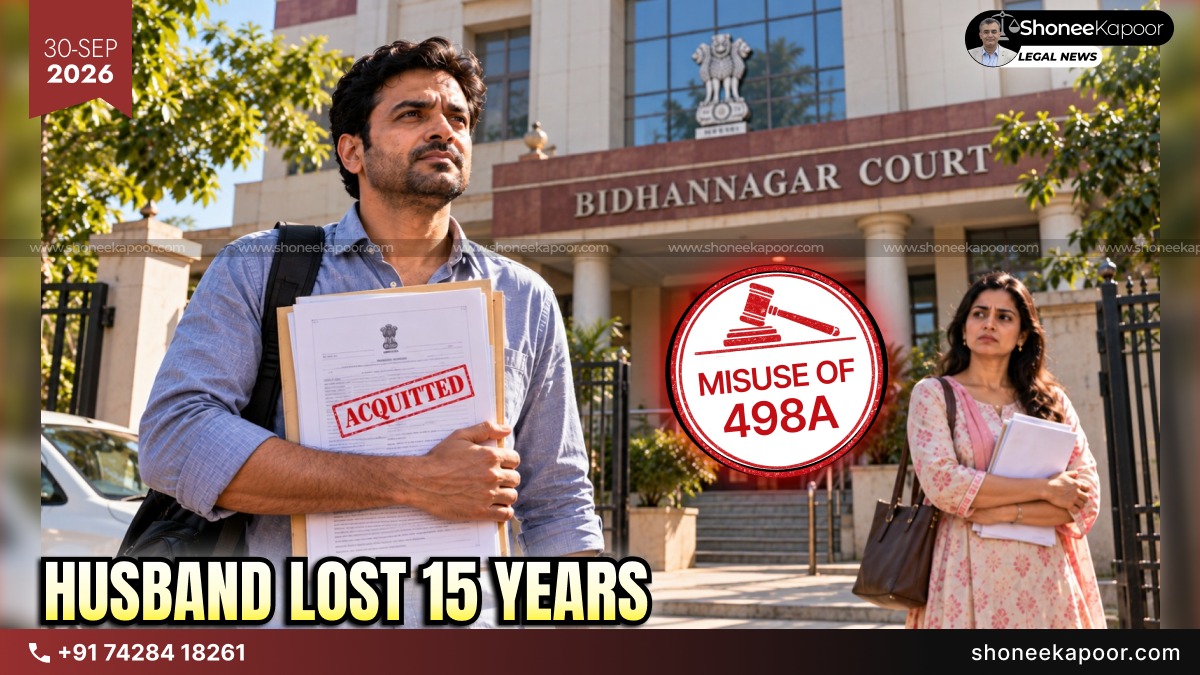
False 498A & Dowry Case | Husband Acquitted After 15 Years: Bidhannagar Court In West Bengal Finds Evidence Failed to Prove Cruelty

Curated by NEWS DESK
Editorial DeskWEST BENGAL: A Bidhannagar court acquitted a husband in a 498A and 406 IPC case after holding that the prosecution failed to prove cruelty, dowry demand and criminal breach of trust beyond reasonable doubt. The FIR was registered on 23 April 2010, while the acquittal came on 6 December 2025, meaning the husband remained involved in the criminal case for more than 15 years.
The Additional Chief Judicial Magistrate, Bidhannagar, North 24 Parganas, tried the matter. The parties had married under the Special Marriage Act. The wife alleged that after marriage she lived with her husband in Hyderabad and later in the United States, where she was subjected to physical and mental cruelty.
The Court framed charges under Sections 498A and 406 IPC. The husband denied the allegations and pleaded “Amra Nirdosh”, maintaining that he was innocent.
The prosecution mainly relied upon the evidence of the wife, her parents and a doctor. The wife alleged that her husband assaulted and mistreated her during trips to Sikkim, while they were living in Hyderabad and later during their stay in the USA. She also alleged incidents involving a cooking gas stove, electric wire, iron rod, hanger and other acts of physical cruelty.
She claimed that she had received treatment in Hyderabad, the USA and Kolkata for injuries allegedly caused by her husband.
However, the court found serious gaps in the prosecution evidence. The major incidents were alleged to have taken place in Sikkim, Hyderabad, and the USA, but the prosecution did not produce medical documents from Hyderabad or the USA. The prosecution relied mainly on a Kolkata medical prescription dated 13 February 2009.
The court also noted the lack of independent material from the places where the alleged incidents had occurred. The investigating officers' evidence also showed gaps in the investigation.
During cross-examination, the wife admitted:
“I did not lodge any complaint after returning from USA, from 11.02.09 to 23.04.10.”
She also admitted that she had filed divorce proceedings in around April or May 2009 and that she had not filed any complaint against her husband while staying in Hyderabad.
The court considered the timing important. The wife returned to India on 11 February 2009, but lodged the criminal complaint only on 23 April 2010, more than a year later. Divorce proceedings had already been initiated before the criminal case.
The prosecution also relied upon the doctor who examined the complainant after her return to India. The doctor stated that he had found bruises, abrasions and swellings on different parts of her body.
However, the court found that the medical evidence did not establish when the injuries were caused or whether they could specifically be connected to the husband.
During cross-examination, the doctor explained:
“If somebody is assaulted today, that will be named as new.”
The complainant had returned from the USA on 11 February 2009 and was examined on 13 February 2009. The court found that the prosecution could not establish a reliable evidentiary link between the injuries mentioned in the prescription and the alleged assaults abroad.
The court therefore observed that the prosecution “has not been able to connect the dots” between the allegation of assault and the medical prescription.
On the Section 406 IPC charge, the prosecution faced another evidentiary failure. The court found that it had not proved that the alleged stridhan articles were entrusted to the husband and later dishonestly misappropriated by him.
The court also found that the prosecution had failed to prove the alleged dowry demand against the accused.
While examining Section 498A IPC, the court referred to Bhaskar Lal Sharma v. Monica and discussed the ingredients required to establish cruelty. It also relied on the Supreme Court decision in Noorjhan v. State regarding the level of cruelty required to attract Section 498A.
After examining the oral testimony, medical material and other evidence, the court held that the prosecution had failed to prove the essential ingredients of Sections 498A and 406 IPC beyond reasonable doubt.
The husband was consequently found not guilty and acquitted under Section 248(1) CrPC. The court also discharged his bail bond liabilities and those of his sureties.
EXPLANATORY TABLE OF LAWS AND SECTIONS
| Law / Section | What It Means | Application In This Case |
|---|---|---|
| Section 498A IPC | Punishes cruelty by a husband or his relative against a married woman where the statutory ingredients of cruelty are proved. | The husband faced trial under this provision, but the court held that the prosecution failed to prove the required ingredients beyond reasonable doubt. |
| Section 405 IPC | Defines criminal breach of trust, including dishonest misappropriation or use of property entrusted to a person. | Discussed while examining the prosecution's allegation concerning the complainant's alleged stridhan. |
| Section 406 IPC | Provides punishment for criminal breach of trust. | The court found that entrustment and subsequent dishonest misappropriation of stridhan were not proved against the accused. |
| Section 248(1) CrPC | Permits acquittal in a warrant case instituted on a police report when the Magistrate finds the accused not guilty. | The accused was ultimately acquitted under this provision. |
| Section 313 CrPC | Allows the court to personally examine an accused regarding incriminating circumstances appearing in the evidence. | The accused was examined under this provision on 30 August 2025 and denied the material allegations. |
| Section 428 CrPC | Provides for set-off of detention undergone during investigation, inquiry or trial against a sentence of imprisonment. | Mentioned in the prescribed case-information form concerning the accused's detention status; no sentence followed because he was acquitted. |
| Special Marriage Act | Provides a civil form of marriage irrespective of personal religious law. | The judgment records that the parties' marriage was solemnised under this Act. |
CASE DETAILS
| Particular | Details |
|---|---|
| Case Title | State of West Bengal v. Accused Person. |
| G.R. Case No. | 242 of 2010 |
| CIS Registration No. | 603 of 2018 |
| Police Case | BDN(S) P.S. Case No. 57/2010 |
| Court | Court of the Additional Chief Judicial Magistrate, Bidhannagar, North 24 Parganas, West Bengal |
| Presiding Officer / Bench | Additional Chief Judicial Magistrate, Bidhannagar |
KEY TAKEAWAYS
- 15 Years to Prove Innocence: FIR in 2010, acquittal in 2025. The husband spent over a decade defending himself before the court found him not guilty.
- 498A Allegations Need Proof: The court found that the prosecution failed to prove the essential ingredients of cruelty beyond reasonable doubt.
- Medical Evidence Failed to Connect the Husband: The court said the prosecution “has not been able to connect the dots” between the alleged assault and the medical prescription.
- 406 IPC Also Failed: Entrustment and dishonest misappropriation of alleged stridhan were not proved. The alleged dowry demand was also not established.
- Acquitted, But 15 Years Are Gone: The husband walked out legally innocent, but no judgment can return the years consumed by a criminal prosecution.
Share Your Thoughts
Comments are moderated before publication.