
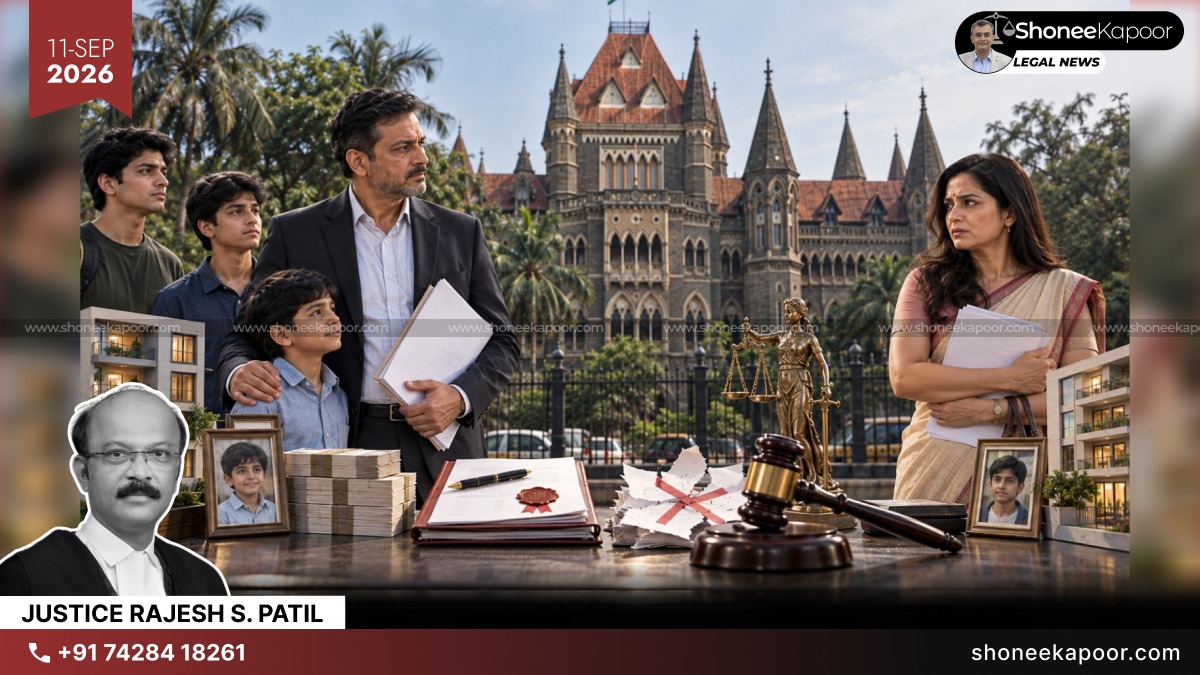
Wife Tried To Back Out Of Signed Matrimonial Settlement After Husband Honoured His Obligations: Bombay High Court Says No

Curated by NEWS DESK
Editorial DeskCan a wife back out of consent terms after the husband has already performed part of the settlement? The Bombay High Court refused to remove a clause protecting their youngest son and said the wife's attempt “smells trouble in these proceedings.”
MUMBAI: The Bombay High Court dismissed an application filed by a wife seeking to recall consent terms dated 13 October 2025 that had settled a matrimonial dispute with her husband. Justice Rajesh S. Patil found no merit in her plea, noting that the husband had already performed part of his obligations and was ready to complete the remaining payment.
The dispute began with the husband's application seeking transfer of Domestic Violence proceedings filed by the wife from the Metropolitan Magistrate at Andheri to the Family Court at Bandra. The couple has three sons, aged 22, 20 and 15.
After settlement talks, both parties signed consent terms before the Court on 13 October 2025. Under the settlement, the husband was to retain the slightly larger Flat No. 1401 with two sons, while the wife was to receive Flat No. 1101 with the youngest son. However, she could not sell that flat until the youngest son turned 26 or got married.
The husband also agreed to pay Rs. 20 lakh. He had already paid Rs. 2,26,600 towards the youngest son's pending school fees. The remaining Rs. 17,73,400 was payable by 13 October 2026. His lawyer told the Court that the balance had been withheld because the wife challenged the settlement, but the husband remained ready to deposit it.
The wife claimed that she was physically unwell and mentally disturbed when the settlement was signed. She argued that her consent was not free or properly informed and that she had signed the terms under anxiety and confusion without adequate legal advice. She also alleged misconduct against her former advocate, who later denied it in an affidavit.
Her main objection was to the restriction on selling Flat No. 1101. She wanted the clause removed so that she could sell the property if she wished to return to Amravati. She also relied on Section 13-B(2) of the Hindu Marriage Act to argue that the consent terms could be modified or set aside.
The High Court was unconvinced. It noted that the settlement had followed several discussions and court hearings and that the wife was now objecting to a clause specifically meant to protect the youngest son's future.
The Court remarked:
“This, according to me, smells of trouble in these proceedings.”
The case also took an unusual turn when the couple's 22-year-old eldest son, asked to address the Court. In his parents' absence but in the presence of their lawyers, he made serious allegations about his mother's behaviour.
He alleged that his mother had physically assaulted him on several occasions, leaving stitches on his body, and had once thrown chilli powder into his eyes. He also described the social and mental trauma he allegedly suffered. The High Court clarified that these allegations would have to be considered on evidence in the appropriate proceedings.
The Court relied on the Supreme Court's ruling in Dhananjay Rathi v. Ruchika Rathi, which emphasised the binding nature of settlements. The Supreme Court held that a party may step back where it successfully establishes force, fraud or undue influence, or non-fulfilment of agreed conditions by the opposite party.
The judgment also reproduced the principle from Gimpex Private Limited v. Manoj Goel:
“Once a settlement agreement has been entered into between the parties, the parties are bound by the terms of the agreement...”
Applying these principles, the Bombay High Court noted that the husband had already performed part of the settlement and was ready to perform the remaining part, while the wife sought removal of a clause protecting the youngest son. The Court also recorded that the youngest son had been staying with his father since 10 April 2026.
Finding the wife's application devoid of merit, the Court rejected it. The husband remained ready to pay the balance Rs. 17,73,400 within the period provided under the settlement.
Before closing the case, the High Court also raised concerns over medicines allegedly suggested to the youngest son by Dr Kartik Rao on three occasions without physically examining him. It directed that the doctor's affidavit be forwarded to the Medical Council of Psychiatrics for examination and appropriate action under the rules.
EXPLANATORY TABLE OF LAWS AND SECTIONS
| Law / Section | What It Means | Application In This Case |
|---|---|---|
| Section 13-B(2), Hindu Marriage Act, 1955 | Deals with the second motion in a divorce by mutual consent and the statutory period connected with such proceedings. | The wife's counsel relied on it to argue that consent can be reconsidered and that the consent terms could similarly be modified or set aside. The Court did not accept this as sufficient to undo the settlement. |
| Section 138, Negotiable Instruments Act, 1881 | Provides criminal consequences for dishonour of cheques when statutory requirements are satisfied. | Mentioned in the Supreme Court precedent reproduced by the Bombay High Court while explaining the legal consequences of breach of a settlement. |
| Domestic Violence proceedings | Proceedings providing statutory remedies to an aggrieved woman under the domestic violence law. | The husband filed the original MCA to transfer the wife's DV proceedings from the Metropolitan Magistrate at Andheri to the Family Court at Bandra. The judgment does not identify a specific DV Act section. |
CASE DETAILS
| Particular | Details |
|---|---|
| Case Title | Urvashi Dhanorkar v. Avinash Dhanorkar (Interim Application in Avinash Dhanorkar v. Urvashi Dhanorkar) |
| Interim Application | Interim Application No. 13287/2025 |
| Main Proceeding | Miscellaneous Civil Application No. 429/2022 |
| Court | High Court of Judicature at Bombay, Civil Appellate Jurisdiction |
| Bench | Justice Rajesh S. Patil |
| Counsel for Applicant-Wife | Senior Advocate Seema Sarnaik, with Advocate Shahan Kapadia and Advocate Irfan Unwala |
| Counsel for Respondent-Husband | Advocate Himanshu Nagarkar, with Advocate Kajal S. |
| Counsel for Dr. Kartik Rao | Advocate Suraj Kaushik |
| Reserved On | 27 August 2026 |
| Pronounced On | 7 September 2026 |
| Neutral Citation | 2026:BHC-AS:36699 |
| CNR No. | HCBM010579182025 |
| Result | Wife's Interim Application rejected as devoid of merit |
KEY TAKEAWAYS
- Husband performs; wife wants a reset. A court settlement cannot become optional the moment one side dislikes the deal.
- He paid Rs. 2.26 lakh and stood ready with Rs. 17.73 lakh more. His obligations continued, while the settlement itself was dragged back into litigation.
- The wife wanted freedom to sell the flat. The Court refused because the restriction protected their youngest son, not punished her.
- Men and boys can be victims inside families too. The eldest son made serious allegations of physical abuse by his mother, though these remain subject to proof.
- A settlement cannot be a one-way contract against the husband. Men cannot be expected to keep paying and performing while the other side gets repeated opportunities to rewrite settled terms.
Share Your Thoughts
Comments are moderated before publication.