
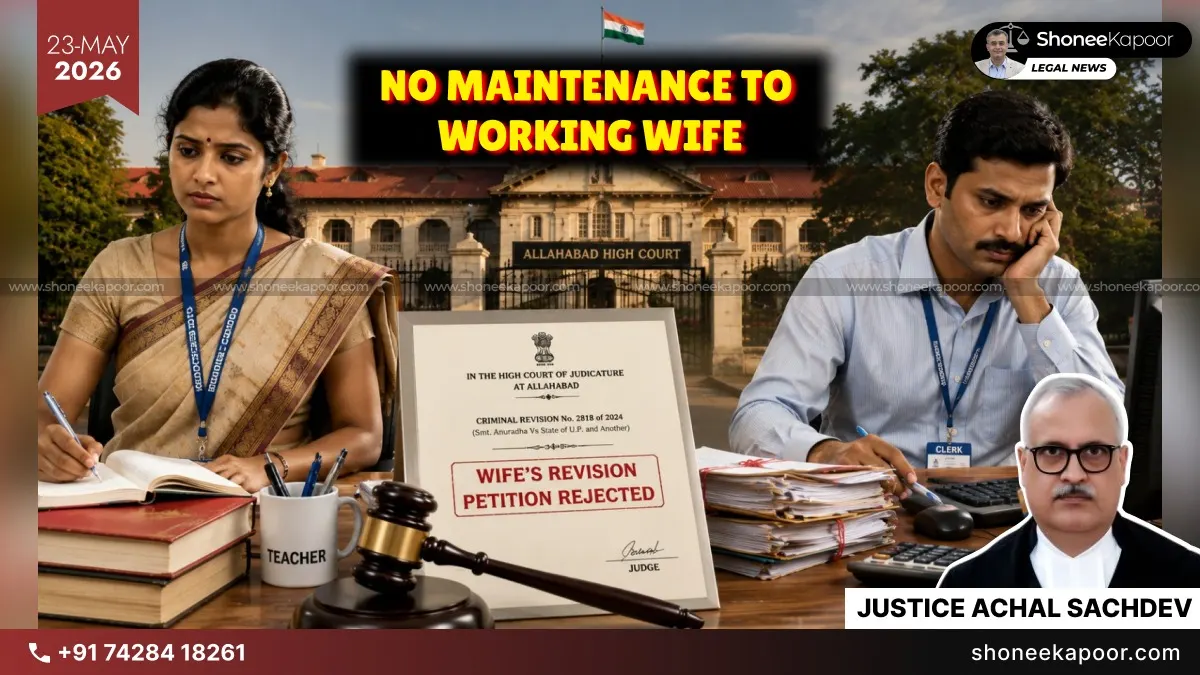
Does A Husband’s Maintenance Liability Continue Forever Despite Wife Becoming Financially Independent?
The Allahabad High Court negated this perception and upheld the Family Court order granting maintenance only till the date the wife joined government service as a teacher in Bihar.
PRAYAGRAJ: The Allahabad High Court, in an important judgment delivered by Justice Achal Sachdev, refused to interfere with a Family Court order which had granted maintenance of ₹10,000 per month to a wife only till the date she secured a permanent government job as a teacher in Bihar.
The case arose from a criminal revision filed by the wife challenging the order passed by the Family Court, Basti. The Family Court had directed the husband to pay maintenance from 14 July 2019 till 8 February 2024 because the wife later joined a government teacher’s job on 9 February 2024.
According to the wife, the marriage took place on 22 May 2017 as per Hindu rituals. She alleged that her husband and his family were demanding a Swift Desire car as dowry and started mentally and physically harassing her soon after marriage. She also alleged that her husband was involved in an illicit relationship with another woman and even expressed his intention to marry her. The wife further informed the Court that she had lodged an FIR under Sections 498A, 323, 504, 506, 316 IPC and Sections 3/4 of the Dowry Prohibition Act.
The wife argued before the High Court that she was unemployed for several years and had no independent source of income. She stated that she was dependent upon her parents for survival, while her husband was working as a clerk, earning around ₹50,000 per month. She relied upon Supreme Court judgments to argue that even a working woman can claim maintenance if her earnings are not sufficient to maintain herself properly.
The husband, however, denied the allegations and stated that no dowry was demanded at the time of marriage. According to him, the wife left the matrimonial house on the pretext of preparing for competitive examinations and never returned. He also stated that several mediation efforts were made to restore the marriage. The husband further pointed out that during cross-examination, the wife herself admitted that her educational and coaching expenses were being borne by him.
The husband argued that after securing a government teacher’s job in Bihar from 9 February 2024, the wife became financially capable of maintaining herself and therefore was no longer entitled to further maintenance.
While examining the matter, the High Court discussed several important judgments including “Chaturbhuj v. Sita Bai”, “Rajnesh v. Neha” and “Captain Ramesh Chander Kaushal Vs. Mrs. Veena Kaushal.” The Court explained that the main purpose behind maintenance laws is to support a spouse who is unable to maintain herself.
The Court specifically observed:
“The claimant must be unable to maintain herself or themselves and if a wife obtain a government job it constitute a change in the circumstances and constitutes a sufficient ground to limit the maintenance amount to the period prior to the wife securing a government job.”
The Court further referred to the principle laid down by the Supreme Court that maintenance is a measure of social justice. However, once the wife secures a stable and reliable source of livelihood, the obligation of the husband may come to an end. The judgment records,
“The maintenance is a measure of social justice and the social necessity ends, because the wife has secured a stable and reliable source for her livelihood.”
At the same time, the Court clarified that even after getting a job, a wife may still claim supplementary maintenance if her salary is significantly lower than the husband’s income or if it is insufficient to maintain the same standard of living enjoyed during marriage.
After considering the facts of the case, the High Court found that the wife did not have sufficient income between 2019 and February 2024, and therefore the Family Court was justified in granting maintenance for that period. However, after she joined the government job as a teacher, the Court found no reason to continue maintenance.
The Court ultimately dismissed the criminal revision and upheld the Family Court’s order.
Explanatory Table: Laws And Sections Involved
| Law / Section | Meaning In Simple Language | Why It Was Mentioned In This Case |
| Section 397 Cr.P.C. | Gives High Court power to examine correctness of lower court orders | Wife filed criminal revision before High Court under this provision |
| Section 401 Cr.P.C. | Gives revisional powers to High Court | Used along with Section 397 Cr.P.C. |
| Section 96(4) Family Court Act | Allows challenge against Family Court orders | Revision was filed against Family Court maintenance order |
| Section 125 Cr.P.C. | Maintenance provision for wife, children and parents | Wife claimed monthly maintenance from husband |
| Section 144 BNSS | New Bharatiya Nagarik Suraksha Sanhita equivalent of Section 125 Cr.P.C. | Court referred to updated legal framework |
| Section 127 Cr.P.C. | Allows modification of maintenance due to changed circumstances | Court said government job was a changed circumstance |
| Section 146 BNSS | New BNSS equivalent of Section 127 Cr.P.C. | Mentioned regarding modification of maintenance |
| Section 18 Hindu Adoption and Maintenance Act | Gives wife right to seek maintenance under Hindu law | Court discussed principles of maintenance |
| Section 498A IPC | Cruelty by husband or relatives | Wife alleged dowry harassment and cruelty |
| Section 323 IPC | Punishment for causing hurt | Included in wife’s FIR allegations |
| Section 504 IPC | Intentional insult provoking breach of peace | Mentioned in FIR |
| Section 506 IPC | Criminal intimidation | Wife alleged threats from husband and family |
| Section 316 IPC | Causing death of unborn child by act amounting to culpable homicide | Mentioned in FIR registered by wife |
| Sections 3/4 Dowry Prohibition Act | Punishment for giving/taking or demanding dowry | Wife alleged demand of Swift Desire car as dowry |
Case Details
- Case Title: Smt. Anuradha vs State of U.P. and Another
- Court: Allahabad High Court
- Case Number: Criminal Revision No. 2818 of 2024
- Bench: Justice Achal Sachdev
- Neutral Citation: 2026:AHC:113439
- Date Of Judgment: 15.05.2026
- Counsels:
- For Revisionist: Ashwani Kumar Mishra, Sandeep Kumar Keshari, Vivek Srivastava
- For Opposite Parties: Sheetala Prasad Pandey, G.A.
Key Takeaways
- Equal accountability in matrimonial disputes requires courts to examine real financial need instead of mechanically continuing maintenance in every situation.
- Maintenance is meant to support a financially dependent spouse, not to create lifelong financial liability even after stable employment and regular income begin.
- A person who becomes financially independent through a secure government job may no longer remain automatically entitled to continued monetary support.
- Financial capability, earning capacity and changed life circumstances must matter equally while deciding maintenance disputes.
- Laws related to maintenance should operate as instruments of fairness and social support, not as permanent economic punishment against one side.
This Could Change Your Case-Get FREE Legal Advice-Click Here!
Disclaimer: The views and opinions expressed in this article are those of the Indian courts and do not necessarily reflect the official policy or position of “ShoneeKapoor.com” or its affiliates. This article is intended for informational and educational purposes only. The content provided is not legal advice, and viewers should not act upon this information without seeking professional counsel. Viewer discretion is advised.
