
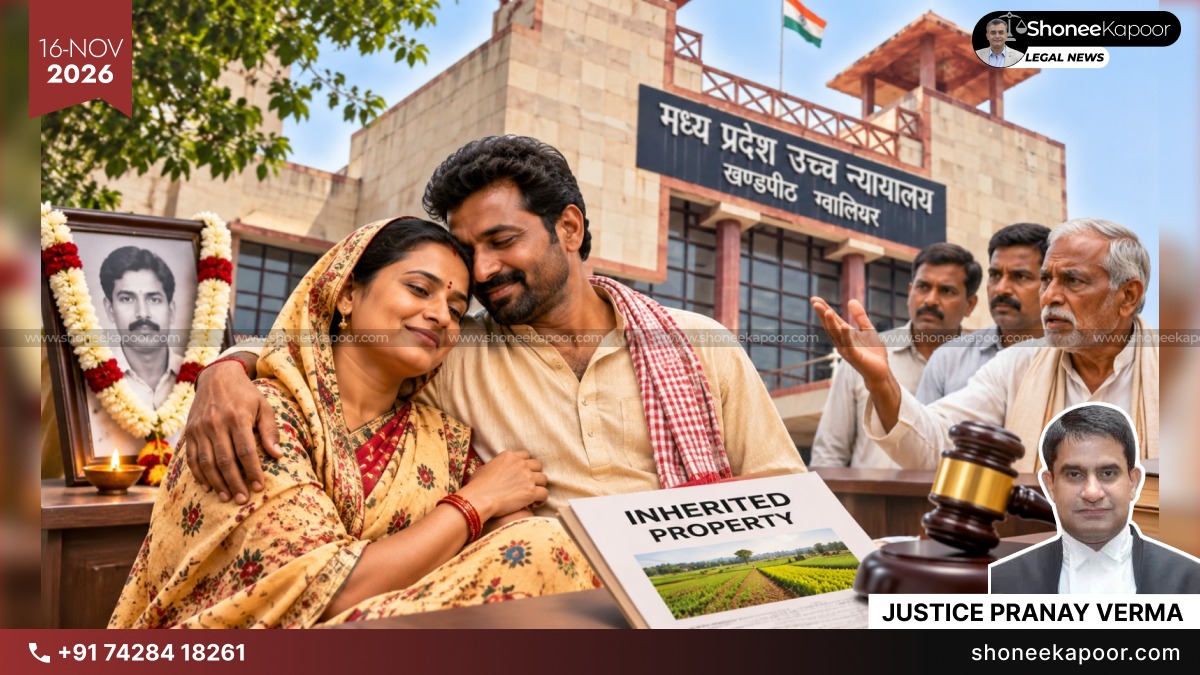
Can A Widow Lose Her Inherited Property If She Lives With Another Man After Her Husband’s Death? Madhya Pradesh High Court Answers

Curated by NEWS DESK
Editorial DeskMADHYA PRADESH: The Madhya Pradesh High Court has ruled that a widow cannot lose property inherited from her deceased husband merely because she later starts living with another man.
Justice Pranay Verma dismissed a second appeal filed by the defendants and upheld the widow's 1/3rd share in the disputed agricultural land.
The dispute involved land originally owned by a man who had four sons.
The plaintiff was first married to one of the sons, who died without children in 1950. Following caste customs, she later married his brother and had a daughter.
After her second husband's death, the widow began living with another brother of the deceased as his wife. However, the man was already married, and there was no evidence that his earlier marriage had been legally dissolved under customary practices.
The widow claimed that she inherited a 1/3 share in the family land after her second husband's death and that her name was recorded in the revenue records.
She alleged that the defendants later partitioned the land among themselves, excluding her share.
The defendants argued that since the widow had started living with another man as his wife, she could not separately claim inheritance through her deceased husband. They also questioned her entitlement on the ground of alleged unchastity.
The Civil Judge, Nagod, allowed the widow's claim on 4 April 1989. The District Judge, Satna, upheld the decision on 25 November 1993.
The defendants then approached the High Court by way of a second appeal under Section 100 CPC.
On 22 December 2009, the High Court admitted the appeal on two substantial questions of law concerning whether the plaintiff continued to be the widow of her deceased husband and whether her alleged subsequent unchastity affected her inheritance rights.
Examining the evidence, the High Court found that the other man's first wife was alive when the widow allegedly began living with him. The defendants had failed to prove any customary divorce between the man and his first wife.
The Court held that the widow's alleged subsequent marriage was not legally valid under the Hindu law applicable at the relevant time. Therefore, she retained her legal status as the deceased husband's widow.
The Court further noted that the widow had started living with the other man only several years after her husband's death.
Referring to Paragraph 96 of Mulla's Hindu Law, 25th Edition, the Court explained that under the applicable pre-1956 Hindu law, a widow's eligibility to inherit depended on her position at the time of her husband's death.
Once the property had legally vested in her, subsequent unchastity could not take away that inheritance.
The Court held that the widow had inherited her deceased husband's estate as a limited owner and subsequently became its absolute owner under the Hindu Succession Act, 1956.
Finding no illegality or perversity in the concurrent findings of the lower courts, the High Court upheld the widow's 1/3rd ownership share.
On 2 November 2026, the Court dismissed the appeal, deciding both substantial questions of law against the defendants. No costs were imposed.
EXPLANATORY TABLE OF LAWS AND SECTIONS
| Law / Section | What It Means | Application In This Case |
|---|---|---|
| Section 100, Code of Civil Procedure, 1908 | Allows a second appeal before the High Court on substantial questions of law. | Defendants challenged the lower courts' decisions granting Savitri a 1/3rd share. |
| Hindu Succession Act, 1956 | Governs inheritance and succession among Hindus. | The Court held that Savitri's inherited limited estate became absolute ownership after the Act came into force. |
| Pre-1956 Hindu Law | Earlier Hindu inheritance principles applicable before the 1956 legislation. | Used to determine Savitri's inheritance rights at the time of Lalli's death. |
| Paragraph 96, Mulla's Hindu Law, 25th Edition | Explains the historical rule concerning a widow's unchastity and inheritance rights. | Subsequent unchastity could not divest an estate the widow had already inherited. |
| Customary Marriage and Divorce | Recognises certain community marriage and divorce practices where legally established. | No customary divorce between Saheba and Kamli was proved, making his alleged marriage to Savitri invalid. |
CASE DETAILS
| Particular | Details |
|---|---|
| Case Title | Sahaba @ Sahab & Ors. v. Smt. Savitri & Ors. |
| Court | Madhya Pradesh High Court, Jabalpur |
| Jurisdiction | Civil Appellate Jurisdiction |
| Bench | Justice Pranay Verma |
| Case Number | Second Appeal No. 2 of 1994 |
| CNR Number | MPHC010139011994 |
| Appellants | Sahaba @ Sahab & Others |
| Respondents | Smt. Savitri & Others |
| Appellants' Counsel | Shri Ranno Rajak, Advocate |
| Respondents' Counsel | None appeared |
| Trial Court | Civil Judge Class-I, Nagod, District Satna |
| Trial Court Judgment | 4 April 1989 |
| First Appellate Court | District Judge, Satna |
| First Appeal Judgment | 25 November 1993 |
| Appeal Admitted | 22 December 2009 |
| Judgment Reserved | 1 July 2026 |
| Judgment Pronounced | 2 November 2026 |
| Decision | Second appeal dismissed; widow's 1/3rd share upheld; no costs |
KEY TAKEAWAYS
- Widow Keeps Property Despite Another Relationship: Living with another man did not cost her a single share of her inherited land.
- Husband's Family Loses Decades-Long Battle: After over 30 years of litigation, the family's challenge failed, and the widow retained her 1/3rd share.
- Another Man, Same Inheritance Rights: The Court held that her subsequent relationship could not destroy property rights already vested in her.
- Unchastity Argument Rejected: Even allegations about the widow's personal conduct failed to defeat her legally acquired inheritance.
- Decades in Court, Family Walks Away Empty-Handed: The High Court dismissed the appeal, leaving the defendants without the disputed 1/3rd share or relief they sought.
Share Your Thoughts
Comments are moderated before publication.