
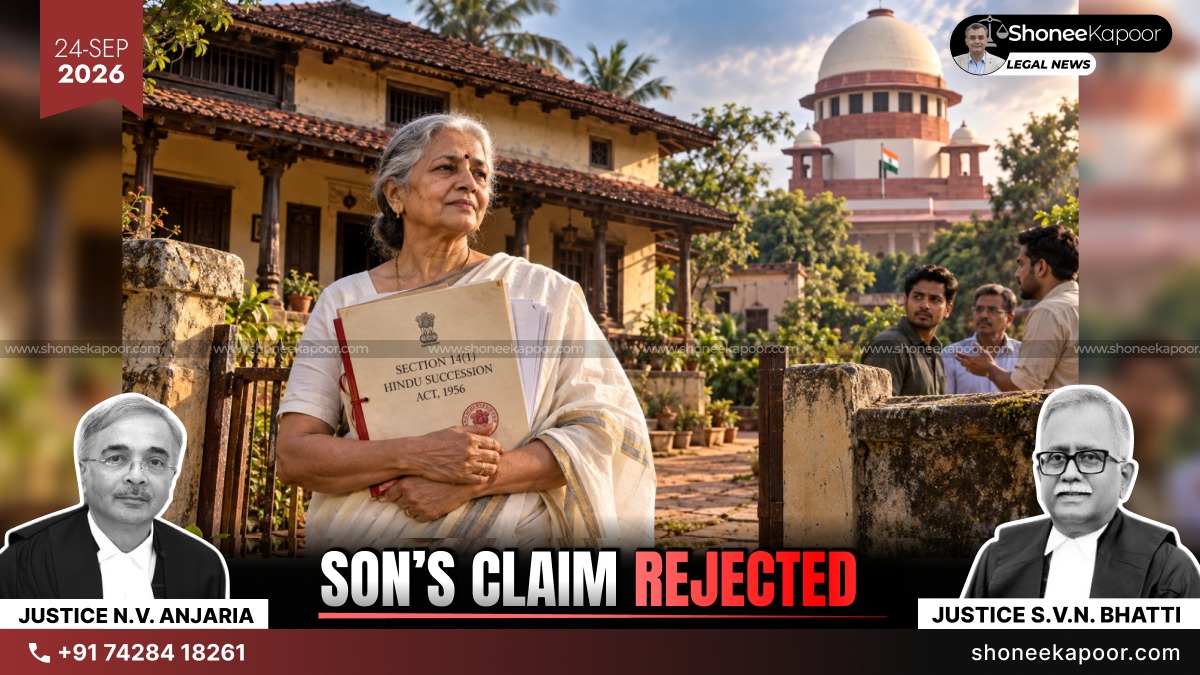
Hindu Widow Becomes Absolute Owner Of Her Share In Husband’s Property Even Without Partition: Supreme Court Rejects Son’s Exclusive Claim

Curated by NEWS DESK
Editorial DeskNEW DELHI: The Supreme Court has held that a Hindu widow’s limited interest in her deceased husband’s property can become her absolute ownership under Section 14(1) of the Hindu Succession Act, 1956, even if there was no formal partition of the property.
A Bench of Justice S.V.N. Bhatti and Justice N.V. Anjaria dismissed an appeal arising from a long-running property dispute involving the estate of Gangaram, who died in 1949. The case concerned competing property rights between his son Ganapati, from his first wife, and his second wife, Kashibai.
Ganapati claimed that after his father’s death, he alone succeeded to the estate as the surviving male coparcener and became its absolute owner. Kashibai’s side, however, asserted her right in the property as Gangaram’s widow.
The dispute involved house properties bearing TMC Nos. 1074 and 1075 at Terdal Village, Jamkhandi Taluka, Bagalkot District, Karnataka. Kashibai died in 1986. Before her death, she had executed a registered Will dated 13 October 1984 in favour of her daughter. The daughter later got the properties mutated in her name and subsequently sold one of the properties to a third party.
The Trial Court ruled in Ganapati's favour. It held that Kashibai had acquired only a limited interest under the Hindu Women’s Rights to Property Act, 1937, and because she had not sought partition, that interest had not become absolute ownership. The First Appellate Court upheld this view.
However, the Karnataka High Court, Dharwad Bench, reversed those findings. It held that Kashibai had acquired a statutory interest in her husband’s property and that this interest became absolute under Section 14(1) of the Hindu Succession Act, 1956. Consequently, she was legally capable of dealing with that property and executing the Will.
The matter then reached the Supreme Court.
The Supreme Court held that the law consistently recognises a Hindu widow's limited right as capable of “blossoming into an absolute right”, except where the case falls within Section 14(2) of the Hindu Succession Act.
The Court explained that Kashibai had acquired her husband’s interest under the 1937 Act. Section 14(1) of the 1956 Act then enlarged that limited interest into absolute ownership.
Importantly, the Supreme Court rejected the argument that Kashibai first needed to obtain a formal partition before her right could become absolute. It held that partition was “not a sine qua non” to continue enjoying the property as an independent or absolute owner.
The Court further clarified that even if no partition had taken place in the undivided property, this could affect the precise shares but could not result in “denial of a right.”
The Supreme Court relied upon earlier precedents including V. Tulasamma v. Sesha Reddy and Raghubar Singh v. Gulab Singh, which recognised that a Hindu woman’s pre-existing property and maintenance rights must receive the wider protection intended by Section 14(1). The Court reiterated that the expression “possessed by” under Section 14(1) has a wide meaning and is not restricted only to actual physical possession.
Finding no reason to interfere with the Karnataka High Court judgment, the Supreme Court dismissed the Civil Appeal. The Court did not order costs.
EXPLANATORY TABLE OF LAWS AND SECTIONS
| Law / Section | What It Means | Relevance In This Case |
|---|---|---|
| Section 3(1), Hindu Women’s Rights to Property Act, 1937 | Dealt with a widow’s succession rights in property where a Hindu man died intestate. | The Supreme Court recognised Kashibai’s statutory right arising after Gangaram’s death. |
| Section 3(2), Hindu Women’s Rights to Property Act, 1937 | Gave the widow, in specified circumstances, the same interest in joint family property that her husband had. | Kashibai acquired her deceased husband’s interest subject to the nature of the widow’s estate under the 1937 Act. |
| Section 3(3), Hindu Women’s Rights to Property Act, 1937 | Characterised the widow’s interest under the Act as a limited Hindu woman’s estate, while giving her a right to claim partition. | The lower courts treated absence of partition as crucial; the Supreme Court did not accept partition as a prerequisite for enlargement under Section 14(1). |
| Section 14(1), Hindu Succession Act, 1956 | Converts qualifying property possessed by a Hindu female into property held by her as full owner, not merely a limited owner. | This was the central provision. Kashibai’s limited interest became an absolute right. |
| Section 14(2), Hindu Succession Act, 1956 | Creates an exception where property is acquired for the first time through specified instruments imposing a restricted estate. | The Court noted that Section 14(2) is an exception to the broad operation of Section 14(1). |
| Section 100, Code of Civil Procedure, 1908 | Governs second appeals to a High Court on substantial questions of law. | The Supreme Court held that the Karnataka High Court’s exercise of second appellate jurisdiction was within Section 100 CPC. |
CASE DETAILS
| Particular | Details |
|---|---|
| Case Title | Ganapati (Dead) By His LRs v. Prabhakar & Others |
| Court | Supreme Court of India |
| Case Number | Civil Appeal No. 660 of 2019 |
| Neutral Citation | 2026 INSC 1033 |
| Decision Date | 22 September 2026 |
| Bench | Justice S.V.N. Bhatti and Justice N.V. Anjaria |
| Judgment By | Justice S.V.N. Bhatti |
| Impugned Judgment | Karnataka High Court, Circuit Bench at Dharwad, R.S.A. No. 551 of 2007, dated 19 July 2012 |
| For Appellants | Mr. Anil Katarki, Advocate; Ms. E.R. Sumathy, AOR; Mrs. Veena Katarki, Advocate; Mr. Deva Vrat Anand, Advocate |
| For Respondents | Mr. Shanthkumar V. Mahale, Senior Advocate; Ms. Jahanvi Malik, Advocate; Mr. Shreyas Mahale, Advocate; Mr. Adviteeya, Advocate; Mr. Madhvendra Singh, Advocate; Mr. Harisha S.R., AOR |
| Result | Civil Appeal dismissed; no order as to costs |
KEY TAKEAWAYS
- A son’s inheritance claim cannot override a widow’s statutory property rights merely because she never sought partition.
- A widow’s legally acquired limited interest can become absolute ownership under Section 14(1) of the Hindu Succession Act.
- No formal partition is necessary for that existing limited right to mature into absolute ownership.
- Male heirs cannot assume exclusive ownership simply because property remained undivided or the widow did not separately claim her share.
- The Supreme Court dismissed the son’s appeal, reinforcing that inheritance rights of male heirs remain subject to the widow’s legally vested property rights.
Share Your Thoughts
Comments are moderated before publication.