
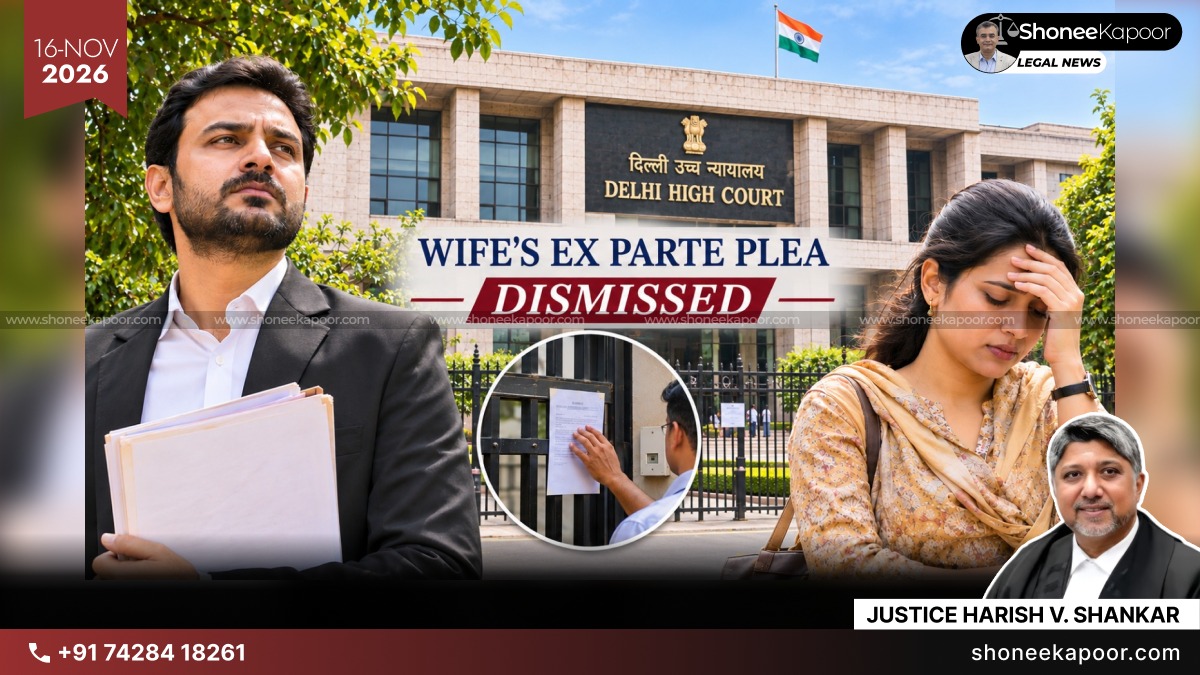
Wife Skips Counselling Despite Summons, Seeks Ex Parte Order Recall After 15 Months: Delhi High Court Rejects Her Plea

Curated by NEWS DESK
Editorial DeskNEW DELHI: The Delhi High Court has dismissed a wife's petition seeking to recall an ex parte order in a matrimonial case, holding that the nature of matrimonial proceedings cannot justify ignoring valid court summons or reopening proceedings without sufficient grounds.
Justice Harish Vaidyanathan Shankar upheld the Family Court's refusal to recall the order against the wife, who approached the court nearly 15 months after being proceeded against ex parte in a case filed by her husband.
The husband had initiated proceedings under the Hindu Marriage Act before the Family Court at Tis Hazari Courts, Delhi.
Court records showed that summons sent to the wife through speed post were returned unserved. On 6 March 2024, a process server reported that the wife personally refused to accept the summons, following which they were pasted on the main gate of her residence.
On 5 July 2024, another process server visited her address. Her mother informed him that the wife was away and refused to accept the summons. The summons was again affixed at the premises.
Despite the Family Court treating the service as valid, the wife did not appear for matrimonial counselling. Consequently, on 10 September 2024, the Family Court proceeded ex parte against her.
The husband subsequently submitted his evidence affidavit on 12 November 2024 and examined three additional witnesses on 21 November 2025. The matter then reached the stage of ex parte final arguments.
However, on 20 December 2025, the wife sought to recall the order. The Family Court rejected her application on 1 October 2026.
Challenging this decision before the Delhi High Court under Article 227 of the Constitution, the wife argued that her mother's refusal to accept summons could not amount to valid service upon her. She also questioned the legality of affixing the summons and requested an opportunity to file her written statement.
The High Court noted that the Family Court had already examined the process servers' reports, previous orders and the wife's conduct before concluding that service was valid under Order V Rules 15 and 17 CPC.
The Court noted that the summons were validly served after examining the complete sequence of events, process server reports and evidence on record, rather than relying on any single incident.
The High Court further held that its supervisory jurisdiction under Article 227 could not be used to reconsider the same evidence merely because another conclusion might be possible.
It stated:
“This Court cannot be called upon to undertake a second round of adjudication on the question of service, particularly when the learned Family Court has considered the same and recorded reasons in support of its conclusion.”
The Court also rejected the argument that the matrimonial nature of the dispute alone justified another opportunity.
It observed:
“However, the nature of the proceedings, by itself, cannot be a ground to disregard the procedural history of the case or to unsettle findings which have been returned by the learned Family Court after due consideration of the material on record.”
Referring to the Supreme Court's decision in Bhuwan Mohan Singh v. Meena & Ors. (2015), the High Court emphasised that matrimonial disputes should be decided without unnecessary delays.
It stated:
“While such observations cannot dispense with the requirement of ensuring due process, they reinforce the need for proceedings before Family Courts to be conducted with due expedition and without avoidable delays.”
The Family Court had also relied on the Supreme Court's observations regarding delay in matrimonial litigation and concluded:
“Dilatory tactics are not to be encouraged as held by Hon'ble Supreme Court.”
Finding no jurisdictional error, patent illegality or perversity in the Family Court's decision, the Delhi High Court dismissed the wife's petition along with the pending applications.
EXPLANATORY TABLE OF LAWS AND SECTIONS
| Law / Section | What It Means | Application In This Case |
|---|---|---|
| Article 227, Constitution of India | Gives High Courts supervisory powers over subordinate courts. | Wife challenged the Family Court's refusal to recall the ex parte order. |
| Hindu Marriage Act, 1955 | Governs matrimonial reliefs for marriages covered by the Act. | Husband initiated matrimonial proceedings under this Act. |
| Order V Rule 15 CPC | Provides for service on an eligible adult family member in specified circumstances. | Family Court considered the process server's report involving the wife's mother. |
| Order V Rule 17 CPC | Permits affixation of summons when statutory conditions are satisfied. | Summons were affixed after reported refusals to accept service. |
| Order IX Rule 7 CPC | Allows an ex parte defendant to seek participation upon showing good cause before the proceedings reach the relevant stage. | Family Court considered the wife's delayed recall request under this provision. |
| Order IX Rule 13 CPC | Provides for setting aside an ex parte decree on specified grounds. | Wife initially invoked this provision, although the matter was still at the ex parte proceedings stage. |
| Section 125 CrPC | Provides for maintenance of eligible dependants. | Mentioned in the Supreme Court precedent cited on delays in matrimonial proceedings; not the substantive claim in this case. |
CASE DETAILS
| Particular | Details |
|---|---|
| Case Title | Purnima @ Neha v. Gagan Kumar |
| Court | Delhi High Court, New Delhi |
| Bench | Justice Harish Vaidyanathan Shankar |
| Judgment Authored By | Justice Harish Vaidyanathan Shankar |
| Neutral Citation | 2026:DHC:10013 |
| Judgment Date | 6 November 2026 |
| Case Number | CM(M) 2457/2026 |
| Connected Application | CM APPL. 78276/2026 (Stay) |
| CNR Number | DLHC010543822026 |
| Family Court Case | HMA No. 1929/2022 |
| Family Court | Principal Judge, Family Court (West), Tis Hazari Courts, Delhi |
| Wife's Counsel | Advocate Amit Singh, through video conferencing |
| Final Decision | Wife's petition dismissed; Family Court's refusal to recall the ex parte order upheld |
KEY TAKEAWAYS
- Ignoring Court Summons Has Consequences: A wife cannot avoid proceedings and later demand another chance without sufficient grounds.
- Matrimonial Cases Are No Exception: Being a family dispute does not justify ignoring court procedures.
- Husband's Time Matters Too: Unnecessary delays prolong litigation and affect the husband's right to timely justice.
- Ex Parte Orders Cannot Be Easily Recalled: Valid service and unexplained delays cannot be casually overlooked.
- Equal Accountability For Both Spouses: Courts must protect due process, not reward delaying tactics in matrimonial disputes.
Share Your Thoughts
Comments are moderated before publication.