
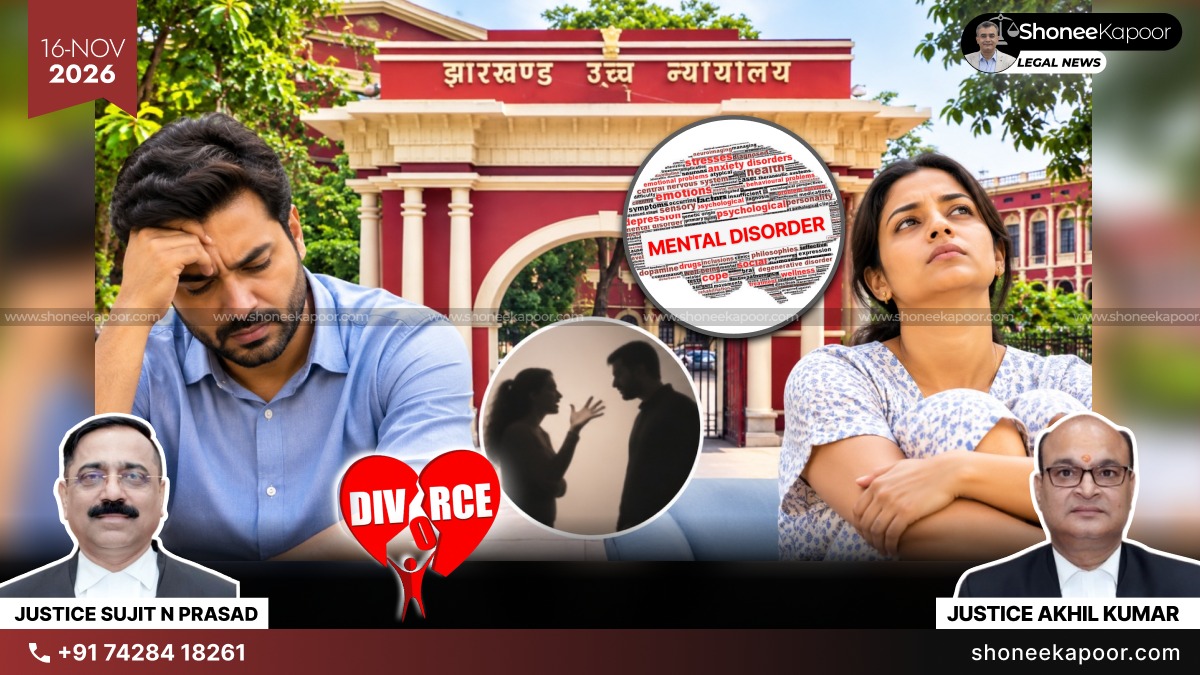
Husband Alleges Wife’s Schizophrenia And Mental Cruelty; Jharkhand HC Still Rejects Divorce Plea, Says ‘One Or Two Instances Not Enough’

Curated by NEWS DESK
Editorial DeskJHARKHAND: The Jharkhand High Court has dismissed a husband's divorce appeal, holding that one or two instances of alleged mental illness are insufficient to establish mental disorder as a ground for divorce under the Hindu Marriage Act, 1955.
A Division Bench of Justice Sujit Narayan Prasad and Justice Akhil Kumar upheld the Dhanbad Family Court's decision refusing divorce to the husband, who had alleged that his wife suffered from schizophrenia and subjected him to mental cruelty.
The couple married on 14 July 2021 in Dhanbad and later lived together in the United States. According to the husband, his wife disclosed after marriage that she had agreed to marry under pressure from her family.
He alleged that she behaved violently, avoided family members and suffered from mental health problems that her parents had concealed before marriage. He also claimed that their marriage was never consummated.
The husband further alleged that his wife had attempted suicide, behaved aggressively and threatened him with a knife. He claimed that her conduct caused him serious mental cruelty and made their married life difficult.
In January 2023, while the husband was preparing to travel to India following his father's death, his wife reportedly required hospital treatment in the United States. He claimed that she was suffering from a psychiatric disorder, including schizophrenia.
Read Also:- Supreme Court Defines what is Cruelty in Matrimonial Life fit for Divorce
The wife denied these allegations. She maintained that she did not suffer from any mental disorder and accused her husband and his family of causing her mental distress through repeated allegations about her mental health. She also expressed willingness to continue the marriage.
The husband approached the Dhanbad Family Court seeking divorce under Sections 13(1)(i-a) and 13(1)(iii) of the Hindu Marriage Act, citing cruelty and mental disorder.
On 16 December 2024, the Family Court dismissed his petition. He subsequently challenged the decision before the Jharkhand High Court.
Examining the legal requirements for divorce on the ground of mental disorder, the High Court observed:
“However, the mental disorder must be of such kind and extent that the Court needs to be satisfied that it is not advisable to ask the petitioner to live with the respondent. ... the period of illness must not be too short, or the petition should not be based on one or two instances showing such mental disorder.”
The Court explained that medical evidence and the seriousness of the alleged disorder must be examined before granting divorce. It also observed that expert psychiatric opinions are relevant under Section 45 of the Indian Evidence Act, but courts are not bound to accept them without scrutiny.
The husband relied on his testimony, another witness and hospital discharge papers from the United States. However, during cross-examination, he admitted that the documents did not mention schizophrenia and instead recorded “Altered Mental Status Unspecified”.
The High Court found that the husband had not produced reliable medical evidence establishing that his wife suffered from an incurable mental disorder or a psychiatric condition serious enough to make continued married life unreasonable.
The Court also found no sufficient evidence supporting his allegation that the wife had undergone psychiatric treatment since childhood or that her family had concealed such treatment before marriage.
Referring to the Supreme Court's decision in Kollam Chandra Sekhar v. Kollam Padma Latha (2014), the High Court emphasised that matrimonial relationships may involve illness and difficult periods, which do not automatically justify divorce.
Regarding mental cruelty, the Court noted that the husband's allegations of violent behaviour, a knife attack and suicide attempts were not supported by independent witnesses, police complaints or reliable medical records. One witness had largely relied on information heard from others.
The Bench concluded that the husband had failed to prove either matrimonial cruelty or a mental disorder meeting the statutory requirements for divorce.
Accordingly, the Jharkhand High Court dismissed the husband's divorce appeal, upholding the Family Court's refusal to dissolve the marriage.
EXPLANATORY TABLE OF LAWS AND SECTIONS
| Law / Section | What It Means | Application in This Case |
|---|---|---|
| Section 13(1)(i-a), Hindu Marriage Act, 1955 | Allows divorce on the ground of cruelty, including mental cruelty. | Husband alleged violent behaviour and mental cruelty but failed to prove them. |
| Section 13(1)(iii), Hindu Marriage Act, 1955 | Allows divorce for incurable unsoundness of mind or a mental disorder of the required nature and severity. | Husband failed to establish a qualifying psychiatric condition. |
| Section 45, Indian Evidence Act, 1872 | Makes expert opinions, including medical opinions, relevant evidence. | Court discussed the importance and scrutiny of psychiatric evidence. |
| Section 19(1), Family Courts Act, 1984 | Provides for appeals against eligible Family Court judgments and orders. | Husband challenged the Family Court's refusal of divorce. |
| Section 96, Code of Civil Procedure, 1908 | Governs first appeals from original decrees, subject to applicable law. | Discussed in the context of appellate powers and review of evidence. |
CASE DETAILS
| Particular | Details |
|---|---|
| Case Title | Mayank Kumar v. Somya Kumari |
| Court | Jharkhand High Court, Ranchi |
| Bench | Justice Sujit Narayan Prasad and Justice Akhil Kumar |
| Judgment Date | 5 November 2026 |
| Neutral Citation | 2026:JHHC:32502-DB |
| Case Number | First Appeal No. 85 of 2025 |
| Appellant | Husband |
| Respondent | Wife |
| Husband's Counsel | Advocate Pandey Neeraj Rai and Advocate Saurabh Sagar |
| Original Suit | Original Suit No. 288 of 2023 |
| Family Court | Additional Principal Judge, Additional Family Court No. II, Dhanbad |
| Family Court Judgment | 16 December 2024 |
| Family Court Decree | Signed on 21 December 2024 |
| Judgment Reserved | 23 September 2026 |
| Decision | Husband's divorce appeal dismissed; Family Court judgment upheld |
KEY TAKEAWAYS
- Husband Denied Divorce: Jharkhand HC rejected his plea despite allegations of serious marital difficulties.
- Wife’s Schizophrenia Not Proved: Husband failed to establish the alleged mental disorder through reliable medical evidence.
- Mental Cruelty Not Established: Allegations of violence, threats and suicide attempts lacked sufficient proof.
- Hospital Records Insufficient: Medical documents alone could not establish a legal ground for divorce.
- Husband’s Burden of Proof: Even serious allegations cannot secure divorce unless supported by credible evidence.
Share Your Thoughts
Comments are moderated before publication.