
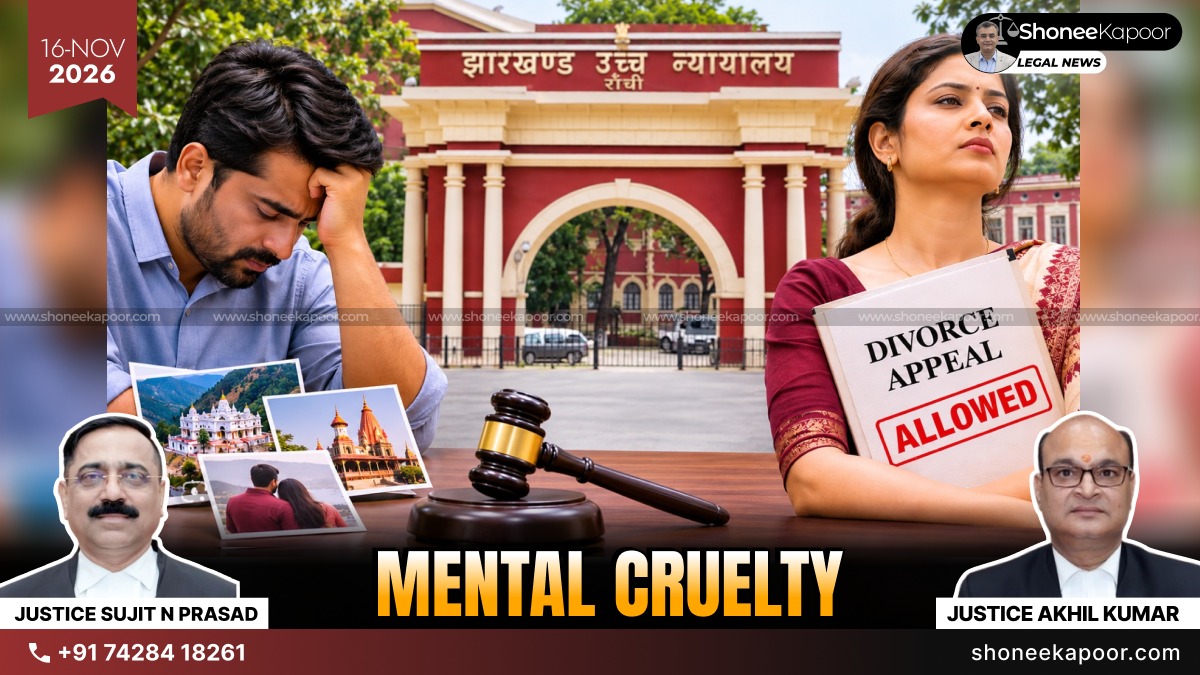
Can Photos Of Husband And Wife Together Or Family Outings Disprove Matrimonial Cruelty Allegations? Jharkhand High Court Answers

Curated by NEWS DESK
Editorial DeskJHARKHAND: The Jharkhand High Court has allowed a wife's divorce appeal, holding that occasional religious visits, family functions and photographs of a couple together cannot automatically disprove allegations of matrimonial cruelty.
A Division Bench of Justice Sujit Narayan Prasad and Justice Akhil Kumar set aside the Palamau Family Court's decision rejecting the wife's divorce petition under the Hindu Marriage Act, 1955.
The couple entered into a love marriage on 15 February 2015, registered their marriage in May 2015 and later performed a social marriage ceremony on 27 February 2016.
The wife alleged that her husband subjected her to physical and mental cruelty, demanded ₹5 lakh and a car as dowry, and took away jewellery worth ₹10 lakh. She also claimed that he abused her family members and forced her to live separately.
The husband denied the allegations. He maintained that his wife voluntarily stayed at her parental home and refused to return despite his efforts to continue the marriage.
To challenge the cruelty allegations, he relied on their visits to Vaishno Devi, Ujjain and other places, along with family celebrations and photographs. He also stated that he had filed a petition seeking restitution of conjugal rights under Section 9 of the Hindu Marriage Act.
The wife approached the Palamau Family Court seeking divorce on the grounds of cruelty and desertion. On 30 April 2026, the Family Court dismissed her petition.
She subsequently challenged that decision before the Jharkhand High Court.
The High Court observed that the couple's participation in religious visits and family functions could not be treated as conclusive evidence that the husband had never committed cruelty.
The Bench stated:
"A matrimonial relationship may remain outwardly cordial on certain occasions and yet one spouse may be subjected to humiliation, harassment and mental agony during the course of ordinary matrimonial life. Occasional visits to religious places, participation in family functions or photographs taken during celebrations cannot automatically neutralise the effect of other acts of cruelty."
The Court explained that matrimonial cruelty must be assessed from the entire evidence, rather than isolated happy occasions in a marriage.
The Bench also considered the testimony of the wife, her mother and her maternal uncle, alongside the evidence produced by the husband and his witnesses.
It noted that matrimonial proceedings follow the standard of preponderance of probabilities, rather than the criminal standard of proof beyond reasonable doubt.
The Court further examined the husband's earlier restitution of conjugal rights petition, which had been dismissed by the Family Court after finding that the wife had reasonable grounds to withdraw from his company.
However, the High Court clarified that dismissal of a restitution petition does not automatically establish a ground for divorce.
The Bench found that the Family Court had given excessive importance to photographs, temple visits and family gatherings without adequately examining the cumulative effect of the wife's allegations and supporting testimony.
The High Court ultimately concluded that the husband's conduct, considered as a whole, amounted to matrimonial cruelty under Section 13(1)(i-a) of the Hindu Marriage Act.
Accordingly, the Court set aside the Family Court's judgment dated 30 April 2026 and the decree dated 7 May 2026, allowing the wife's divorce appeal.
EXPLANATORY TABLE OF LAWS AND SECTIONS
| Law / Section | What It Means | Application in This Case |
|---|---|---|
| Section 13(1)(i-a), Hindu Marriage Act, 1955 | Allows divorce on grounds of physical or mental cruelty. | High Court found that the husband's conduct amounted to matrimonial cruelty. |
| Section 13(1)(i-b), Hindu Marriage Act, 1955 | Allows divorce for desertion lasting at least two continuous years before the petition is filed. | The court examined the circumstances behind the wife's separation and found reasonable cause for leaving. |
| Section 9, Hindu Marriage Act, 1955 | Allows a spouse to seek restitution of conjugal rights. | The Family Court dismissed the husband's petition. |
| Section 13, Explanation, Hindu Marriage Act | Defines desertion, including separation without reasonable cause and wilful neglect. | The court considered whether the wife's separation was justified. |
| Section 7, Family Courts Act, 1984 | Defines the jurisdiction of Family Courts over matrimonial disputes. | Relevant to the Family Court's authority to decide the divorce petition. |
| Section 19(1), Family Courts Act, 1984 | Provides for appeals against eligible Family Court judgments and orders. | Wife challenged the rejection of her divorce petition. |
| Section 96, Code of Civil Procedure, 1908 | Governs appeals from original civil decrees. | Discussed while explaining appellate powers. |
| Section 3, Indian Evidence Act, 1872 | Defines evidence and the concept of a fact being proved. | Relevant to the standard of proof in matrimonial disputes. |
| Sections 323, 379, 498A, 504 and 506, IPC | Concerned hurt, theft, cruelty by husband or relatives, intentional insult and criminal intimidation, respectively. | Husband stated that a separate criminal complaint had been filed against him under these provisions. The judgment does not determine guilt in that complaint. |
CASE DETAILS
| Particular | Details |
|---|---|
| Case Title | K. v. V |
| Court | Jharkhand High Court, Ranchi |
| Bench | Justice Sujit Narayan Prasad and Justice Akhil Kumar |
| Judgment Date | 5 November 2026 |
| Neutral Citation | 2026: JHHC:32533-DB |
| Case Number | First Appeal No. 273 of 2026 |
| Appellant | Wife |
| Respondent | Husband |
| Wife's Counsel | Advocate Amit Kumar Chaturvedi |
| Husband's Counsel | Advocates Arbind Kumar, Prem Prakash and Sakshi Diksha |
| Original Suit | Original Suit No. 61 of 2022 |
| Family Court | Principal Judge, Family Court, Palamau at Daltonganj |
| Family Court Judgment | 30 April 2026 |
| Family Court Decree | 7 May 2026 |
| Judgment Reserved | 6 October 2026 |
| Related Proceeding | Original Suit No. 07 of 2023, under Section 9 of the Hindu Marriage Act |
| Decision | Wife's appeal allowed; Family Court judgment and decree set aside |
KEY TAKEAWAYS
- Wife Granted Divorce: Jharkhand HC overturned the Family Court's decision and granted divorce on grounds of cruelty.
- Husband's Evidence Insufficient: Temple visits, family photographs and celebrations could not automatically disprove cruelty.
- Husband's Reconciliation Efforts: His willingness to continue the marriage did not defeat the wife's cruelty claim.
- Cruelty Requires Judicial Scrutiny: Courts must examine the complete evidence, not merely isolated happy moments.
- Men's Rights Concern: A husband's defence and reconciliation efforts deserve fair consideration, with allegations of cruelty tested against the evidence.
Share Your Thoughts
Comments are moderated before publication.