
Does a delayed FIR with contradictory allegations and no independent witnesses justify criminal proceedings against a father during child visitation?
The Court said no and quashed the case, calling continuation of the prosecution an abuse of process.
KOLKATA: The Calcutta High Court, through Justice Dr. Ajoy Kumar Mukherjee, quashed a criminal case filed against a father who was accused of assaulting his minor son during a court-approved visitation meeting.
The Court held that the allegations were contradictory, unsupported by independent evidence, and appeared to be part of an ongoing matrimonial dispute between the husband and wife.
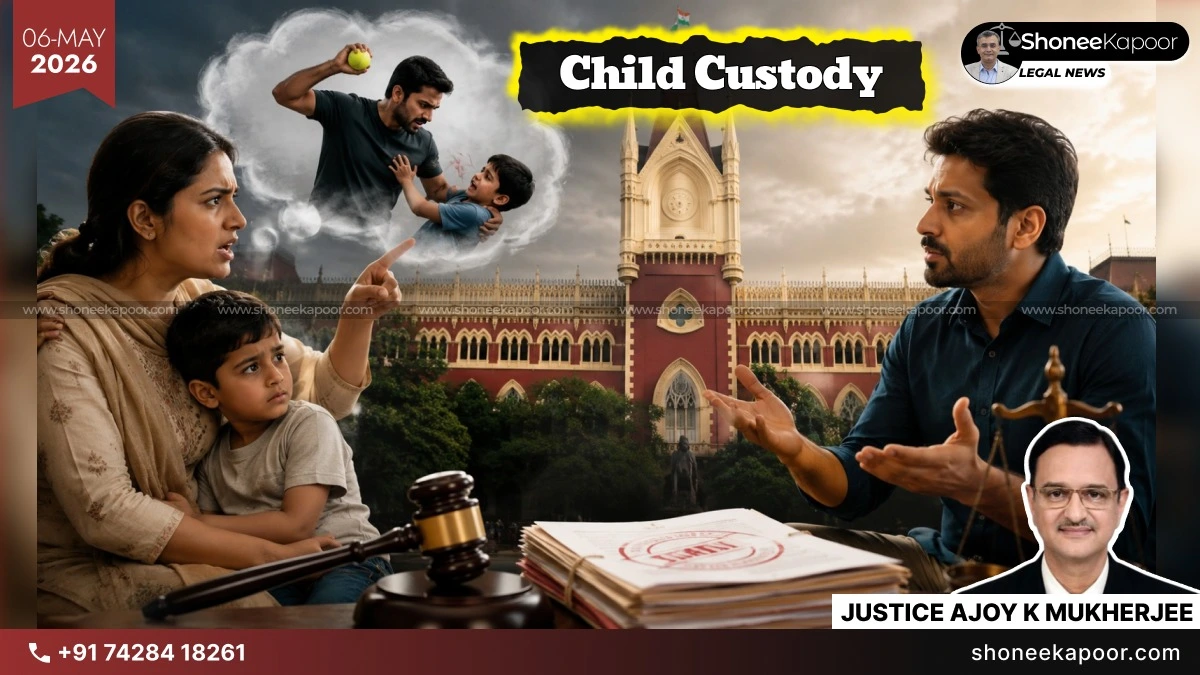
The case was filed by the wife after an incident that allegedly took place on March 1, 2025, inside the Burdwan Court premises. The husband had earlier received visitation rights to meet his six-year-old son under an order passed in a guardianship case.
According to the complaint, the child said he was feeling sleepy during the meeting, after which the father allegedly became angry, dragged the child down the staircase, and later threw a tennis ball at him, causing injury. The wife also claimed that she was pushed during the incident.
The husband challenged the FIR before the High Court and argued that the allegations were false and made only to stop him from meeting his child. He told the Court that the wife had already filed several cases against him and was trying to break the bond between the father and son. He also pointed out that there were major contradictions between the wife’s application filed before the District Judge and the later FIR based on the same incident.
The Court carefully examined the FIR, witness statements, medical papers, and the application filed before the District Court. It noticed that the versions given in different documents were not consistent with each other.
The Court also observed that only two witnesses supported the prosecution — the complainant’s father, who was not present at the spot, and the complainant’s lawyer who had earlier appeared in court seeking suspension of the father’s visitation rights. No independent witness from the crowded court premises was produced by the prosecution.
While discussing the offences alleged against the father, the Court explained that criminal intention is an essential requirement in such cases. The Court found no material showing that the father had any intention to harm his own child. Justice Mukherjee observed:
“The entire allegation even if accepted in toto, at best suggests a momentary reaction during an emotionally charged visitation, which by no stretch of imagination can be equated with the requisite criminal intent.”
The High Court further stated that:
“The allegations made by the complainant in different places are not only contradictory but also vague, omnibus and devoid of particulars necessary to constitute cognizable offence.”
The Court also raised concern over the three-day delay in filing the FIR and noted that the delay had not been properly explained. According to the Court, there were reasons to believe that sufficient time was taken “to deliberate and embellish the story before setting the criminal law in motion.”
Relying on the famous Supreme Court judgment in Bhajanlal v. State of Haryana, the High Court said criminal proceedings can be quashed when allegations are absurd, malicious, or fail to disclose any offence. Justice Mukherjee strongly remarked that:
“It is wholly unnatural and against human conduct that a father, during a court sanctioned visitation, would deliberately assault his own minor child.”
The Court further referred to the Supreme Court decision in Hazi Iqbal Md. Vs. State of UP and observed that false criminal allegations arising out of personal vengeance can seriously damage the life and reputation of an accused person. The judgment noted that:
“General omnibus and frivolous allegation, if left unchecked, would not only result in misuse of the process of law but a criminal trial leading to an eventual acquittal would inflict severe scars upon the accused.”
Finally, the Court concluded that continuing the criminal case would be nothing but an abuse of the legal process. The criminal proceedings pending before the Burdwan Judicial Magistrate Court were therefore quashed by the High Court.
Explanatory Table: Laws & Sections Involved
| Law / Section | Purpose | How It Applied in This Case |
| Section 126(2), Bharatiya Nyaya Sanhita (BNS), 2023 | Punishment for wrongful restraint — stopping someone from going where they legally have a right to go | Police alleged the father wrongfully restrained or dragged the child |
| Section 115(2), BNS, 2023 | Voluntarily causing hurt | Allegation that the father caused injury by throwing a tennis ball |
| Section 352, BNS, 2023 | Intentional insult intended to provoke breach of peace | Allegation that the complainant was abused and insulted |
| Section 25, Guardians and Wards Act, 1890 | Custody and visitation rights relating to children | Father had obtained visitation rights through this provision |
| Protection of Women from Domestic Violence Act | Law protecting women from domestic violence | Separate proceedings between husband and wife were already pending |
| Section 74(1)(iii), Indian Evidence Act | Public documents issued by government authorities | Used to argue that hospital injury report carried legal value |
| Section 119, Bharatiya Sakshya Adhiniyam (BSA) | Presumption regarding official acts being properly done | Relied upon regarding medical documents |
| Section 134, Indian Evidence Act | Quality of evidence matters more than quantity | Used by complainant to defend limited witnesses |
| Section 161 Cr.P.C. | Statements recorded by police during investigation | Witness statements were examined by the High Court |
| Section 482 Cr.P.C. | High Court’s inherent power to quash criminal proceedings | Basis for seeking quashing of FIR and proceedings |
| Section 156(1) Cr.P.C. | Police power to investigate cognizable offences | Discussed in Bhajanlal guidelines |
| Section 155(2) Cr.P.C. | Magistrate permission needed for non-cognizable offences | Mentioned in Supreme Court guidelines for quashing |
Case Details
- Case Title: Subhadeep Chakraborty Vs. The State of West Bengal & Anr.
- Court: Calcutta High Court
- Case Number: CRR 4122 of 2025
- Bench: Dr. Justice Ajoy Kumar Mukherjee
- Neutral Citation: 2026:CHC-AS:660
- Date of Judgment: 04.05.2026
- Counsels:
- For Petitioner: Mr. Jayanta Narayan Chatterjee, Ms. Ameena Kabir, Mr. Nirmalya Dutta, Ms. Moumita Pandit, Mr. R. Banerjee
- For Opposite Party No. 2: Mr. Soumya Basu Roy Chowdhury, Mr. Sarbananda Sanyal, Mr. Saikat Gayen
- For State: Mr. Joydeep Roy, Ms. Snigdha Saha
Key Takeaways
- False allegations during matrimonial disputes are increasingly being used to emotionally and legally isolate fathers from their own children.
- Mere accusations without independent evidence should never become a weapon to destroy a man’s dignity, fatherhood, and mental peace.
- Courts are finally recognising that criminal law cannot be misused to settle personal revenge in custody and visitation battles.
- Delayed FIRs, contradictory statements, and “interested witnesses” remain major red flags in many family-related criminal complaints against men.
- A child needs both parents, and denying a father-child bond through malicious litigation harms not just the man, but the child’s future as well.
This Could Change Your Case-Get FREE Legal Advice-Click Here!
Disclaimer: The views and opinions expressed in this article are those of the Indian courts and do not necessarily reflect the official policy or position of “ShoneeKapoor.com” or its affiliates. This article is intended for informational and educational purposes only. The content provided is not legal advice, and viewers should not act upon this information without seeking professional counsel. Viewer discretion is advised.
