
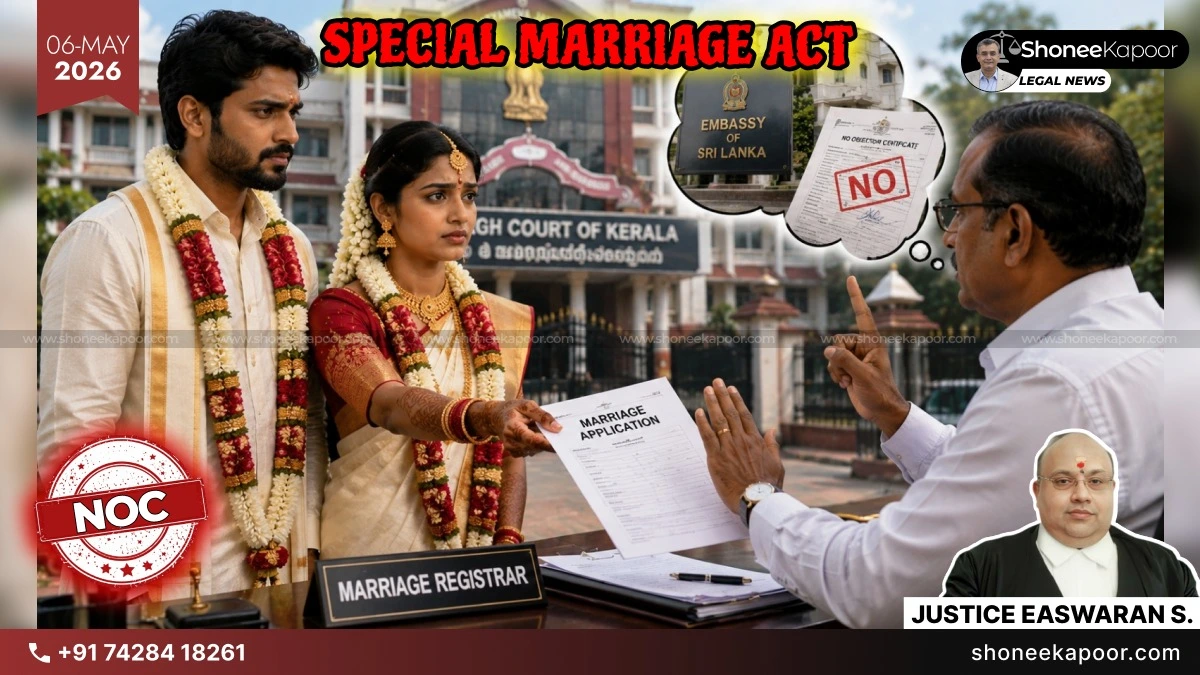
Can a marriage between an Indian citizen and a foreign national be denied merely because an Embassy NOC was not produced?
The Kerala High Court said No, holding that marriage authorities cannot impose arbitrary conditions beyond the requirements of the Special Marriage Act.
ERNAKULAM: The Kerala High Court, led by Justice Easwaran S., gave relief to an Indian man who wanted to marry a Sri Lankan woman under the Special Marriage Act, 1954. The Court made it clear that marriage officers cannot demand unnecessary documents from foreign nationals when the law itself does not require such conditions.
The petitioner approached the Court after the Marriage Officer and Sub Registrar at Mavelikara refused to process the marriage unless the Sri Lankan bride submitted a No Objection Certificate (NOC) from her Embassy. The man argued that this demand was illegal because the Kerala High Court had already clarified in an earlier judgment that such an NOC is not mandatory under law.
The case involved an Indian citizen who intended to marry a Sri Lankan national holding a valid passport and visa. The couple had already submitted the notice of intended marriage and supporting affidavits before the authorities.
However, the Sub Registrar allegedly refused to proceed further and insisted on an Embassy NOC before solemnising the marriage.
After hearing both sides, Justice Easwaran S. relied upon an earlier Kerala High Court judgment in Saranya R.A. v. State of Kerala. The Court observed that the law already settled the issue and there was no legal basis for demanding an Embassy NOC from the foreign bride.
The Court specifically stated:
“There cannot be any insistence on the part of the 2nd respondent which requires the petitioner to obtain a NOC from the Embassy.”
The Court further directed the authorities to process and solemnize the marriage without insisting on “the NOC from the Embassy as well as additional documents.”
Justice Easwaran S. finally ordered that the marriage process should be completed immediately after expiry of the statutory notice period under the Special Marriage Act.
The ruling is important for many inter-country couples facing unnecessary procedural hurdles from local marriage authorities, despite there being no such requirement under Indian law.
Explanatory Table: Laws And Provisions Involved
| Law / Section | Purpose | How Applied In This Case |
| Special Marriage Act, 1954 | A central Indian law allowing civil marriages between people of different religions or nationalities without religious ceremonies | The couple applied for marriage under this Act |
| Notice Of Intended Marriage | Mandatory public notice issued before solemnization of marriage under the Act | The petitioner had already submitted the required marriage notice |
| Statutory Notice Period | Waiting period prescribed before marriage can be formally solemnized | Court directed marriage to be completed immediately after expiry of this period |
| Embassy NOC (No Objection Certificate) | A document sometimes demanded by local authorities from foreign nationals stating the Embassy has no objection to the marriage | Court held that such NOC cannot be demanded when law does not require it |
| Affidavit Regarding Marital Status | Declaration confirming that the foreign national is unmarried and legally eligible to marry | Bride had already produced supporting affidavit and documents |
| Judicial Precedent | Earlier binding High Court rulings that subordinate authorities must follow | Court relied upon Saranya R.A. v. State of Kerala to reject the NOC demand |
Case Details
- Case Title: Vinu Vikraman v. State of Kerala & Another
- Court: Kerala High Court
- Case Number: W.P.(C) No. 15665 of 2026
- Bench: Justice Easwaran S.
- Neutral Citation: 2026:KER:33547
- Date of Judgment: 05 May 2026
- Counsels:
- For Petitioner: Sri. Harigovind S. Nair
- For Respondents: Sri. Imam Grigorious Karat, Government Pleader
Key Takeaways
- Marriage authorities cannot demand documents that are not specifically required under law.
- Foreign nationals marrying in India under the Special Marriage Act still have legal protection against arbitrary procedural hurdles.
- Valid passport, visa, affidavits, and statutory marriage documents are generally sufficient if legal requirements are already fulfilled.
- Administrative authorities are expected to follow existing legal precedents instead of creating extra conditions on their own.
- Civil marriage procedures should remain simple, lawful, and accessible for inter-country and inter-faith couples without unnecessary delays.
This Could Change Your Case-Get FREE Legal Advice-Click Here!
Disclaimer: The views and opinions expressed in this article are those of the Indian courts and do not necessarily reflect the official policy or position of “ShoneeKapoor.com” or its affiliates. This article is intended for informational and educational purposes only. The content provided is not legal advice, and viewers should not act upon this information without seeking professional counsel. Viewer discretion is advised.
