
Supreme Court Rejects Plea To Track Repeated Sexual Offence Complaints Over Privacy Concerns, But Who Protects Innocent Men From False Cases?

Curated by NEWS DESK
Editorial DeskNEW DELHI: The Supreme Court of India refused to entertain a petition filed by men's rights activist and legal consultant Shonee Kapoor, seeking a structured police database to identify persons filing repeated sexual offence complaints.
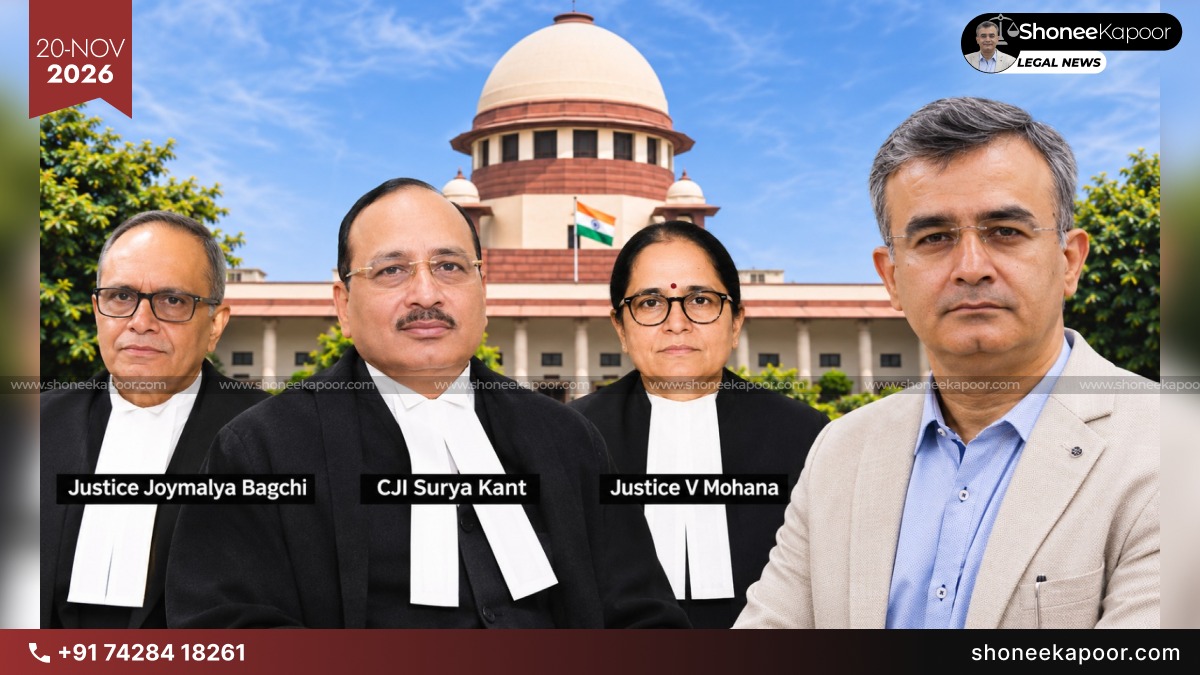
A three-judge Bench comprising Chief Justice Surya Kant, Justice Joymalya Bagchi and Justice V. Mohana raised concerns that maintaining such a database could expose the identities of sexual offence complainants and compromise their privacy.
The petition aimed to address concerns about repeated rape complaints, false sexual offence allegations and misuse of criminal law, particularly where multiple complaints are allegedly filed against different men.
The matter reached the Supreme Court after the disposed of earlier public interest litigation. The High Court had directed the Delhi Police and other authorities to expeditiously decide his representation seeking such a mechanism.
During the Supreme Court hearing, the petitioner’s counsel submitted that police headquarters in every district could maintain the proposed database to help identify people making repeated complaints.
However, Justice Bagchi expressed concern that such a system could become a "gateway to the disclosure of identity (of victims)".
The Court referred to existing identification safeguards in sexual offence investigations, including medical examination, DNA profiling where applicable, and recording statements before a Magistrate.
Justice Bagchi observed:
“The law itself provides for lawyers of privacy for the victims. You want this to be maintained with the police station, which in our considered opinion is a gateway of disclosure of identity.
The law today first requires, immediately on commencement of investigation, a medical examination including DNA Profiling of the victims. On physical identity, the law requires recording of the statement before a Magistrate. Why should we go any further into the requirement of maintenance of identity profiles (of victims) at police stations?”
The petitioner's counsel clarified that the main concern was not the identification of complainants but the possibility of repeated sexual offence complaints being filed by the same person.
Justice Bagchi responded that every individual has the right to approach the police and file complaints, even repeatedly. However, false complaints can attract legal consequences.
The Court also considered the petitioner's submissions concerning compensation. Justice Bagchi indicated that compensation was a matter for the State, not the petitioner.
During the earlier proceedings before the Delhi High Court, the petitioner had sought a mechanism for police authorities to obtain complainants' identity documents. He had also referred to a reported 4.3% conviction rate in rape cases in Delhi, while highlighting concerns about repeated complaints.
The Supreme Court ultimately declined to entertain the plea and disposed of the matter, leaving the proposed database without judicial approval.
EXPLANATORY TABLE OF LAWS AND SECTIONS
| Law / Section | Explanation | Relevance to the case |
|---|---|---|
| Article 21, Constitution of India | Protects life, personal liberty and privacy. | Relevant to the Court's concern about disclosure of complainants' identities. |
| Section 72, BNS, 2023 | Restricts disclosure of the identity of victims of specified sexual offences. | Relevant statutory protection concerning confidentiality. |
| Section 184, BNSS, 2023 | Governs medical examination of a rape victim during investigation, subject to statutory requirements. | Relevant to the Court's observations concerning medical identification. |
| Section 183, BNSS, 2023 | Provides for recording statements and confessions by a Magistrate. | Relevant to the existing identification mechanism discussed by the Bench. |
| Section 248, BNS, 2023 | Addresses false charges of offences made with intent to injure. | Potentially relevant to knowingly false criminal accusations, subject to proof of statutory ingredients. |
| Article 136, Constitution of India | Gives the Supreme Court discretionary jurisdiction to grant special leave to appeal. | Relevant to the challenge against the Delhi High Court's earlier order. |
CASE DETAILS
| Particular | Details |
|---|---|
| Case Title | Shonee Kapoor v. Union of India & Ors. |
| Court | Supreme Court of India |
| Case Number | Diary No. 67304/2026 |
| Hearing Date | November 20, 2026 |
| Bench | CJI Surya Kant, Justice Joymalya Bagchi and Justice V. Mohana |
| Petitioner | Shonee Kapoor |
| Respondents | Union of India & Others |
| Earlier Court | Delhi High Court |
| Earlier Case | W.P.(C) 11731/2025 |
| Relief Sought | Database to identify persons filing repeated sexual offence complaints |
| Supreme Court Decision | Plea not entertained; matter disposed of |
KEY TAKEAWAYS
- Men’s Rights Plea Rejected: The Supreme Court rejected Shonee Kapoor’s plea to track repeated sexual offence complaints, leaving concerns about misuse unresolved.
- Privacy For Complainants, But What About Accused Men? Protecting complainants' identities is essential, but innocent men also deserve protection from malicious allegations.
- False Allegations Can Destroy Lives: A single false rape accusation can ruin a man's reputation, career, family and mental peace before guilt is ever established.
- Repeated Complaints Deserve Scrutiny: Every complaint must be investigated fairly, but authorities must also identify and act against deliberately false accusations.
- One Petition Rejected, Fight Not Over: Men deserve justice, dignity and protection from misuse of law. Men's rights are human rights, not optional privileges.
Share Your Thoughts
Comments are moderated before publication.