
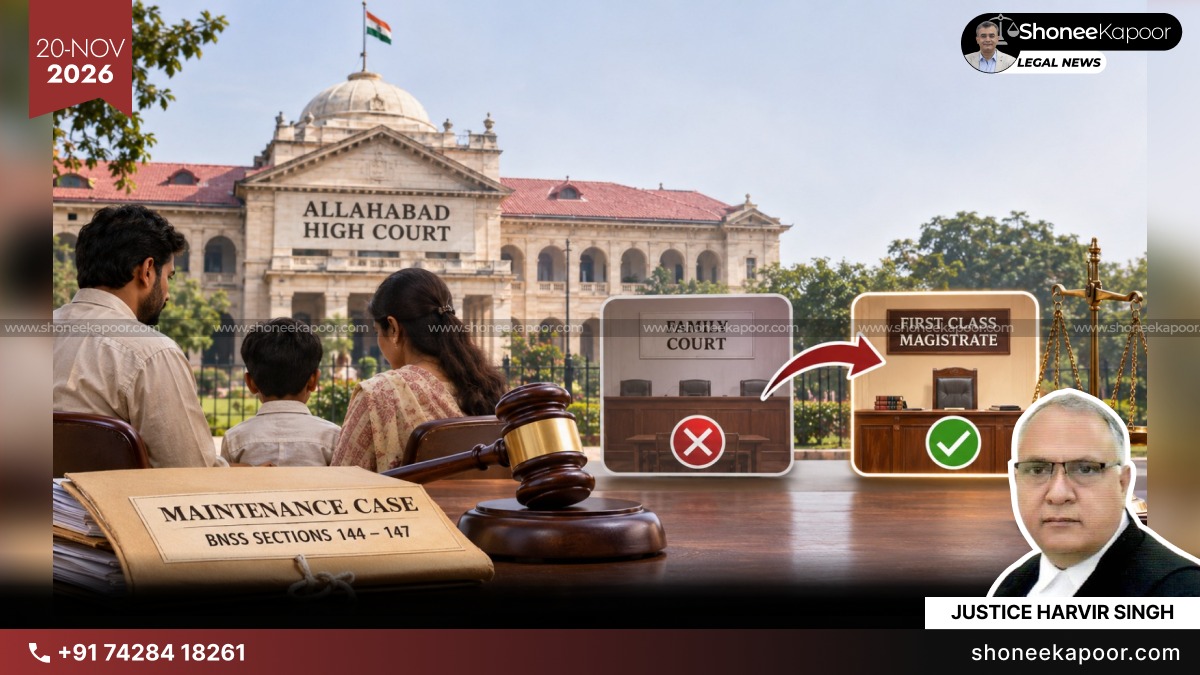
Maintenance Cases Under BNSS Are To Be Decided by First Class Magistrates, Not Family Courts: Allahabad High Court

Curated by NEWS DESK
Editorial DeskUTTAR PRADESH: The Allahabad High Court has held that maintenance cases under Sections 144 to 147 of the Bharatiya Nagarik Suraksha Sanhita (BNSS), 2023, must be decided by First Class Magistrates.
In a judgment dated November 6, 2026, Justice Harvir Singh also directed that the matter be placed before the Chief Justice to consider appointing Magistrates within the Family Court system.
On November 20, 2003, the Family Court, Agra, passed an ex-parte maintenance order, directing a husband to pay Rs. 1,000 each per month to his wife and daughter.
In July 2024, the husband sought to have the order cancelled, claiming he had not received proper notice of the proceedings.
However, the Family Court rejected his application for condonation of nearly 21 years of delay on April 8, 2025.
Subsequently, the court issued a recovery warrant against the husband on July 23, 2025, after which he approached the High Court under Section 528 BNSS.
The wife's counsel argued that the husband had an alternative legal remedy of filing a criminal revision.
The High Court examined the overlapping jurisdiction of Family Courts and Judicial Magistrates in maintenance proceedings.
The Court noted that while orders passed by Magistrates under the Domestic Violence Act can be challenged at the district level, litigants challenging maintenance orders passed by Family Courts have to approach the High Court in revision.
The Court expressed concern over the loss of district-level legal remedies and the additional financial burden on litigants.
The Court held:
“The adjudication of proceedings under Sections 144, 145, 146 and 147 of the BNSS, 2023 falling under Chapter X is to be conducted and carried out by a First-Class Magistrate, being the latest legislation on the subject.”
The High Court directed that the exercise of posting Magistrates within the Family Court system be completed within three months.
However, in the connected criminal revision, the Court found that the husband had received notices and had applied for certified copies of the orders in 2008.
Accordingly, the High Court dismissed the husband's application with liberty to file a revision against the execution orders, while separately upholding the original maintenance order.
EXPLANATORY TABLE OF LAWS AND SECTIONS
| Law / Section | What It Means | Application In This Case |
|---|---|---|
| Section 144 BNSS / 125 CrPC | Maintenance of wives, children and parents. | Governs the original maintenance order. |
| Section 145 BNSS / 126 CrPC | Procedure for deciding maintenance cases. | Husband sought cancellation of the ex-parte order. |
| Section 146 BNSS / 127 CrPC | Modification or cancellation of maintenance allowance. | Examined while deciding jurisdiction. |
| Section 147 BNSS / 128 CrPC | Enforcement of maintenance orders. | Recovery proceedings were initiated against the husband. |
| Section 528 BNSS / 482 CrPC | Inherent powers of the High Court. | Husband challenged the execution orders. |
| Section 397 CrPC | Revisional powers of the High Court and Sessions Court. | Discussed as an alternative legal remedy. |
| Section 2(a), Family Courts Act, 1984 | Defines a District Court for the purposes of the Act. | Discussed in relation to jurisdiction. |
| Section 8, Family Courts Act, 1984 | Excludes the jurisdiction of certain courts and Magistrates where Family Courts are established. | Examined regarding overlapping jurisdiction. |
| Section 19, Family Courts Act, 1984 | Governs appeals and revisions against Family Court orders. | Discussed regarding legal remedies against maintenance orders. |
| Section 12, Domestic Violence Act, 2005 | Allows an aggrieved person to seek relief before a Magistrate. | Referred to while comparing judicial powers. |
| Gram Nyayalayas Act, 2008 | Provides for accessible justice at the grassroots level. | Discussed regarding concurrent jurisdiction. |
| Section 5, Limitation Act, 1963 | Allows condonation of delay on sufficient grounds. | Husband's application for condonation of delay was rejected. |
CASE DETAILS
| Particular | Details |
|---|---|
| Case Title | Rajendra Singh v. State of U.P. and Another |
| Court | High Court of Judicature at Allahabad |
| Bench | Justice Harvir Singh |
| Neutral Citation | 2026: AHC:232101 |
| Judgment Reserved on | August 5, 2026 |
| Judgment Delivered on | November 6, 2026 |
| Case Number | Application U/S 528 BNSS No. 37393 of 2025 |
| Connected Case | Criminal Revision No. 4610 of 2025 |
| Counsel For Applicant | Manvendra Narain Pathak, Rajeev Kumar Tiwari, Sanjay Tiwari |
| Counsel For Opposite Parties | G.A., Kuldeep Singh Chahar |
| Maintenance Case Number | 209 of 2003 |
| Execution Case Number | 327 of 2024 |
| Final Decision | Application and connected criminal revision dismissed; liberty granted to challenge execution orders through revision. |
KEY TAKEAWAYS
- Family Court Jurisdiction Questioned: BNSS maintenance cases must be decided by First Class Magistrates.
- Costly Legal Battles Challenged: Why force husbands to approach High Courts for maintenance disputes?
- Accessible Justice For Men: District-level legal remedies could reduce financial and legal burdens.
- Three-Month Deadline: High Court directs an exercise for posting Magistrates within Family Courts.
- Accountability In Maintenance Proceedings: Men deserve affordable, accessible and fair legal remedies.
Share Your Thoughts
Comments are moderated before publication.