
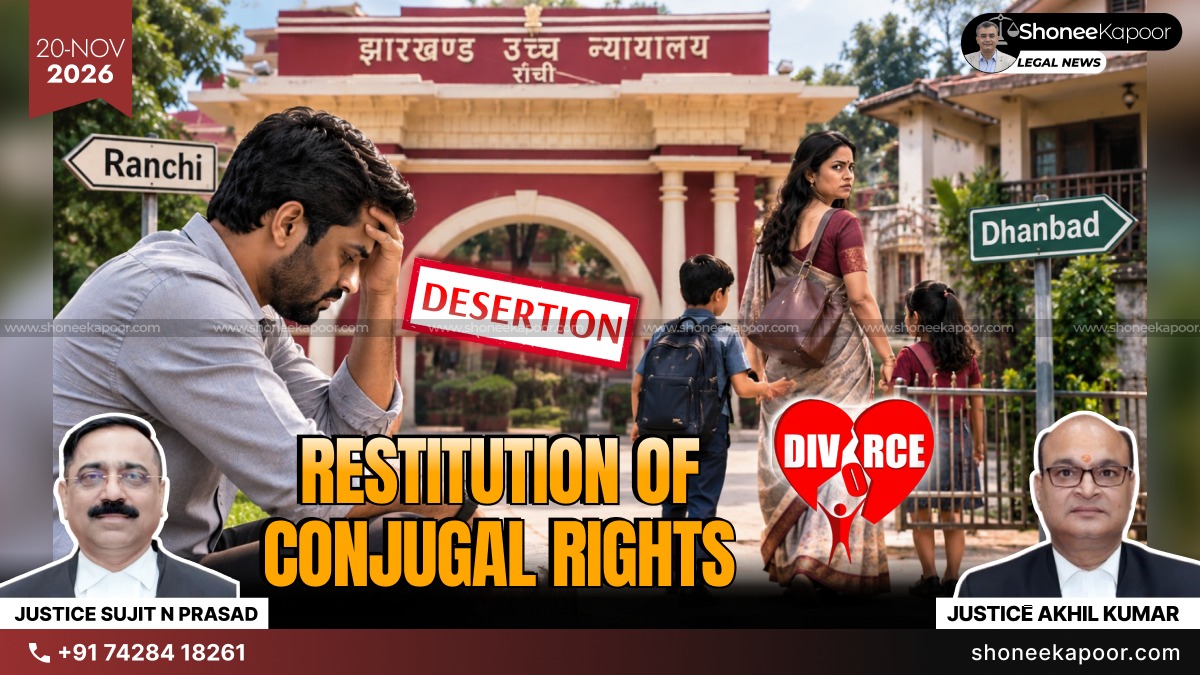
Husband Denied Divorce Despite Years Of Separation And RCR Decree? Jharkhand HC Says Wife’s Intentional Desertion Must Be Proved

Curated by NEWS DESK
Editorial DeskJHARKHAND: The Jharkhand High Court held that a husband seeking divorce after a restitution of conjugal rights decree must prove his wife knew about the decree and failed to resume matrimonial life despite that knowledge.
A Division Bench of Justice Sujit Narayan Prasad and Justice Akhil Kumar upheld the dismissal of a husband's divorce petition, observing that living separately does not automatically establish desertion under Hindu Marriage Act, 1955.
The couple married on May 11, 1995, in Ranchi and had two sons.
According to the husband, matrimonial disputes began in 2013 when his wife allegedly insisted that he shift to Dhanbad to live with her retired parents.
He claimed that on April 13, 2013, his wife left their matrimonial home in Ranchi with both children and started living at her parental residence.
Despite repeated efforts, the husband alleged that his wife refused to return unless he agreed to relocate to Dhanbad.
The husband subsequently filed a petition under Section 9 of the Hindu Marriage Act, seeking restitution of conjugal rights.
On November 11, 2016, the Family Court granted an ex-parte restitution decree in his favour.
The husband also alleged that his wife had filed a criminal complaint against him in 2013 under Sections 498A, 323 and 506 IPC, based on false allegations.
Attempts at reconciliation, including mediation before JHALSA, Ranchi, did not permanently restore their matrimonial relationship.
The husband thereafter sought divorce under Section 13(1A)(ii) of the Hindu Marriage Act, claiming that matrimonial cohabitation had not resumed despite the restitution decree.
However, on March 19, 2025, the Additional Principal Judge, Additional Family Court-I, Ranchi, dismissed his divorce petition.
Challenging the decision, the husband approached the Jharkhand High Court.
The High Court examined Section 13(1A)(ii) HMA, which allows either spouse to seek divorce when restitution of conjugal rights has not taken place for at least one year after the decree.
The Court observed that the husband had failed to produce reliable evidence proving that his wife knew about the ex parte decree and had deliberately refused to resume matrimonial life.
The Bench further examined whether the wife's separate residence amounted to matrimonial desertion.
It held that physical separation alone was insufficient. The husband also had to establish animus deserendi, meaning an intention to permanently end matrimonial cohabitation.
The High Court observed:
“Although the factum of separation between the parties stands established, the appellant has failed to prove that the respondent had the requisite intention to bring matrimonial cohabitation permanently to an end. The evidence available on record does not disclose the existence of animus deserendi on the part of the respondent.
...her separate residence was not driven by an intention to forsake the marital relationship permanently, but was a consequence of the prevailing circumstances. As such, one of the essential ingredients constituting desertion remains unproved...”
Shortened using extracts from the original judgment, with ellipses indicating omitted text.
The Court considered the wife's statement expressing willingness to live with her husband and found insufficient evidence of an intention to permanently abandon the marriage.
Accordingly, the Jharkhand High Court dismissed the husband's appeal and upheld the Family Court's refusal to grant divorce.
EXPLANATORY TABLE OF LAWS AND SECTIONS
| Law / Section | What It Means | Application In This Case |
|---|---|---|
| Section 9, Hindu Marriage Act, 1955 | Allows a spouse to seek restitution of conjugal rights. | Husband obtained an ex-parte decree in 2016. |
| Section 13(1A)(ii), Hindu Marriage Act | Provides a ground for divorce when conjugal rights have not been restored for at least one year after the decree. | Main provision relied upon by the husband. |
| Section 13(1)(ib), Hindu Marriage Act | Desertion for a continuous period of at least two years immediately before filing the divorce petition. | Relevant to the Court's examination of intentional desertion. |
| Section 19(1), Family Courts Act, 1984 | Provides for appeals against eligible Family Court judgments and orders. | Husband challenged the Family Court's decision. |
| Section 498A IPC | Criminal cruelty by husband or his relatives. | Wife had filed a criminal complaint. |
| Section 323 IPC | Punishment for voluntarily causing hurt. | Included in the wife's criminal complaint. |
| Section 506 IPC | Punishment for criminal intimidation. | Included in the wife's criminal complaint. |
| Section 125 CrPC | Maintenance for eligible wives, children and parents. | Relevant to the maintenance proceedings between the parties. |
CASE DETAILS
| Particular | Details |
|---|---|
| Case Title | Husband v. Wife |
| Court | Jharkhand High Court, Ranchi |
| Bench | Justice Sujit Narayan Prasad and Justice Akhil Kumar |
| Neutral Citation | 2026:JHHC:32489-DB |
| Judgment Reserved On | September 29, 2026 |
| Judgment Delivered On | November 5, 2026 |
| Case Number | F.A. No. 148 of 2025 |
| Original Suit Number | 270 of 2019 |
| Counsel For Husband | Anurag Kashyap, Kanika Sinha |
| Counsel For Wife | Sanjay Prasad |
| Family Court Order | March 19, 2025 |
| Restitution Decree | November 11, 2016 |
| Final Decision | Husband's appeal dismissed; refusal to grant divorce upheld. |
KEY TAKEAWAYS
- Restitution Decree, Still No Divorce: Husband’s years of separation and court decree failed to secure matrimonial relief.
- Wife’s Knowledge Becomes Crucial: Husband could not prove that his wife knew about the restitution decree.
- Years Apart, Marriage Still Legally Alive: Prolonged separation alone is not proof of intentional desertion.
- Husband Faces the Burden of Proof: Even after securing a court decree, he must establish the legal grounds for divorce.
- Men Deserve Freedom from Endless Litigation: A failed marriage should not become a lifetime of legal battles. Justice must include timely matrimonial closure.
Share Your Thoughts
Comments are moderated before publication.