
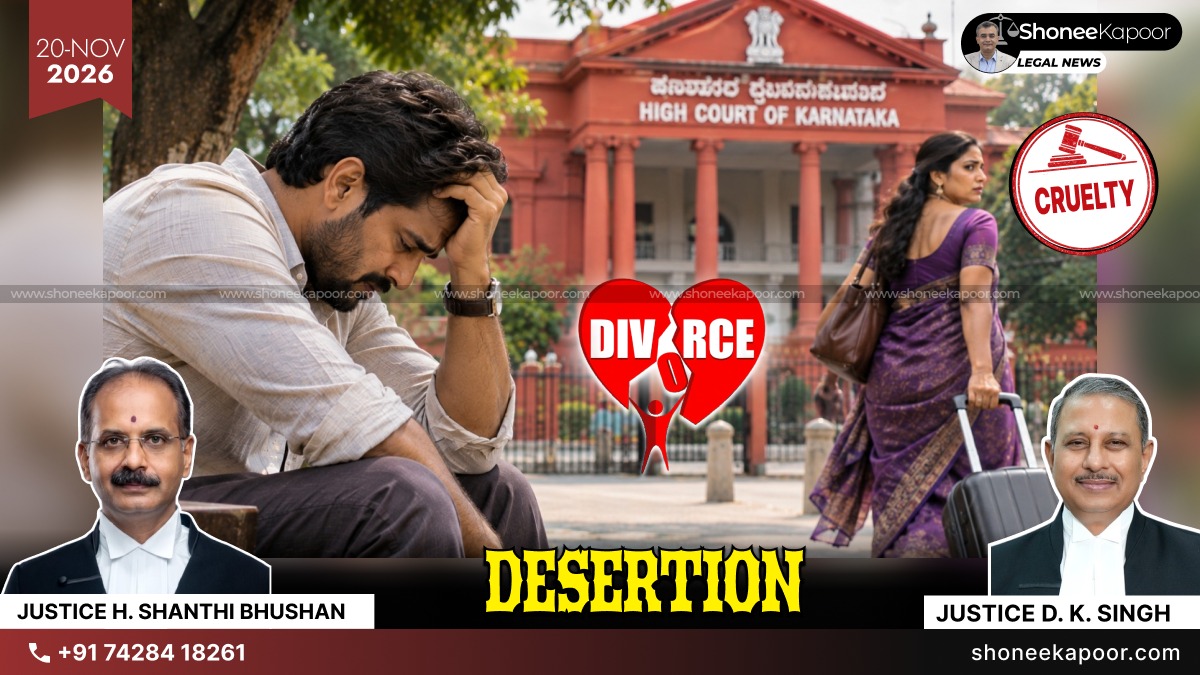
Wife Living Separately From Husband For Less Than 2 Years Is Not Desertion? Karnataka High Court Denies Divorce

Curated by NEWS DESK
Editorial DeskKARNATAKA: The Karnataka High Court has dismissed a husband's divorce appeal, holding that a wife living separately for less than two years cannot be treated as having deserted her husband under the Hindu Marriage Act, 1955. The Court also held that ordinary marital disputes and general allegations without sufficient evidence cannot establish mental cruelty.
A Division Bench of Justice D.K. Singh and Justice H. Shanthi Bhushan delivered the judgment on September 17, 2026, upholding the Family Court's decision dated September 6, 2021.
The couple married on September 26, 2014, in Davanagere, Karnataka, and had a son. According to the husband, their marriage remained peaceful for about a year before disagreements started.
The husband alleged that his wife repeatedly insisted on living separately from his parents. Being their only son, he claimed that he could not leave his ageing parents. He also alleged that she frequently visited her parental home without informing him and once took their four-month-old child to Hyderabad without his consent.
He claimed that his wife left the matrimonial home on November 27, 2016, despite attempts by relatives and community elders to resolve their differences. Earlier, he had initiated restitution of conjugal rights proceedings under Section 9 of the Hindu Marriage Act, after which they resumed living together.
The wife denied his allegations and accused him of suspecting her character, physically assaulting her over minor disagreements and neglecting his matrimonial responsibilities. She maintained that his conduct had forced her to live separately.
The husband approached the Family Court seeking divorce on grounds of cruelty and desertion. However, the Family Court rejected his petition, finding that his allegations lacked specific and reliable evidence.
During cross-examination, the husband's sister admitted that she had no direct knowledge of the incidents inside the matrimonial home and had learned about them through telephone conversations.
The High Court agreed that the husband had failed to establish specific incidents of cruelty through convincing evidence.
The Bench observed:
"Ordinary wear and tear and quarrels arising in the course of matrimonial life do not, by themselves, amount to cruelty."
The Court found that the husband's oral and documentary evidence, including records of earlier matrimonial proceedings, did not establish cruelty under Section 13(1)(ia) of the Hindu Marriage Act.
Regarding desertion under Section 13(1)(ib), the Court noted that the wife had admittedly been living with her parents since November 27, 2016. However, the husband filed his divorce petition on December 15, 2016, just 18 days after the alleged separation.
Under the law, desertion must continue for at least two years immediately before filing a divorce petition. Therefore, the husband could not establish the statutory ground of desertion.
The Court further observed:
"The evidence on record also does not indicate that the respondent intended to permanently abandon the matrimonial relationship."
The Bench also considered the husband's statement during cross-examination that his wife was "not necessary" for him, even if she was willing to return and continue the marriage.
The wife, meanwhile, maintained that she was willing to resume matrimonial cohabitation. The Court found insufficient evidence that she intended to end the marriage permanently.
The High Court consequently upheld the Family Court's findings and dismissed the husband's divorce appeal, ruling that neither cruelty nor desertion had been legally established.
EXPLANATORY TABLE OF LAWS AND SECTIONS
| Law / Section | What It Means | Relevance In This Case |
|---|---|---|
| Section 13(1)(ia), Hindu Marriage Act, 1955 | Allows divorce when a spouse proves matrimonial cruelty. | Husband alleged mental cruelty, but the Court found insufficient evidence. |
| Section 13(1)(ib), Hindu Marriage Act, 1955 | Allows divorce for continuous desertion of at least two years immediately before filing the petition. | Husband filed his divorce petition just 18 days after the alleged separation. |
| Section 9, Hindu Marriage Act, 1955 | Provides a remedy for restitution of conjugal rights when a spouse withdraws from matrimonial society without reasonable excuse. | Husband had earlier initiated proceedings seeking restoration of cohabitation. |
CASE DETAILS
| Particulars | Details |
|---|---|
| Case Title | P v. L |
| Court | Karnataka High Court |
| Bench | Justice D.K. Singh and Justice H. Shanthi Bhushan |
| Case Number | Miscellaneous First Appeal No. 6384/2021 (FC) |
| Neutral Citation | 2026:KHC:51557-DB |
| Date of Judgment | September 17, 2026 |
| Family Court Order | September 6, 2021 |
| Final Decision | Husband's divorce appeal dismissed; Family Court judgment upheld |
KEY TAKEAWAYS
- Husband Denied Divorce: Wife's separation from the matrimonial home did not automatically establish desertion.
- Two-Year Rule: Desertion must continue for at least two years before filing a divorce petition.
- Mental Cruelty Requires Proof: Allegations of harassment and marital disputes alone cannot justify divorce.
- Ageing Parents Matter: A husband's responsibility towards his parents deserves consideration, but disputes over separate residence do not automatically establish cruelty.
- Men Must Build Strong Evidence: Husbands seeking divorce must prove cruelty or desertion through legally admissible evidence, not merely allegations.
Share Your Thoughts
Comments are moderated before publication.