
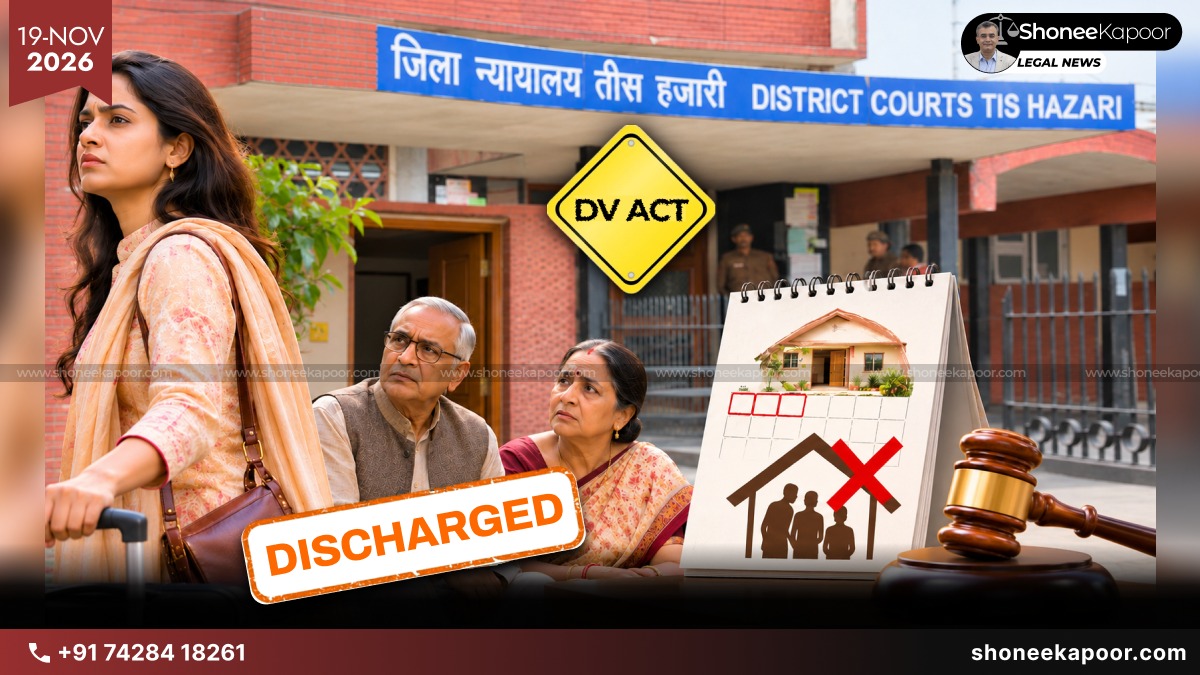
Wife’s Brief Stay With In-Laws Does Not Constitute A Shared Household Under DV Act: Delhi Court Upholds Discharge Of NRI Husband’s Parents

Curated by NEWS DESK
Editorial DeskNEW DELHI: A Delhi Sessions Court has upheld the discharge of a husband’s parents in a domestic violence case, observing that a temporary stay at the matrimonial home without any intention of permanent residence does not constitute a shared household under the Domestic Violence Act, 2005.
Additional Sessions Judge of Tis Hazari Court passed the judgment on October 8, 2026.
The couple lived in Australia before their marriage and came to India to marry on February 9, 2020. After a brief stay with the husband's parents, the couple returned to Australia on February 27, 2020.
The woman started living separately from her husband on May 2, 2020.
Subsequently, she filed a complaint under Section 12 of the Domestic Violence Act against her husband, father-in-law and mother-in-law through her father.
The couple obtained a divorce in Australia on April 11, 2023, following which the woman withdrew the domestic violence proceedings against her husband.
On January 13, 2026, the Trial Court discharged her parents-in-law from the domestic violence proceedings.
Challenging the order under Section 29 of the Domestic Violence Act, the woman alleged that her in-laws had retained her jewellery and stridhan. She also levelled allegations of torture, economic abuse and dowry demands.
However, the Sessions Court noted that the appeal was filed 33 days beyond the limitation period calculated from the date of the order. The medical documents submitted to justify the delay were from 2024, not 2026.
The Court observed:
“It is to be noted that it is not the length of the delay, but the reason of the delay which has to be considered.”
While rejecting the application for condonation of delay, the Court also examined the case on merits.
Referring to the Supreme Court judgment in Satish Chander Ahuja vs. Sneha Chander Ahuja, the Court noted:
“The living of a woman in a household has to refer to a living which has some permanency. Mere fleeting or casual living at different places shall not make a shared household.”
The Court found that the couple had always intended to establish their permanent matrimonial home in Australia and that no domestic relationship had been established between the woman and her parents-in-law.
The Court also found that the allegations against the husband's parents were general and omnibus.
Referring to the Supreme Court judgment in Kahkashan Kausar vs. State of Bihar, the Court observed:
“It would be unjust if the in-laws are forced to go through the tribulations of a trial”
The Court further referred to the Supreme Court judgment in Preeti Gupta vs. State of Jharkhand, which cautioned against unnecessarily implicating the husband's relatives in matrimonial disputes:
“The tendency of implicating the husband and all his immediate relations is also not uncommon.”
Accordingly, the Delhi Court dismissed the woman's appeal both on grounds of limitation and merits, upholding the discharge of the husband's parents from the domestic violence proceedings.
EXPLANATORY TABLE OF LAWS AND SECTIONS
| Law / Section | What It Means | Application In This Case |
|---|---|---|
| Section 2(a) DV Act | Defines an aggrieved person. | Examined the woman's legal status in relation to her in-laws. |
| Section 2(f) DV Act | Defines a domestic relationship. | Court found that no domestic relationship had been established with the in-laws. |
| Section 2(s) DV Act | Defines a shared household. | Temporary residence with in-laws was held insufficient. |
| Section 3 DV Act | Defines domestic violence, including physical, verbal, emotional and economic abuse. | Relevant to allegations of torture, dowry demands and retention of stridhan. |
| Section 12 DV Act | Application to the Magistrate seeking relief under the DV Act. | Woman initiated proceedings against her husband and in-laws. |
| Section 17 DV Act | Right to reside in a shared household. | Discussed through Supreme Court precedents. |
| Section 18 DV Act | Protection orders against domestic violence. | Relief sought by the woman. |
| Section 19 DV Act | Residence orders. | Discussed in relation to shared household rights. |
| Section 19(8) DV Act | Magistrate's power to direct the return of stridhan or other property. | Relief sought concerning retention of jewellery and stridhan. |
| Section 20 DV Act | Monetary relief. | Relief claimed by the woman. |
| Section 22 DV Act | Compensation for injuries, mental torture and emotional distress. | Invoked by the woman in her complaint. |
| Section 29 DV Act | Provides 30 days to file an appeal against a Magistrate's order from the relevant date of service. | Appeal was dismissed on grounds of delay and merits. |
| Section 3 Limitation Act, 1963 | Provides for dismissal of proceedings filed beyond the prescribed limitation period, subject to statutory exceptions. | Discussed through Supreme Court precedents. |
| Section 5 Limitation Act, 1963 | Permits condonation of delay upon establishing sufficient cause. | Application for condonation of delay was dismissed. |
| Section 498A IPC | Punishment for cruelty by a husband or his relatives. | Referred to through Supreme Court judgments cautioning against omnibus allegations. |
CASE DETAILS
| Particular | Details |
|---|---|
| Case Title | SS v. RK & Ors. |
| Court | Additional Sessions Court, West District, Tis Hazari Courts, Delhi |
| CNR Number | DLWT010033942026 |
| Case Number | Criminal Appeal No. 123/2026 |
| Original Complaint Number | MC No. 179/2021 |
| Counsel for Appellant | Advocate Babita Sharma |
| Counsel for Respondents | Tripaksha Litigation through Advocates Prateek Jindal, Himanshu Goel and Pritha Khanna |
| Police Station | Paschim Vihar (West), Delhi |
| Final Decision | Appeal dismissed on limitation and merits; discharge of parents-in-law upheld. |
KEY TAKEAWAYS
- Brief Stay Is Not A Shared Household: Temporary residence cannot automatically establish a domestic relationship.
- Marriage Alone Cannot Make In-Laws Liable: Statutory requirements must be established before proceeding against them.
- General Allegations Against In-Laws Rejected: Omnibus allegations of torture, dowry demands and retention of stridhan were found insufficient in this case.
- Separately Residing Parents Deserve Legal Protection: Matrimonial disputes cannot automatically justify dragging the husband's relatives into litigation.
- Delhi Court Upholds Discharge Of In-Laws: Woman's domestic violence appeal dismissed on both limitation and merits.
Share Your Thoughts
Comments are moderated before publication.