
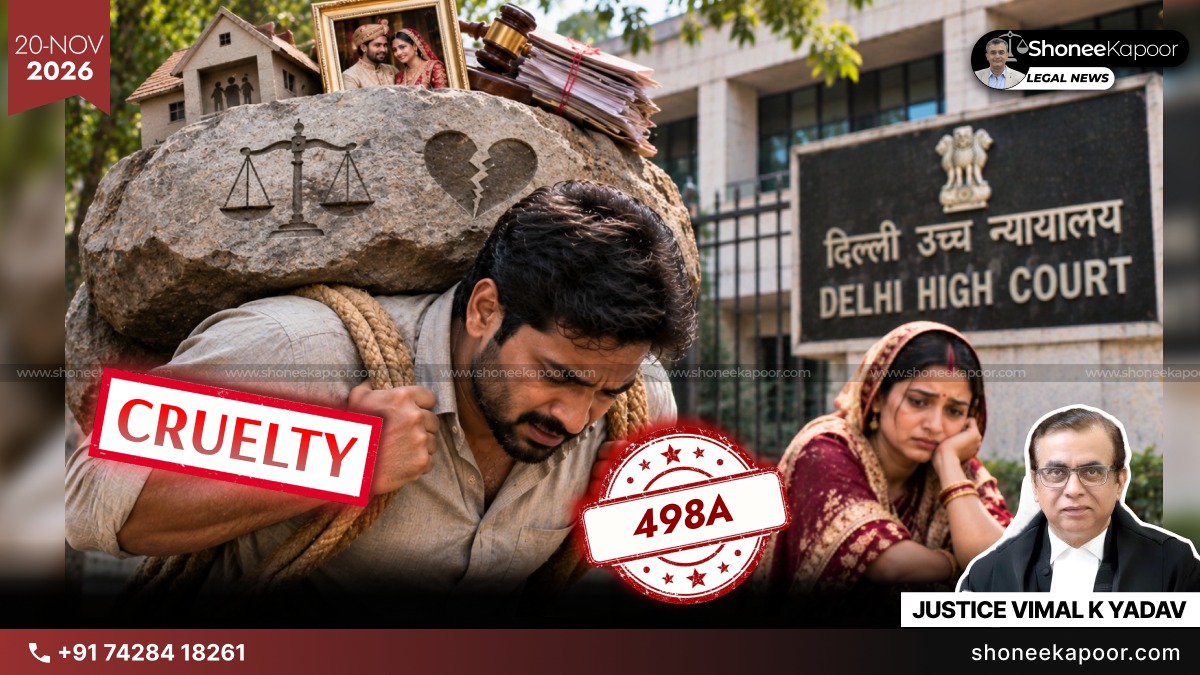
Husband Primarily Responsible For Wife’s Care Just Because She Left Her Parental Home After Marriage? Delhi High Court Answers

Curated by NEWS DESK
Editorial DeskNEW DELHI: The Delhi High Court observed that a husband is primarily responsible for caring for his wife, who leaves her family after marriage to live with him.
Justice Vimal Kumar Yadav made the observation while examining a dowry death and matrimonial cruelty case, in which the Court upheld the husband's conviction under Section 498A IPC and convicted him under Section 306 IPC for abetment of suicide, while setting aside his conviction under Section 304B IPC.
The Court also acquitted the husband's father and brother, holding that general allegations of dowry harassment without specific evidence were insufficient to establish their criminal liability.
The case arose from the death of Sonia, who was found burnt inside her matrimonial home in Vijay Vihar, Delhi, on October 17, 2001.
Following statements from her parents, police registered a case against her husband, Jai Dev, father-in-law Chhotey Lal, mother-in-law Seema Devi and brother-in-law Veeru under Sections 498A and 304B IPC.
On January 28, 2004, the Trial Court convicted all four accused and subsequently sentenced them to three years' rigorous imprisonment under Section 498A IPC and seven years under Section 304B IPC. The mother-in-law later died.
The prosecution alleged that Sonia faced harassment over demands for a motorcycle, gas stove, water motor and Rs. 25,000 during the final six months of her marriage.
However, the High Court found that the first 18 months of marriage were peaceful and that the woman's parents had failed to establish specific acts of harassment by each accused.
The Court observed:
“Merely saying that so and so was harassed by so and so, could not be sufficient”
Referring to the Supreme Court's ruling in Geddam Jhansi v. State of Telangana, the Court also highlighted the possibility of exaggerated allegations against family members during matrimonial disputes.
The Supreme Court had observed:
“when tempers run high and relationships turn bitter, there is also a propensity to exaggerate the allegations”
The High Court held that vague and omnibus allegations could not justify convicting the husband's father and brother under Sections 498A and 304B IPC.
However, while examining the husband's conduct, the Court noted that Sonia had stayed with her parents for several months because of matrimonial disputes.
The husband subsequently brought her back to the matrimonial home after assuring her family, in the presence of others, that he would take care of her.
Approximately one and a half months later, Sonia died by suicide.
The High Court observed that a husband has a primary responsibility to care for his wife, particularly when she leaves her parental family to live with him after marriage.
The Court found that although the prosecution failed to establish dowry-related cruelty soon before death, the evidence was sufficient to hold the husband responsible for matrimonial cruelty and abetment of suicide.
Accordingly, the Delhi High Court acquitted Chhotey Lal and Veeru of all charges and set aside Jai Dev's conviction under Section 304B IPC.
However, the Court maintained the husband's conviction under Section 498A IPC and substituted his dowry death conviction with a conviction under Section 306 IPC.
For the offence of abetment of suicide, the husband was sentenced to the imprisonment already undergone, while his original sentence under Section 498A IPC was maintained.
EXPLANATORY TABLE OF LAWS AND SECTIONS
| Law / Section | What It Means | Application In This Case |
|---|---|---|
| Section 498A IPC | Cruelty towards a married woman by her husband or his relatives. | Husband's conviction upheld; relatives acquitted. |
| Section 304B IPC | Dowry death involving dowry-linked cruelty soon before an unnatural death within seven years of marriage. | Convictions set aside. |
| Section 306 IPC | Punishment for abetment of suicide. | Husband convicted under this provision. |
| Section 34 IPC | Common intention in criminal acts. | Invoked in the original charges against the family. |
| Section 113A, Evidence Act | Permits a presumption of abetment of suicide in specified circumstances. | Applied in assessing the husband's liability. |
| Section 113B, Evidence Act | Presumption concerning dowry death when statutory conditions are established. | Could not support the dowry death conviction. |
| Section 2, Dowry Prohibition Act, 1961 | Defines dowry. | Relevant to the alleged demands. |
| Section 176 CrPC | Inquiry into specified categories of deaths. | SDM conducted proceedings. |
| Section 313 CrPC | Opportunity for the accused to explain incriminating evidence. | Accused gave their explanations. |
| Section 464 CrPC | Addresses the effect of an omitted or defective charge. | Relevant to conviction under Section 306 without a separate charge. |
CASE DETAILS
| Particular | Details |
|---|---|
| Case Title | Chhotey Lal & Jai Dev v. The State; Veeru v. State |
| Court | Delhi High Court, New Delhi |
| Bench | Justice Vimal Kumar Yadav |
| Neutral Citation | 2026: DHC:10177 |
| Judgment Reserved on | July 7, 2026 |
| Judgment Delivered on | November 18, 2026 |
| Case Numbers | CRL.A. 532/2004 and CRL.A. 824/2004 |
| Counsel For Appellants | Aishwarya Rao and Mansi Rao |
| Counsel For State | Mukesh Kumar, APP |
| Final Decision | Father-in-law and brother-in-law acquitted; husband's conviction modified to Sections 498A and 306 IPC. |
KEY TAKEAWAYS
- Husband Primarily Responsible: Delhi High Court held that a husband has the primary responsibility to care for his wife after marriage.
- Dowry Death Charges Not Proved: Husband’s conviction under Section 304B IPC was set aside, but he was convicted of abetment of suicide.
- In-Laws Cannot Be Convicted on Vague Allegations: Father-in-law and brother-in-law acquitted due to lack of specific evidence.
- Husband Still Held Criminally Liable: Despite failure to prove dowry death, his conviction under Section 498A IPC was upheld.
- Justice Must Not Mean Collective Family Punishment: Criminal liability must rest on individual evidence, not assumptions against the husband’s entire family.
Share Your Thoughts
Comments are moderated before publication.