
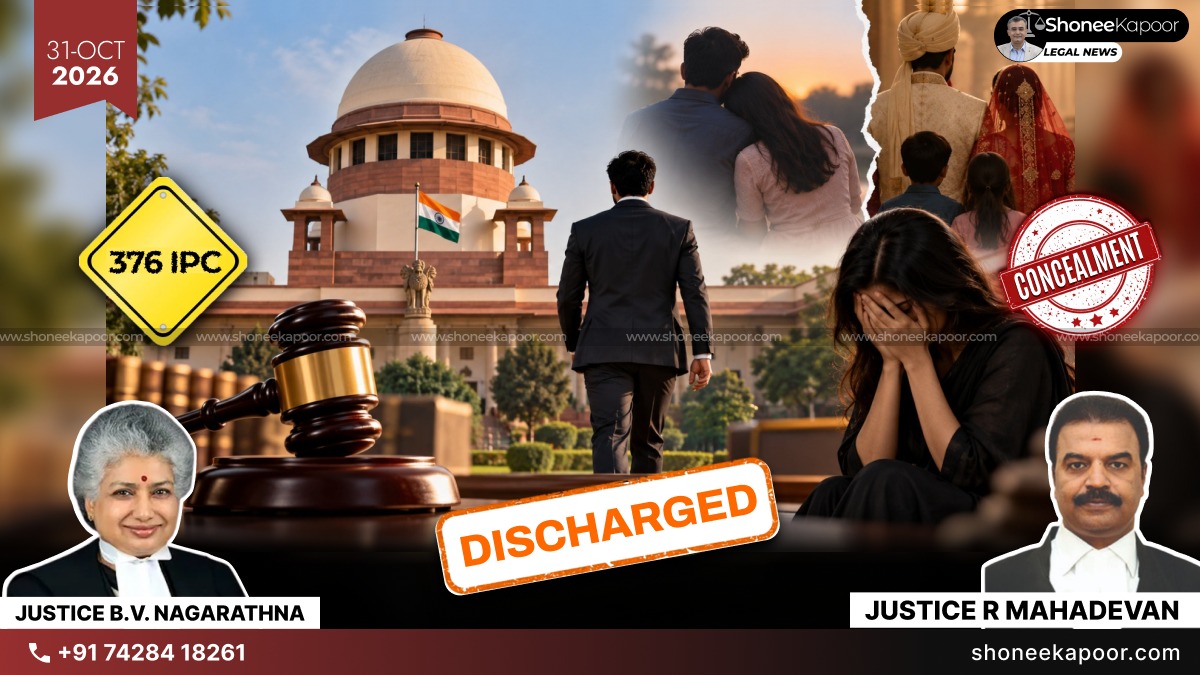
Woman Who Continued Relationship Despite Knowing About Man’s First Marriage Cannot Claim Deception: Supreme Court Discharges Him in Rape Case

Curated by NEWS DESK
Editorial DeskNEW DELHI: The Supreme Court of India has discharged a man accused of rape, cheating and concealing his first marriage, after finding that the woman continued their relationship despite knowing he was already married and had two children.
A bench of Justice B.V. Nagarathna and Justice R. Mahadevan set aside the Kerala High Court and Trial Court orders, holding that the essential ingredients of offences under Sections 376, 420, 493, 494 and 495 IPC were not established.
According to the complainant, the man claimed to be unmarried and performed a marriage ceremony at a temple in Mysuru in 1996. They lived together until 2003. However, the woman admitted that she learned about his existing marriage within months of their relationship beginning.
In 2008, nearly five years after their separation, the woman filed a case under the Domestic Violence Act, seeking accommodation and financial relief. Her complaint was dismissed in 2009, and her appeal also failed.
She later filed criminal complaints alleging rape, cheating and marriage-related offences. Her first complaint was dismissed for non-prosecution in 2011. A second complaint resulted in an FIR, leaving the man facing serious criminal proceedings.
The Trial Court rejected his discharge application in January 2015. The Kerala High Court upheld that decision in May 2025, following which he approached the Supreme Court.
Senior Advocate R. Basant, representing the accused man, argued that the relationship was consensual and the complainant knew about his earlier marriage. Advocate K. Rajeev, representing the woman, relied on IVF documents, a rental agreement and a joint savings account to support her claim that she believed they were legally married.
The Supreme Court observed that these documents indicated a long personal relationship but did not independently establish a legally valid marriage.
The bench described the relationship as “evidently one of consensual relationship that perhaps was camouflaged in a marriage for the sake of avoiding scrutiny or stigma, which eventually came to an end.”
The Court found it difficult to accept that the woman continued believing she was legally married solely because of the man's alleged verbal assurances, despite knowing about his existing marriage.
The judges further observed that the woman's conduct indicated a consensual relationship rather than a legally recognised marriage. The documents presented did not independently prove a valid marriage.
While examining the rape allegation arising from a failed relationship, the Supreme Court expressed concern about a worrying trend in recent years wherein consensual relationships that have come to an end are retrospectively combed with a fine tooth so as to identify what can post-facto be construed as violence and sexual assault.
The judges emphasised that genuine sexual assault complaints must be investigated seriously, but the breakdown of a consensual relationship cannot automatically justify criminal prosecution.
The Supreme Court further declared:
“Criminal law cannot be used as munitions to settle personal scores, exact revenge or coerce an individual to act in any particular way.”
The Supreme Court concluded that the material did not establish the essential ingredients of rape, cheating, deceitful cohabitation or bigamy. It found that the High Court had proceeded on a misconceived basis and discharged the accused man from all five alleged IPC offences.
EXPLANATORY TABLE OF LAWS AND SECTIONS
| Law / Section | What It Means | Application in This Case |
|---|---|---|
| Section 375 IPC | Defines rape and circumstances affecting valid consent. | Court examined whether sexual consent was obtained through deception. |
| Section 376(2)(n) IPC | Punishes repeated rape of the same woman. | Court found the essential ingredients absent. |
| Section 420 IPC | Cheating involving dishonest inducement to deliver property or deal with valuable security. | No qualifying property transaction was established. |
| Section 493 IPC | Deceitfully making a woman believe she is lawfully married and inducing cohabitation or sexual intercourse. | Woman's knowledge of the earlier marriage was crucial. |
| Section 494 IPC | Punishes entering a void second marriage during the lifetime of a spouse. | Validity of the alleged second marriage was not established. |
| Section 495 IPC | Bigamy involving concealment of an earlier marriage. | Necessary ingredients were not established. |
| Section 30 IPC | Defines valuable security. | Relevant to the cheating allegation. |
| Section 12(1), DV Act, 2005 | Allows an aggrieved person to seek relief before a Magistrate. | Earlier domestic violence proceedings were dismissed. |
| Section 156(3) CrPC | Empowers a Magistrate to order police investigation. | Second complaint was referred to police. |
| Section 227 CrPC | Provides for discharge when sufficient grounds to proceed are absent. | Basis of the Supreme Court's discharge analysis. |
| Section 228 CrPC | Concerns framing of charges. | Discussed through Supreme Court precedents. |
| Section 482 CrPC | High Court's inherent powers to prevent abuse of process. | Man had earlier sought quashing of the FIR. |
CASE DETAILS
| Particular | Details |
|---|---|
| Case Title | Santhosh Kumar N.P. v. State–Station House Officer |
| Court | Supreme Court of India |
| Neutral Citation | 2026 INSC 1179 |
| Date of Judgment | 30 October 2026 |
| Bench | Justice B.V. Nagarathna and Justice R. Mahadevan |
| Case Number | Criminal Appeals arising out of SLP (Crl.) Nos. 10173–10174/2025 |
| Diary Number | 33755/2025 |
| Counsel for Appellant | Senior Advocate R. Basant |
| Counsel for Complainant | Advocate-on-Record K. Rajeev |
| FIR | No. 503/2011, Kadirur Police Station |
| Challenged High Court Order | 21 May 2025, Kerala High Court |
| Decision | Appeals allowed; man discharged from offences under Sections 376, 420, 493, 494 and 495 IPC |
KEY TAKEAWAYS
- Knowledge Defeats Deception Claims: A woman who knew about the man's existing marriage cannot rely on alleged concealment without proving the offence.
- Consensual Relationship Is Not Rape: A failed relationship cannot automatically become a criminal case against a man.
- Criminal Law Is Not a Revenge Weapon: The Supreme Court warned against using criminal proceedings to settle personal scores.
- Evidence Matters, Not Just Allegations: Living together, IVF records and joint accounts do not automatically prove a legally valid marriage.
- Men Deserve Protection From Unsupported Cases: After years of criminal proceedings, the Supreme Court discharged the man from all five alleged IPC offences.
Share Your Thoughts
Comments are moderated before publication.