
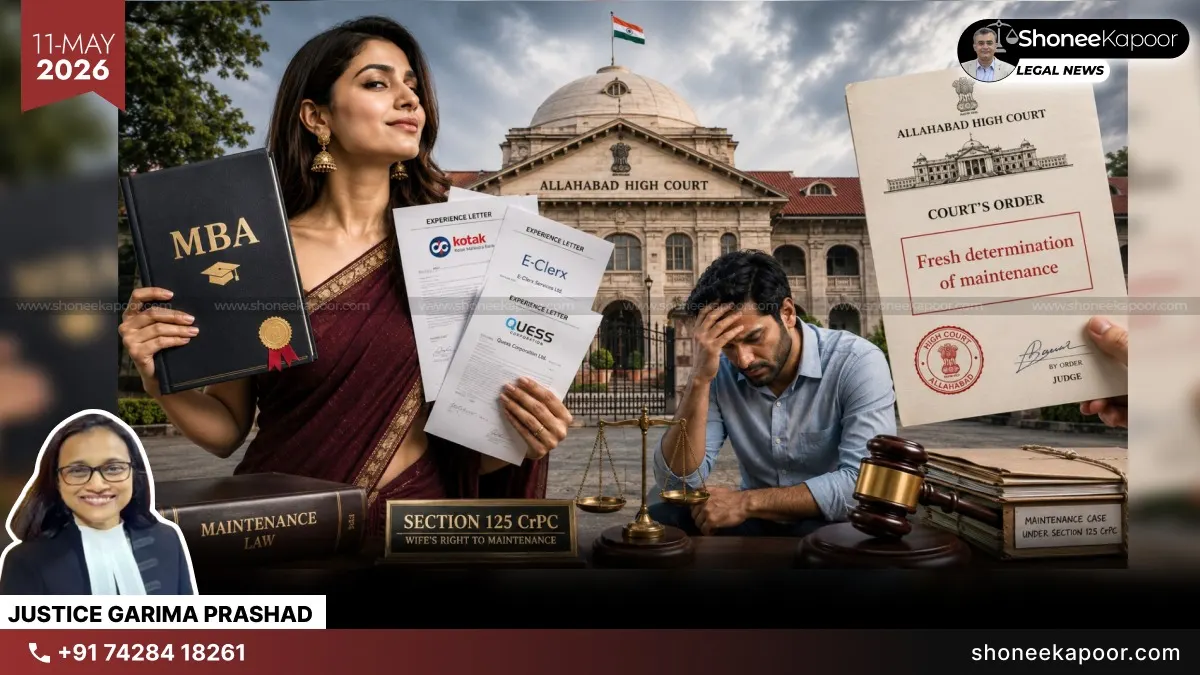
Can A Husband Be Dragged Into Years Of Maintenance Litigation Even After A Marriage Lasting Barely One Month?
The Allahabad High Court says Yes, holding that maintenance proceedings can continue even where the wife is highly qualified or previously employed.
PRAYAGRAJ: The Allahabad High Court recently dealt with a long-running maintenance dispute between a husband and wife whose marriage lasted for barely a few weeks before separation. Justice Garima Prashad heard the matter relating to maintenance under Section 125 CrPC.
The dispute reached the High Court after the wife challenged a Family Court order that had granted her ₹15,000 per month as maintenance. She sought enhancement of the amount and argued that her husband was financially well-settled and involved in a successful overseas education consultancy business in Ahmedabad.
As per the records before the Court, the marriage took place on 31 August 2014 according to Sikh rites and ceremonies. However, the relationship reportedly broke down within a very short time and the wife started living separately from September 2014 itself.
She alleged dowry harassment and abandonment and claimed she had no independent source of income when the maintenance proceedings were initiated.
The husband denied the allegations and argued that the wife herself had left the matrimonial home without sufficient reason. He informed the Court that she was highly educated, held an MBA degree, and had previously worked with companies such as Kotak Mahindra and E-Clerx. According to the husband, she had earlier earned around ₹37,000 per month and was capable of maintaining herself independently.
The Court noted that the parties had lived together for less than one month. The judgment specifically records:
“The parties cohabited for less than one month.”
The Court also recorded that during cross-examination, the wife admitted that she had worked at multiple places before marriage and had earned approximately ₹37,000 per month for more than two years.
Despite these admissions, the wife argued that she was unemployed at the time of filing the maintenance case and therefore remained entitled to financial support. The High Court observed that:
“The mere fact that the wife is educated or possesses the capacity to earn does not, by itself, disentitle her from claiming maintenance under Section 125 Cr.P.C.”
At the same time, the judgment reflects the Court’s concern regarding the husband’s financial disclosures and inconsistencies in his Income Tax Returns. The husband claimed that he had only a small share in the business and earned between ₹15,000 and ₹20,000 per month, but the Court noticed contradictions regarding his ownership share and financial position.
The Court observed:
“The inconsistencies in his financial disclosures, coupled with his reluctance to produce complete records, cast a serious doubt on the veracity of his claim regarding limited income.”
The Court also noted that the husband admitted he had been involved in IELTS coaching, visa consultancy and related businesses for many years and had studied in Canada between 2012 and 2014.
Importantly, the High Court did not set aside maintenance altogether. Instead, it held that the Family Court needed to reconsider the quantum and starting date of maintenance after properly examining all financial aspects and evidence placed on record.
The Court held:
“The amount of Rs. 15,000/- per month awarded by the learned Family Court does not appear to be just, fair, or commensurate with the standard of living to which the revisionist was entitled.”
The matter was ultimately remanded back to the Family Court for fresh determination of maintenance, while directing continuation of interim payments until a fresh decision is taken.
Explanatory Table: Laws And Sections Involved
| Law / Section | Purpose | Relevance In This Case |
| Section 125 CrPC | A legal provision that allows wife, children or parents to seek monthly maintenance if they cannot maintain themselves. | Wife filed maintenance proceedings under this section. |
| Section 12, Protection of Women from Domestic Violence Act, 2005 | Allows an aggrieved woman to seek reliefs including maintenance and protection orders in domestic violence matters. | Court noted that an earlier order of ₹13,000 per month had already been passed under the DV Act. |
| Hindu Marriage Act, 1956 | Governs matrimonial disputes like divorce, restitution of conjugal rights and related issues among Hindus. | Court clarified that marital disputes and dissolution issues are decided separately under matrimonial laws. |
| Rajnesh v. Neha, (2021) 2 SCC 324 | Supreme Court judgment laying down guidelines regarding disclosure of income and assets in maintenance cases. | Husband argued that wife failed to provide proper financial disclosures. |
| Chaturbhuj v. Sita Bai, (2008) 2 SCC 316 | Supreme Court judgment stating that merely because a wife can earn does not automatically defeat her maintenance claim. | Relied upon by the High Court while discussing maintenance entitlement. |
Case Details
- Case Title: Smt. Komal Lakhani vs State of U.P. and Another
- Court: Allahabad High Court
- Case Number: Criminal Revision No. – 5310 of 2024
- Bench: Justice Garima Prashad
- Date of Judgment: 20 April 2026
- Counsels:
- For Revisionist: Dileep Kumar Shukla, Kaushal Kumar, Mohit Singh
- For Opposite Party: G.A., Sujan Singh
Key Takeaways
- Marriage lasted less than one month, yet the husband continued facing prolonged maintenance litigation for years.
- Wife admitted she was MBA-qualified and had previously earned around ₹37,000 per month, but maintenance claim still survived.
- Court reiterated that educational qualification and earning capacity alone do not automatically defeat a maintenance claim.
- Husband’s financial disclosures and ITR inconsistencies became a major factor against him during maintenance proceedings.
- The case reflects how even short-duration marriages can lead to long-term financial and legal battles for husbands under maintenance laws.
This Could Change Your Case-Get FREE Legal Advice-Click Here!
Disclaimer: The views and opinions expressed in this article are those of the Indian courts and do not necessarily reflect the official policy or position of “ShoneeKapoor.com” or its affiliates. This article is intended for informational and educational purposes only. The content provided is not legal advice, and viewers should not act upon this information without seeking professional counsel. Viewer discretion is advised.
