
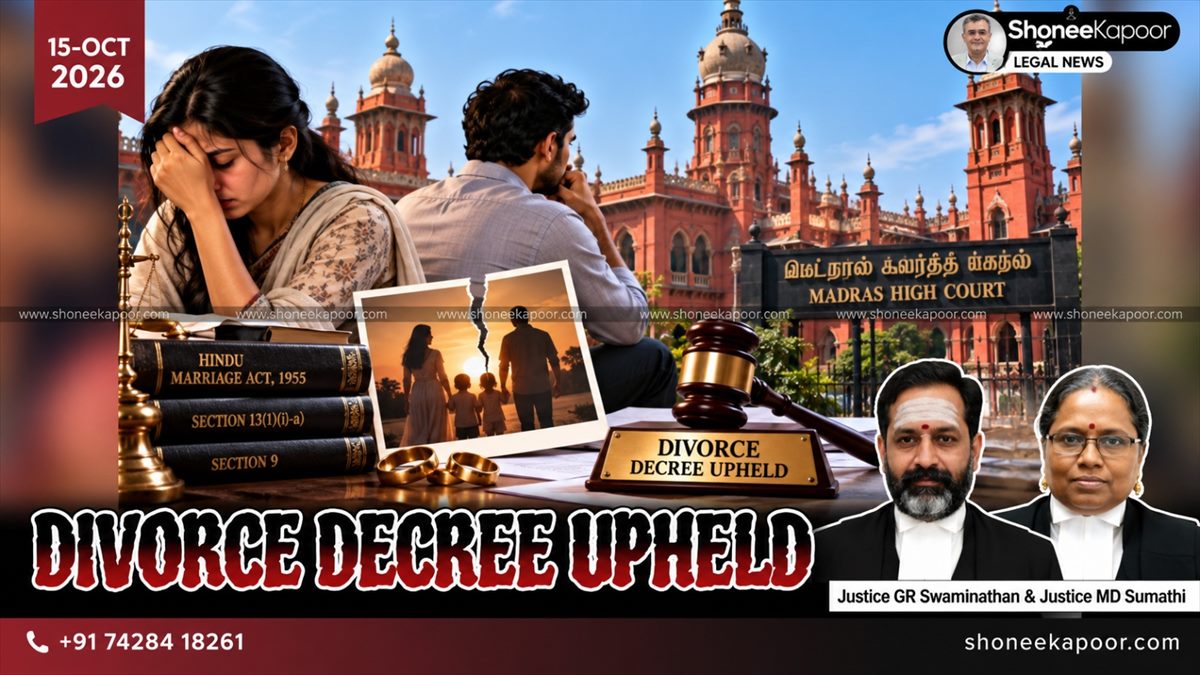
Husband Or Wife Can't Be Forced To Continue A Broken Marriage For The Welfare Of Children: Madras High Court Upholds Divorce

Curated by NEWS DESK
Editorial DeskMADRAS: The Madras High Court has upheld a divorce decree granted to a wife and dismissed her husband's petition for restitution of conjugal rights, ruling that the welfare of children cannot be used to force spouses to continue a broken marriage that has become unworkable.
A Division Bench of Justice G.R. Swaminathan and Justice M.D. Sumathi delivered the judgment on October 8, 2026, dismissing two appeals filed by the husband against the Theni Family Court's decision dated July 1, 2022.
The couple had a love marriage on October 23, 2005, which was registered the following day. They had two children, born in 2006 and 2011.
In 2020, the wife approached the Family Court seeking divorce under Section 13(1)(i-a) of the Hindu Marriage Act, 1955, alleging physical violence, mental cruelty, suspicion about her character and threats to her safety. She had also lodged a police complaint in 2019.
The husband denied these allegations and maintained that he had financially supported his wife and children and helped his wife pursue her education.
However, the husband alleged that his wife had developed an extramarital affair with Ramkumar, his paternal uncle's son, who had visited their matrimonial home on July 15, 2019.
According to the husband, despite his warnings, his wife continued the alleged relationship and left the matrimonial home with Ramkumar on September 18, 2019. He lodged a police complaint and claimed that she later returned after promising to resume matrimonial life.
The husband further alleged that his wife had injured herself and filed a false police complaint against him, accusing him of causing the injury. These remained allegations made by the husband and were not separate criminal findings established by the High Court.
Despite the serious allegations, the husband expressed willingness to forgive his wife and continue the marriage for the welfare of their two children.
He subsequently filed a petition under Section 9 of the Hindu Marriage Act, 1955, seeking restitution of conjugal rights.
The wife opposed his petition and maintained her allegations of matrimonial cruelty.
After examining the evidence, the Theni Family Court observed that the wife had not given a strong or categorical denial of the alleged extramarital relationship with Ramkumar. The Court also considered her admission during cross-examination that she had travelled to Cuddalore with him on September 18, 2019.
The Family Court concluded that the serious allegations, police complaints and breakdown of mutual trust had made peaceful matrimonial life practically impossible.
Read Also:- Children of Warring Couples. Custody Battles. Parental Alienation. Indian Laws.
Accordingly, the Family Court granted the wife a divorce and dismissed the husband's petition for restitution of conjugal rights.
Challenging both decisions before the Madras High Court, the husband argued that the Family Court had failed to properly establish cruelty and had overlooked his willingness to forgive his wife and save the marriage for their children.
The High Court examined the evidence and held that one spouse's willingness to continue the marriage cannot alone restore a relationship when mutual trust has been seriously damaged.
Referring to the Supreme Court's judgment in Amutha v. A.R. Subramanian, 2024 SCC OnLine SC 3822, the Bench reproduced the following observation:
“Marriage is a relationship built on mutual trust, companionship, and shared experiences. When these essential elements are missing for an extended period, the marital bond becomes a mere legal formality devoid of any substance. This Court has consistently held that prolonged separation, coupled with inability to reconcile, is a relevant factor in deciding matrimonial disputes. In the present case, the length of separation and the evident animosity between the parties make it clear that there is no possibility of the marriage being revived.”
The High Court also referred to Chetan Dass v. Kamla Devi, (2001) 4 SCC 250, in which the Supreme Court observed:
“Matrimonial matters are matters of delicate human and emotional relationship. It demands mutual trust, regard, respect, love and affection with sufficient play for reasonable adjustments with the spouse.”
The Bench clarified that irretrievable breakdown of marriage cannot automatically become a ground for granting divorce. Courts must examine the evidence, the conduct of both spouses, the possibility of reconciliation, and the individual circumstances of each matrimonial dispute.
Addressing the husband's argument regarding the welfare of his children, the High Court held that children's welfare cannot justify forcing parents to continue an unworkable marriage.
Read Also:- भारत में पिता को चाइल्ड कस्टडी क्यों नहीं मिलती? कानून बराबर है, सिस्टम नहीं
The Court observed that children need more than financial security and material comforts. Constant matrimonial disputes, parental conflicts and emotional distance can seriously affect their childhood, mental peace and sense of security.
However, the Bench also emphasised that divorce does not end a father's relationship with his children.
The Court held that a father's responsibilities continue even after divorce, including financial assistance, emotional support, affection, guidance and parental care.
It further clarified that both parents remain responsible for their children's welfare after divorce, but children's interests cannot independently justify forcing spouses to remain in a marriage that has completely broken down.
The High Court found that the Family Court had properly examined the evidence, police complaints, allegations of cruelty, alleged extramarital relationship and loss of mutual trust between the spouses.
It concluded that the husband's willingness to forgive his wife and resume matrimonial life alone could not establish a realistic possibility of peaceful reconciliation.
Accordingly, the Madras High Court dismissed both appeals filed by the husband, upheld the divorce decree and confirmed the rejection of the husband's petition for restitution of conjugal rights under Section 9 of the Hindu Marriage Act.
The Court passed no order as to costs and closed the connected miscellaneous petition.
Read Also:- How to get Child Custody as a Father in India: Laws, Strategy & Complete Guide
EXPLANATORY TABLE OF LAWS AND SECTIONS
| Law / Section | What It Means | Application In This Case |
|---|---|---|
| Section 13(1)(i-a), Hindu Marriage Act, 1955 | Provides divorce on the ground of cruelty. | The wife sought divorce alleging physical and mental cruelty. The divorce decree was upheld. |
| Section 9, Hindu Marriage Act, 1955 | Allows a spouse to seek restitution of conjugal rights when the other spouse withdraws from matrimonial society without reasonable excuse. | The husband's petition to restore the matrimonial life was dismissed. |
| Section 19, Family Courts Act, 1984 | Provides for appeals against certain judgments and orders of Family Courts. | The husband challenged the Family Court's common order through two appeals before the High Court. |
CASE DETAILS
| Particular | Details |
|---|---|
| Case Title | G v. B |
| Court | Madurai Bench of Madras High Court |
| Case Numbers | C.M.A. (MD) Nos. 804 and 805 of 2022 |
| CNR Number | HCMD010757802022 |
| Connected Petition | C.M.P. (MD) No. 7377 of 2022 |
| Bench | Justice G.R. Swaminathan and Justice M.D. Sumathi |
| Judgment Authored By | Justice M.D. Sumathi |
| Counsel for Appellant (Husband) | Mr. D. Malaichamy |
| Counsel for Respondent (Wife) | Mr. M.S. Jeyakarthick |
| Judgment Reserved | 10 September 2026 |
| Judgment Delivered | 8 October 2026 |
| Final Decision | Both husband's appeals dismissed; wife's divorce decree upheld; husband's restitution petition rejected. |
KEY TAKEAWAYS
- Marriage Cannot Be Forced For Children's Sake: Madras High Court ruled that neither husband nor wife can be forced to continue a broken marriage merely for the welfare of their children.
- Husband's Willingness Alone Not Enough: Even if a husband is ready to forgive his wife and save the marriage, the Court cannot force reconciliation when mutual trust has broken down.
- Children Need Peace, Not A Forced Marriage: The Court held that constant parental conflicts can harm children. Living together under one roof does not guarantee a happy family.
- Divorce Ends Marriage, Not Fatherhood: A divorce decree cannot end a father's relationship with his children. His financial, emotional and parental responsibilities continue even after separation.
- A Father's Commitment Deserves Recognition: The husband wanted to preserve his marriage for his children's welfare, but his plea was rejected. A father's love and willingness to save his family deserve consideration, even when the marriage cannot legally be restored.
Share Your Thoughts
Comments are moderated before publication.