
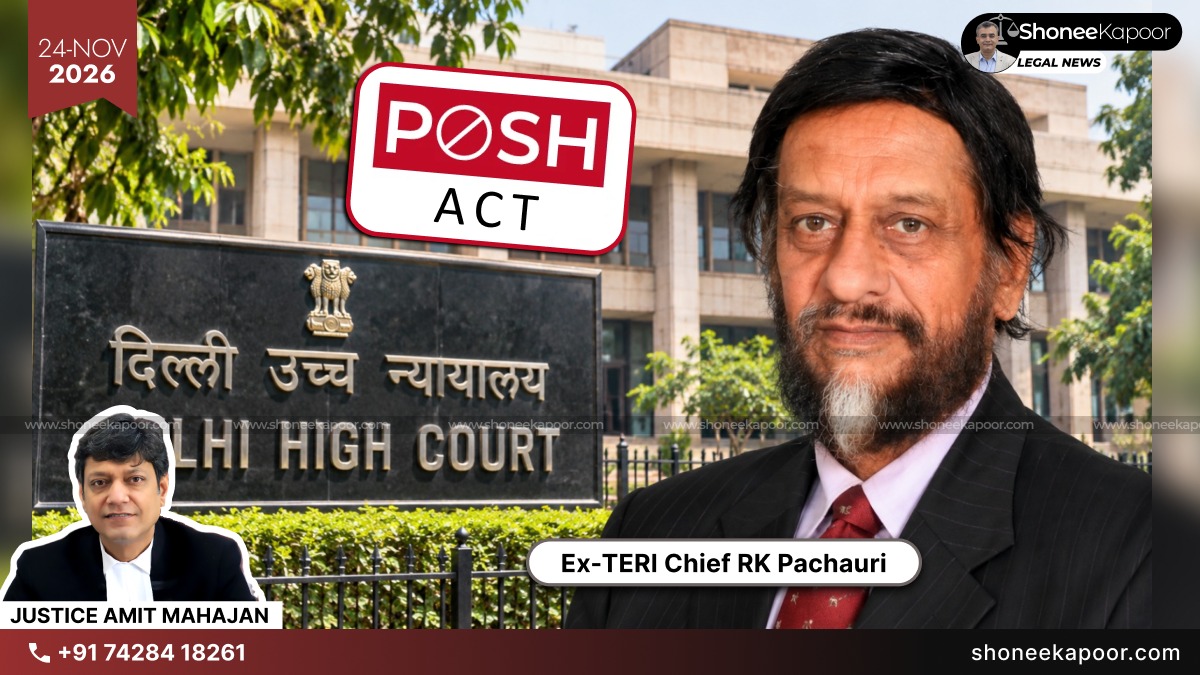
POSH Act | Sexual Harassment Findings Against ex-TERI Chief RK Pachauri Set Aside After 11 Years: Delhi HC Orders Fresh Probe

Curated by NEWS DESK
Editorial DeskNEW DELHI: The Delhi High Court has set aside the sexual harassment findings against former Director General of The Energy and Resources Institute (TERI), RK Pachauri, after holding that its Internal Complaints Committee (ICC) lacked the jurisdiction to investigate the complaint against him.
On November 17, 2026, Justice Amit Mahajan directed the competent district-level Local Committee to reconsider the complaint under the POSH Act, 2013.
In February 2015, a woman research assistant working at TERI accused Pachauri of sexual harassment. The ICC conducted an inquiry and found him guilty in its report dated May 19, 2015.
Pachauri denied the allegations and challenged the findings before the Industrial Tribunal. However, the Tribunal upheld the ICC's findings on July 3, 2023.
Read Also:- When Protection Becomes Punishment: Supreme Court Raises Alarm on PoSH Misuse
Pachauri had passed away in February 2020. His legal representatives subsequently approached the Delhi High Court, challenging both decisions.
His counsel argued that Pachauri, being the Director General of TERI, came within the definition of an employer under the POSH Act. Therefore, under Section 6 of the POSH Act, only the competent Local Committee could investigate the complaint against him.
It was also argued that Pachauri was not provided with copies of witness statements or an opportunity to cross-examine the witnesses.
The High Court clarified that although cross-examination is not an absolute right in sexual harassment proceedings, a person facing adverse findings must be provided a reasonable opportunity to defend himself.
The Court further explained that witness statements and documents relied upon against an accused must be supplied to him to enable an effective defence.
The Court emphasised that a lower standard of proof in sexual harassment inquiries does not remove the requirement of procedural fairness.
Accordingly, the High Court set aside both the ICC report and the Industrial Tribunal's judgment and directed fresh consideration by the competent Local Committee.
The Court also directed that the legal feasibility of continuing the proceedings after Pachauri's death must be examined.
EXPLANATORY TABLE OF LAWS AND SECTIONS
| Law / Section | What It Means | Application In This Case |
|---|---|---|
| POSH Act, 2013 | Provides protection against sexual harassment of women at the workplace and establishes a complaint redressal mechanism. | The validity of the inquiry against Pachauri was examined under this Act. |
| Section 2(g), POSH Act | Defines an employer, including persons responsible for the management and supervision of a workplace. | Pachauri was held to fall within the definition of an employer. |
| Section 4, POSH Act | Provides for the constitution of an Internal Complaints Committee at the workplace. | TERI's ICC lacked jurisdiction to investigate the complaint against its employer. |
| Section 6, POSH Act | Empowers the Local Committee to receive complaints of sexual harassment against an employer. | The complaint was referred to the competent Local Committee for fresh consideration. |
| Principles of Natural Justice | Require impartial proceedings and a reasonable opportunity to defend oneself. | The Court emphasised the need to provide evidence relied upon against the accused. |
CASE DETAILS
| Particular | Details |
|---|---|
| Case Title | AX v. Union of India & Ors. |
| Court | Delhi High Court |
| Bench | Justice Amit Mahajan |
| Judgment Date | November 17, 2026 |
| Neutral Citation | 2026:DHC:10377 |
| Case Numbers | W.P.(C) 8622/2015 and W.P.(C) 11267/2023 |
| Counsel for RK Pachauri | Ashish Dixit and Umar Hashmi, Advocates |
| Counsel for Complainant | Pulkit Malhotra, Advocate |
| Counsel for Union of India | Sandeep Vishnu, Rajesh Kumar, Saumya Johari and N. Kumar |
| Counsel for Respondent No. 4 | Gaurav Gupta, Rupal Gupta and Shambhavi Khare |
| Final Decision | ICC report and Industrial Tribunal judgment set aside; complaint referred to Local Committee for fresh consideration. |
KEY TAKEAWAYS
- Men Deserve Fair Hearings: Sexual harassment allegations cannot override natural justice.
- ICC Must Act Within Its Jurisdiction: Findings without lawful authority cannot stand.
- Right To Defence Is Fundamental: Men must have access to evidence used against them.
- Lower Standard Of Proof Is Not A Licence For Unfair Trials: Procedural safeguards remain mandatory.
- Justice Must Be Gender-Neutral: Protecting women cannot come at the cost of denying men due process
Share Your Thoughts
Comments are moderated before publication.