
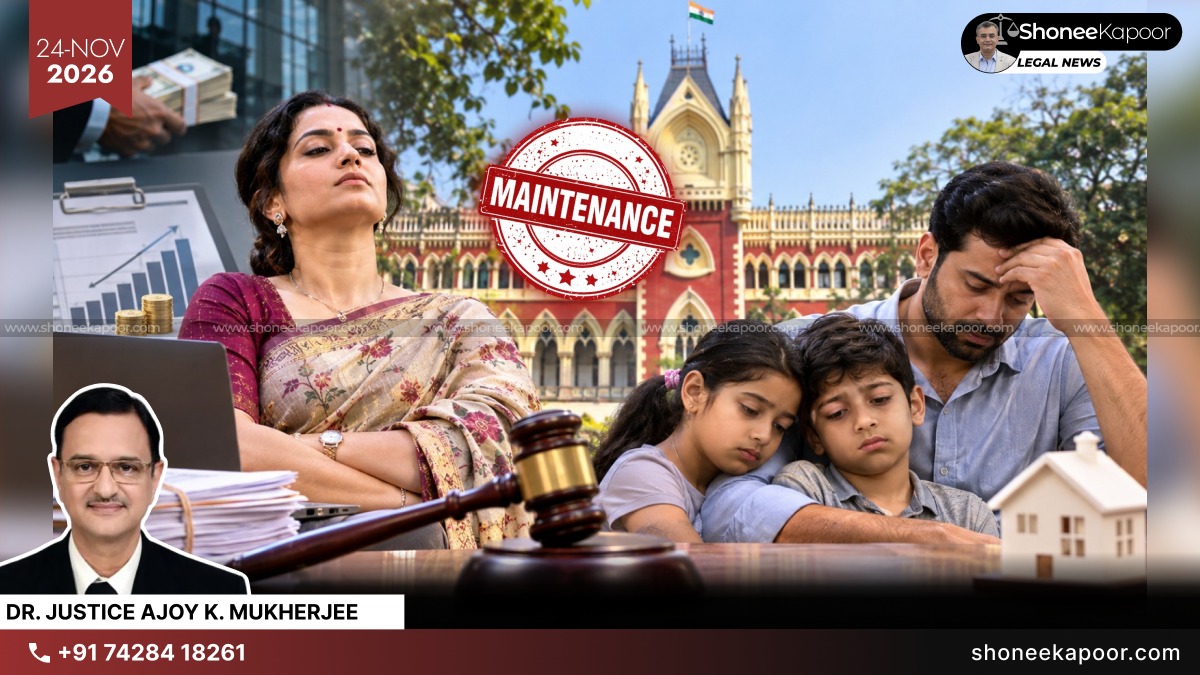
Unemployed Wife Cannot Claim Maintenance Without Disclosing Her Income & Assets: Calcutta High Court Rejects Her Plea

Curated by NEWS DESK
Editorial DeskWEST BENGAL: The Calcutta High Court has upheld an order denying interim maintenance to a wife, observing that her financial resources, bank accounts and access to company funds require examination before deciding her maintenance claim.
Justice Dr. Ajoy Kumar Mukherjee, on November 20, 2026, also upheld the direction requiring the husband to pay Rs. 50,000 per month towards the maintenance of their two children.
The couple married on February 21, 2009, and separated on July 19, 2020. The wife alleged that she was driven out of her matrimonial home after 11 years of marriage.
She initiated criminal proceedings against her husband under Section 498A IPC and other provisions. The case is currently pending trial.
Meanwhile, the husband initiated criminal proceedings alleging that his father-in-law had misappropriated Rs. 75 lakh. However, he could not establish the source of the alleged funds during the investigation.
The husband also filed a child custody case and subsequently sought divorce in 2022. While the children remained in the wife's custody, the husband was granted visitation rights. His divorce proceedings were stayed pending the wife's alimony application.
The wife sought maintenance under Section 125 CrPC and the Domestic Violence Act, 2005, claiming Rs. 5 lakh per month for herself and another Rs. 5 lakh for her children.
On June 20, 2022, the Magistrate awarded Rs. 20,000 per month to the wife, Rs. 15,000 to each child and Rs. 25,000 towards alternative accommodation.
On April 11, 2023, the appellate court set aside the wife's interim maintenance but increased the children's maintenance to Rs. 25,000 each. Both spouses challenged the decision before the High Court.
The wife's counsel argued that she was unemployed and that company assets worth Rs. 43 lakh could not be treated as her personal assets.
Read Also:- Section 498a IPC | 498a Judgments | False Dowry Case | 498a Misuse
The husband's counsel alleged that the wife had concealed her income, investments and majority shareholding in a private company while seeking maintenance.
The appellate court had examined records showing her 99.99% shareholding, substantial bank transactions and a company investment of Rs. 35 lakh generating monthly interest between Rs. 22,000 and Rs. 23,000.
The records also showed that the wife had received interest income exceeding Rs. 23 lakh during the financial year 2019–2020.
The High Court emphasised:
“It is the duty of both the parties (husband and wife) to disclose the actual earnings and non-disclosure of the same is akin to defrauding the court”
The Court clarified that disputed claims regarding the wife's financial resources must be examined through documentary evidence and cross-examination.
However, the High Court rejected the husband's objection to the children's educational expenses, despite his contention that their school admissions were decided without consulting him.
Accordingly, the High Court dismissed all four revision applications, upheld the denial of interim maintenance to the wife and retained the husband's liability to pay Rs. 50,000 per month for both children.
The trial court was directed to decide the pending maintenance proceedings preferably within six months. The wife's final entitlement to maintenance remains open for adjudication.
EXPLANATORY TABLE OF LAWS AND SECTIONS
| Law / Section | What It Means | Application In This Case |
|---|---|---|
| Section 125 CrPC | Maintenance for wives, children and parents. | Wife's interim maintenance denied; children's maintenance upheld. |
| Section 498A IPC | Cruelty by husband or his relatives. | Criminal proceedings initiated by the wife remain pending. |
| Section 406 IPC | Punishment for criminal breach of trust. | Invoked in criminal proceedings between the parties. |
| Section 420 IPC | Cheating and dishonestly inducing delivery of property. | Invoked in criminal proceedings between the parties. |
| Section 467 IPC | Forgery of valuable security, wills and specified documents. | Invoked in the wife's criminal complaint. |
| Section 468 IPC | Forgery for the purpose of cheating. | Invoked in the wife's criminal complaint. |
| Section 471 IPC | Using a forged document as genuine. | Invoked in the wife's criminal complaint. |
| Section 506 IPC | Punishment for criminal intimidation. | Invoked in the husband's criminal complaint. |
| Section 379 IPC | Punishment for theft. | Invoked in the husband's criminal complaint. |
| Section 328 IPC | Causing hurt through poison or specified substances with criminal intent. | Invoked in the husband's criminal complaint. |
| Section 34 IPC | Joint criminal liability for acts committed with common intention. | Invoked in the husband's criminal complaint. |
| Section 12, DV Act | Application before a Magistrate seeking relief under the Act. | Wife sought monetary and other reliefs. |
| Section 23, DV Act | Power to grant interim and ex parte orders. | Relevant to the wife's interim monetary relief application. |
| Section 3, Explanation I(iv), DV Act | Defines economic abuse. | Husband disputed the allegations of economic abuse. |
| Section 58, Indian Evidence Act, 1872 | Admitted facts generally need not be proved. | Husband relied upon the wife's financial admissions. |
| Guardians and Wards Act, 1890 | Governs guardianship and child custody matters. | Husband initiated custody proceedings and obtained visitation rights. |
CASE DETAILS
| Particular | Details |
|---|---|
| Case Title | Mayur Agarwal v. Swati Agarwal |
| Court | Calcutta High Court |
| Neutral Citation | 2026:CHC-AS:2010 |
| Jurisdiction | Criminal Revisional Jurisdiction, Appellate Side |
| Bench | Dr. Justice Ajoy Kumar Mukherjee |
| Case Numbers | CRR 2180/2023, CRR 2181/2023, CRR 2303/2023 and CRR 2304/2023 |
| Husband | Mayur Agarwal |
| Wife | Swati Agarwal |
| Husband's Counsel | Mr. Sourav Chatterjee, Sr. Adv.; Mr. Soumyajit Das Mahapatra; Ms. Madhurai Sinha; Mr. Tasneem Ahamed |
| Wife's Counsel | Mr. Sandipan Ganguly, Sr. Adv.; Mr. Satadru Lahiri; Mr. Rishav Singh; Mr. Soumalya Dutta |
| Maintenance Case | M-383/2020 |
| Domestic Violence Case | C-1436/2020 |
| Child Custody Case | Act VIII Case No. 135/2021 |
| Divorce Case | Matrimonial Suit No. 3803/2022 |
| Alimony Application | Misc. Case No. 97/2023 |
| Original Maintenance Order | June 20, 2022 |
| Criminal Appeal Numbers | 79/2022 and 80/2022 |
| Criminal Motion Numbers | 194/2022 and 201/2022 |
| Impugned Order | April 11, 2023 |
| Final Decision | All four revision applications dismissed; wife's interim maintenance denied; Rs. 50,000 monthly maintenance for children upheld. |
KEY TAKEAWAYS
- Unemployment Is Not A Free Pass: A wife cannot claim maintenance merely by declaring herself unemployed.
- Husbands Are Not ATMs: Maintenance must be based on genuine financial need, not marital status alone.
- Hiding Income Is Deceiving The Court: Financial disclosure cannot be a one-sided obligation imposed on men.
- Financial Accountability Must Be Gender-Neutral: A wife's assets, investments and earnings deserve equal scrutiny.
- Maintenance Is Not A Reward For Marriage: A man's hard-earned money cannot be claimed without establishing legal entitlement.
Share Your Thoughts
Comments are moderated before publication.