
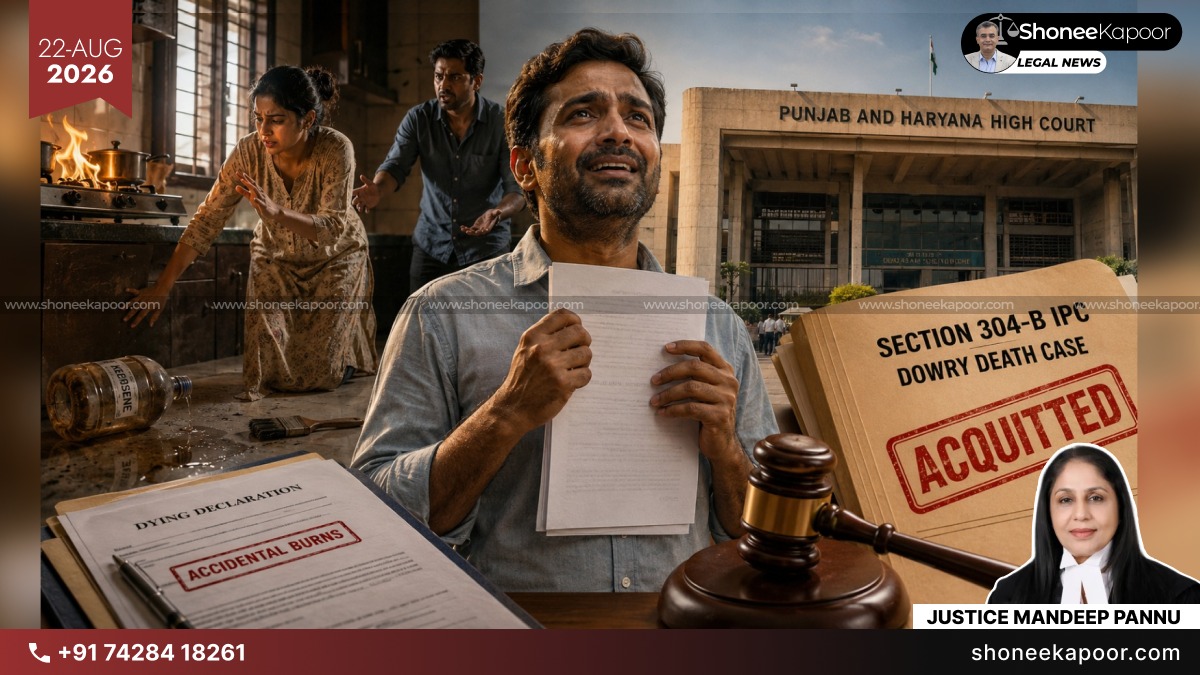
Husband Convicted Of Dowry Death Despite Wife’s Dying Declaration Saying Burns Were Accidental; Punjab & Haryana High Court Acquits After 22 Years

Curated by NEWS DESK
Editorial DeskHer own dying declaration did not blame her husband, and no complaint was made while she remained alive for five days. So how did he still spend 22 years fighting a dowry-death conviction before the Punjab & Haryana High Court found reasonable doubt?
CHANDIGARH: The Punjab & Haryana High Court has acquitted a husband convicted under Section 304-B IPC for dowry death, holding that the prosecution failed to establish the basic ingredients necessary to raise the statutory presumption against him.
Justice Mandeep Pannu allowed the husband's criminal appeal against his 2004 conviction and seven years of rigorous imprisonment. The Court also dismissed the revision filed by the deceased woman's father seeking enhancement of the husband's sentence.
The case arose from an incident dated 4 August 1998, when the wife suffered about 90% burn injuries at her matrimonial home. Her husband and neighbours first took her to the Railway Hospital, and she was later shifted to PGI, Chandigarh. She died on 9 August 1998.
Significantly, the woman's earliest version before the doctor was that the burns were accidental. Later that same day, a Judicial Magistrate recorded her statement after obtaining a medical opinion about her fitness.
She stated that she was painting the kitchen wall and, while soaking the paintbrush in kerosene, kerosene splashed on her clothes and the floor. The bottle also fell, and because the gas stove was on, her clothes caught fire.
She did not accuse her husband or his family of setting her on fire.
The High Court found this circumstance important and observed:
“The prosecution is also required to rule out the possibility of an accidental death before the statutory presumption can be invoked.”
The Court explained that an unnatural death in a matrimonial home is not, by itself, enough for conviction under Section 304-B IPC. The prosecution must first prove dowry-related cruelty or harassment “soon before” the woman's death.
The Court said the expression “soon before” requires a “proximate and live link” between the alleged dowry-related cruelty and the death.
The Bench further observed:
“In the present case, the position is somewhat different and, in fact, significant for the appellant. The dying declaration recorded by the Judicial Magistrate does not implicate the appellant. Rather, the deceased stated that she had sustained the burn injuries accidentally.”
The woman remained alive for around five days after the incident. Her parents reached PGI during this period, and her mother had access to her. However, no complaint accusing the husband of deliberately burning her or alleging that her dying declaration had been given under pressure was made while she was alive.
The FIR was registered only after her death. The High Court clarified that delay in filing an FIR is not automatically fatal to a prosecution case. However, in this case, the delay became important when read together with the woman's two contemporaneous versions supporting accidental burning.
The prosecution also relied upon a note dated 3 May 1998, allegedly written by the deceased, containing allegations of harassment and dowry demand. However, the High Court found problems concerning both its recovery and authorship. Expert opinions on the handwriting conflicted.
The Court also found that the allegations of harassment were largely general and that reliable evidence establishing dowry-related cruelty soon before the death was missing.
On the prosecution theory that the husband could have caused the fire and then returned shortly afterwards to create a defence, the High Court categorically observed:
“A conviction cannot rest upon a possibility or conjecture, particularly when the deceased herself had given a version of accidental burning.”
The Court further made it clear that an accused is not required to first prove his innocence. It held that the prosecution must establish the foundational facts of the offence before the burden can operate against the accused.
The Bench then considered Section 113-B of the Evidence Act, which provides a statutory presumption regarding dowry death after the necessary foundational requirements are established.
The Court observed:
“The statutory presumption under Section 113-B of the Evidence Act, therefore, cannot be invoked mechanically.”
It held that the prosecution had failed to prove beyond reasonable doubt that the deceased had suffered dowry-related cruelty or harassment at the hands of the husband soon before her death.
While recognising the need for sensitivity in dowry death cases, the High Court stressed that this cannot dilute the criminal standard of proof. It observed that courts must balance the social purpose of dowry laws with “the equally fundamental principle that an accused cannot be convicted merely on suspicion, however strong it may be.”
The High Court ultimately found several circumstances creating reasonable doubt: the deceased's earliest statement describing an accident, her dying declaration before a Judicial Magistrate, her failure to implicate the husband, absence of a complaint during the five days she remained alive, registration of the FIR only after her death, doubts surrounding the alleged note, conflicting handwriting opinions and lack of reliable evidence showing proximate dowry-related cruelty.
The Court held that the possibility of accidental burning had not been conclusively excluded and the prosecution had failed to establish the foundational requirements of Section 304-B IPC.
Accordingly, the High Court set aside the husband's conviction, acquitted him of the dowry death charge and dismissed the complainant's revision seeking enhancement of his sentence.
EXPLANATORY TABLE OF LAWS AND SECTIONS
| Law / Section | Simple Meaning | Application in This Case |
|---|---|---|
| Section 304-B IPC | Deals with dowry death. Among its requirements, the prosecution must establish a qualifying unnatural death within seven years of marriage and dowry-related cruelty or harassment soon before death. | Husband was convicted under this section and sentenced to 7 years' RI. High Court held that the foundational requirements were not proved beyond reasonable doubt and acquitted him. |
| Section 302 IPC | Punishment for murder. | The trial court framed an alternative charge under Section 302 IPC. The trial court acquitted the husband of this charge. |
| Section 498-A IPC | Punishes specified cruelty by husband or relatives of husband against a married woman. | Charge was framed under Section 498-A. The trial court considered a separate conviction unnecessary after convicting him under Section 304-B. |
| Section 113-B, Indian Evidence Act | Creates a statutory presumption regarding dowry death once the necessary foundational facts are proved. | High Court held this presumption “cannot be invoked mechanically” because the prosecution had first failed to prove the necessary ingredients of Section 304-B IPC. |
| Section 313 CrPC | Gives an accused an opportunity to personally explain incriminating circumstances appearing in prosecution evidence. | The husband denied dowry demand and cruelty, pleaded false implication and maintained that the burns were accidental. |
CASE DETAILS
| Particular | Details |
|---|---|
| Case Title | Bhanu Parkash v. State of Haryana; connected with Sakesh Mani Sharma v. Bhanu Parkash & Anr. |
| Case Numbers | CRA-S No. 2515-SB of 2004; CRR No. 695 of 2005 |
| Court | Punjab & Haryana High Court at Chandigarh |
| Neutral Citation | 2026:PHHC:113716 |
| Reserved On | 10 August 2026 |
| Pronounced On | 18 August 2026 |
| Bench | Justice Mandeep Pannu |
| Trial Court | Additional Sessions Judge, Jagadhri |
KEY TAKEAWAYS
- Her own dying declaration did not blame the husband — she said the burns were accidental, yet he still carried a dowry-death conviction for over two decades.
- No complaint was made while she was alive — she survived for about five days; her family met her, but the criminal accusation against the husband came only after her death.
- A man cannot be convicted because a story sounds possible — the High Court made it clear: “A conviction cannot rest upon a possibility or conjecture.”
- Section 304-B is not a shortcut to presume the husband guilty — dowry-related cruelty “soon before” death must first be proved before the statutory presumption can even arise.
- The real punishment was the 22-year wait for the system to recognise reasonable doubt — when even the deceased’s own version supported accidental burning, the husband still had to fight for decades to clear his name
Share Your Thoughts
Comments are moderated before publication.