
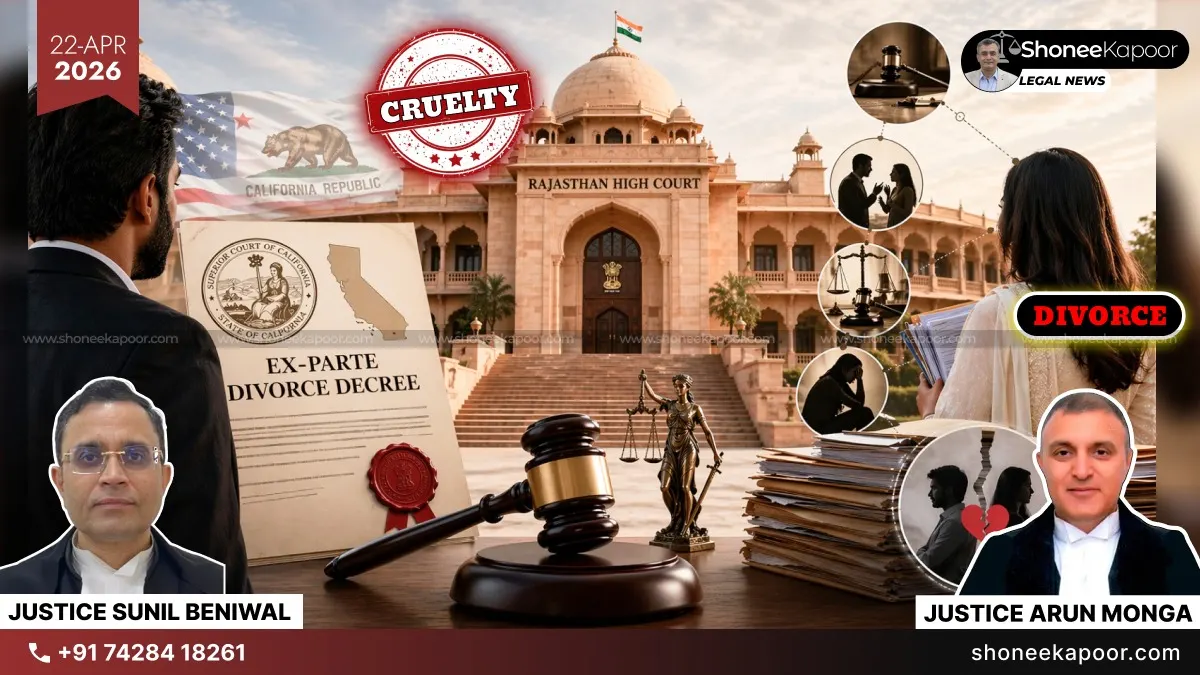
Can a husband be pushed into years of legal uncertainty even after obtaining a foreign divorce decree, only to face continued litigation in India?
The Rajasthan High Court held that foreign divorce orders are not automatically valid in India and granted divorce to wife after prolonged litigation.
In a recent judgment, Hon’ble Mr. Justice Arun Monga and Hon’ble Mr. Justice Sunil Beniwal of the Rajasthan High Court granted divorce to the wife, setting aside the Family Court’s earlier refusal.
The case revolved around a long-broken marriage where both parties had been living separately for years, yet legal relief was denied earlier.
The Court noted that the husband had already obtained an ex parte divorce decree from a California court in 2015. This act was seen as a clear indication that the husband had no intention to continue the marriage. The wife had returned to India in 2013 and since then, both parties were engaged in multiple litigations, with no real effort toward reconciliation.
The Court relied on settled law that while “irretrievable breakdown of marriage” is not a direct ground under Section 13 of the Hindu Marriage Act, the surrounding circumstances can still amount to cruelty. It observed that the relationship had completely failed and continuing it would only worsen the situation for both parties.
The judgment emphasized:
“Irretrievable breakdown of marriage is not included as one of the grounds under Section 13 of the Act of 1955.”
However, it clarified that conduct leading to such a breakdown must be examined under cruelty, and that cruelty cannot be defined in a rigid formula.
The Court further observed, “marriage has irretrievably broken down” but still focused on whether the husband’s actions caused mental cruelty. It clearly held that forcing the parties to stay together in such a situation would be unjust, stating that:
“Compelling the parties to continue in a marriage which has broken down beyond repair would itself amount to cruelty.”
The Court also pointed out that the husband made no serious efforts to reconcile and instead chose legal remedies abroad, strengthening the conclusion that the marriage had ended in substance long ago. The prolonged separation, continuous litigation, and absence of cohabitation made it evident that there was no possibility of restoring the relationship.
This judgment again highlights how matrimonial litigation becomes prolonged and complex, often trapping both parties in years of legal battles. Instead of early resolution, parties are forced into multiple proceedings, increasing emotional and financial burden.
Ultimately, the High Court allowed the appeal and granted divorce, recognizing that the marriage had no real existence left and that continuing it would only cause further harm.
Explanatory Table: Laws And Sections Involved
| Law / Section | Meaning in Simple Language | Role in This Case |
| Section 13, Hindu Marriage Act, 1955 | Main provision for divorce on legal grounds like cruelty, desertion etc. | Wife sought divorce under this section |
| Section 13(1)(i-a), Hindu Marriage Act | Divorce on ground of cruelty | High Court granted relief by treating husband’s conduct as mental cruelty |
| Section 13(1)(i-b), Hindu Marriage Act | Divorce on ground of desertion | Considered during arguments |
| Hindu Marriage Act, 1955 | Governs Hindu marriages and divorce | Core law applicable in dispute |
| Section 14, Code of Civil Procedure (CPC) | Presumption regarding foreign judgments if properly proved | Court discussed whether California decree could be relied upon |
| Principles of Natural Justice / Audi Alteram Partem | No person should be condemned unheard | Foreign ex parte decree seen as unfair to wife |
| Article 142, Constitution of India | Supreme Court’s special power to do complete justice | Court noted only Supreme Court uses it for irretrievable breakdown cases |
| Foreign Judgment Principles | Foreign decree valid only if lawful and fair | California divorce not automatically binding in India |
Case Details
- Case Title: Wife v. Husband
- Court: High Court of Judicature for Rajasthan at Jodhpur
- Case Number: D.B. Civil Misc. Appeal No. 419/2022
- Neutral Citation: 2026:RJ-JD:14686-DB
- Date of Judgment: 06/04/2026
- Bench: Hon’ble Mr. Justice Arun Monga & Hon’ble Mr. Justice Sunil Beniwal
- Counsels:
- For Appellant: Mr. Parvej Khan
- For Respondent: Mr Aman Bishnoi Boia
Key Takeaways
- Men often get trapped in long matrimonial litigation even when the marriage is practically over, leading to years of mental, financial, and legal harassment.
- Courts still hesitate to recognize “irretrievable breakdown” directly, forcing parties—especially men—to fight prolonged cases instead of allowing early exit.
- One-sided actions like foreign ex parte orders or multiple litigations create complex legal battles, where the burden of proving fairness often falls heavily on men.
- Lack of timely resolution and repeated legal proceedings show how the system can be misused to extend pressure rather than resolve disputes.
- Forcing continuation of a dead marriage ultimately harms both sides, highlighting the urgent need for legal reform to prevent unnecessary suffering of men in matrimonial disputes.
This Could Change Your Case-Get FREE Legal Advice-Click Here!
Disclaimer: The views and opinions expressed in this article are those of the Indian courts and do not necessarily reflect the official policy or position of “ShoneeKapoor.com” or its affiliates. This article is intended for informational and educational purposes only. The content provided is not legal advice, and viewers should not act upon this information without seeking professional counsel. Viewer discretion is advised.
