
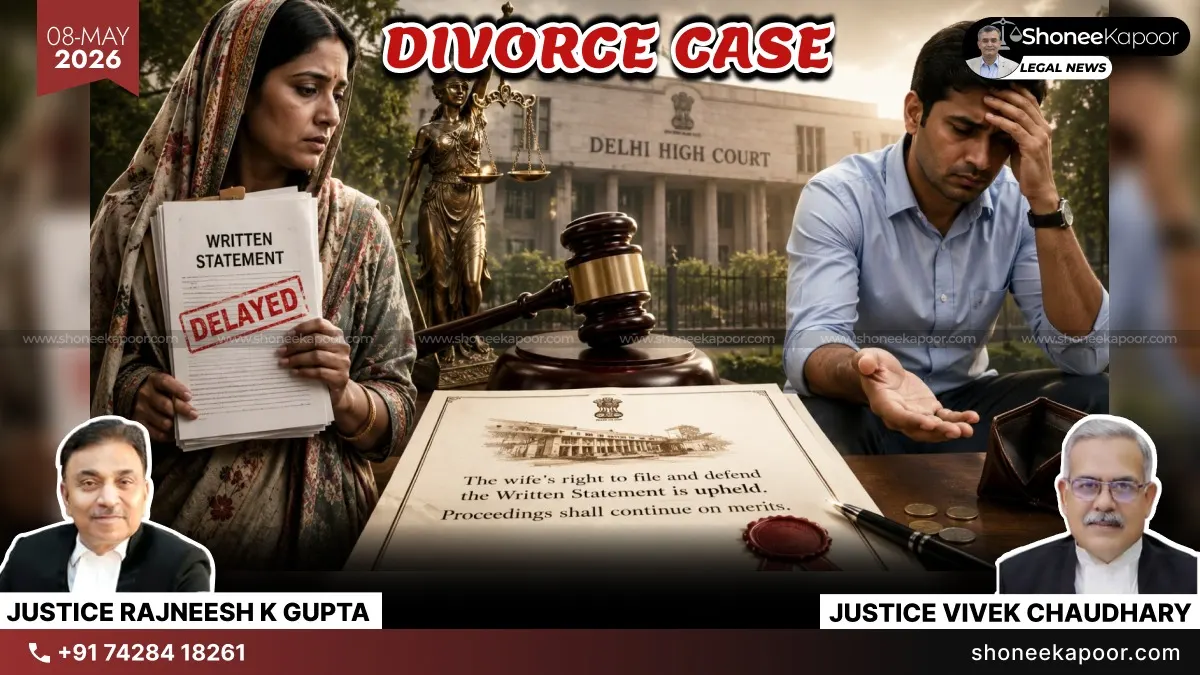
The Delhi High Court restored the wife’s right to defend the divorce case despite delay in filing written statement after the husband failed to pay litigation expenses on time.
Can A Husband’s Inability To Pay Litigation Costs End Up Benefiting The Wife In Divorce Proceedings?
NEW DELHI: The Delhi High Court, comprising Justice Vivek Chaudhary and Justice Rajneesh Kumar Gupta, dismissed an appeal filed by a husband in an ongoing matrimonial dispute arising out of a divorce case.
The dispute started after serious differences developed between the couple, leading to separation. Their minor son is presently living with his wife.
During the proceedings before the Family Court, the wife appeared through legal aid counsel. The Court had directed the husband to pay ₹11,000 towards litigation expenses so that the wife could properly contest the divorce proceedings and arrange legal representation. The wife was also granted time to file her Written Statement.
However, the husband failed to pay the litigation expenses within the time fixed by the Court. At the same time, the wife could not file her Written Statement within the prescribed period. The husband later moved the Family Court seeking strict action against the wife and requested that her defence be struck off completely.
The Family Court initially allowed the husband’s request and closed the wife’s right to file her defence. But later, the wife approached the Court seeking restoration of her right to contest the divorce proceedings. She argued that the husband himself had failed to comply with the earlier direction regarding payment of litigation expenses.
After considering the circumstances, the Family Court restored the wife’s right to defend the case. The husband challenged this order before the Delhi High Court and argued that the wife’s request was delayed and should not have been entertained.
The High Court, however, found that the husband himself had contributed to the situation by not paying the litigation expenses on time. The Court observed:
“Section 23 of the HMA embodies the principle that a party cannot be permitted to take advantage of its own wrong. Though the provision applies at the stage of final adjudication, the underlying principle is one of equity and should apply to the conduct of parties throughout the proceedings.”
The Court further noted that the wife was placed at a disadvantage because the litigation expenses meant for conducting her defence were not paid within time. The judges observed:
“It was incumbent upon the appellant to pay the litigation expenses directed by the Family Court in time to enable the respondent to conduct her case properly. Appellant cannot be permitted, by his conduct, to put the respondent at a disadvantage and thereafter claim benefit of the same.”
The Delhi High Court also rejected the husband’s argument that the delay in filing the Written Statement was fatal. The Court observed that procedural timelines can be relaxed in appropriate cases where justice demands it.
While dismissing the husband’s appeal, the Court made strong observations against allowing a litigant to benefit from his own failure. The Court held:
“The equitable principle reflected in Section 23 squarely applies. The appellant, having failed to comply with the Court’s direction, cannot be permitted to contend that the respondent should suffer the consequences of delay. To permit such a course would amount to allowing the appellant to take advantage of his own default.”
The High Court ultimately upheld the Family Court’s decision restoring the wife’s defence and directed that the divorce proceedings continue on merits before the Family Court.
Explanatory Table: Laws And Sections Involved
| Law / Section | Purpose | Relevance In This Case |
| Section 13(1)(ia), Hindu Marriage Act, 1955 | Provision allowing divorce on ground of cruelty | Husband filed divorce petition under this provision |
| Section 24, Hindu Marriage Act, 1955 | Provision for interim maintenance and litigation expenses | Wife sought maintenance and litigation expenses |
| Section 23, Hindu Marriage Act, 1955 | Prevents a party from taking advantage of their own wrong | High Court relied on this principle while dismissing husband’s appeal |
| Order VIII Rule 1, CPC | Deals with timeline for filing Written Statement | Husband argued wife filed defence beyond limitation |
| Salem Advocate Bar Association, T.N. v. Union of India (2005) 6 SCC 344 | Supreme Court held Written Statement timeline is directory, not mandatory | Used to justify restoration of wife’s defence |
| Sesh Nath Singh v. Baidyabati Sheoraphuli Coop. Bank Ltd. (2021) 7 SCC 313 | Supreme Court held delay can be condoned even without formal application in appropriate cases | Relied upon by Court to support condonation of delay |
| Smt. K.S. Sumi Mol v. Suresh Kumar E.K. | Delhi High Court judgment on speedy matrimonial trials | Husband relied on it, but Court held it was not applicable to facts of this case |
Case Details
- Case Title: Sh. Nikhil Bhatiya v. Ms. Sonam Singh Bhatiya
- Court: Delhi High Court
- Case Number: MAT.APP.(F.C.) 63/2026
- Date Of Judgment: 05 May 2026
- Neutral Citation: 2026:DHC:3804-DB
- Bench: Justice Vivek Chaudhary | Justice Rajneesh Kumar Gupta
- Counsels:
- For Appellant: Mr. Aman Chawla, Advocate
- For Respondent: Respondent in person
Key Takeaways
- Even after filing a cruelty divorce case, husbands can still lose procedural relief over minor technical defaults.
- Matrimonial litigation increasingly punishes procedural lapses by men while extending equitable protection to wives.
- Courts continue prioritising “fair opportunity” for wives even after significant delays in defending cases.
- Husbands in divorce battles are expected to strictly comply with every direction, while delays from the other side are often condoned.
- Matrimonial litigation can become prolonged and exhausting for men despite already broken marriages.
This Could Change Your Case-Get FREE Legal Advice-Click Here!
Disclaimer: The views and opinions expressed in this article are those of the Indian courts and do not necessarily reflect the official policy or position of “ShoneeKapoor.com” or its affiliates. This article is intended for informational and educational purposes only. The content provided is not legal advice, and viewers should not act upon this information without seeking professional counsel. Viewer discretion is advised.
