
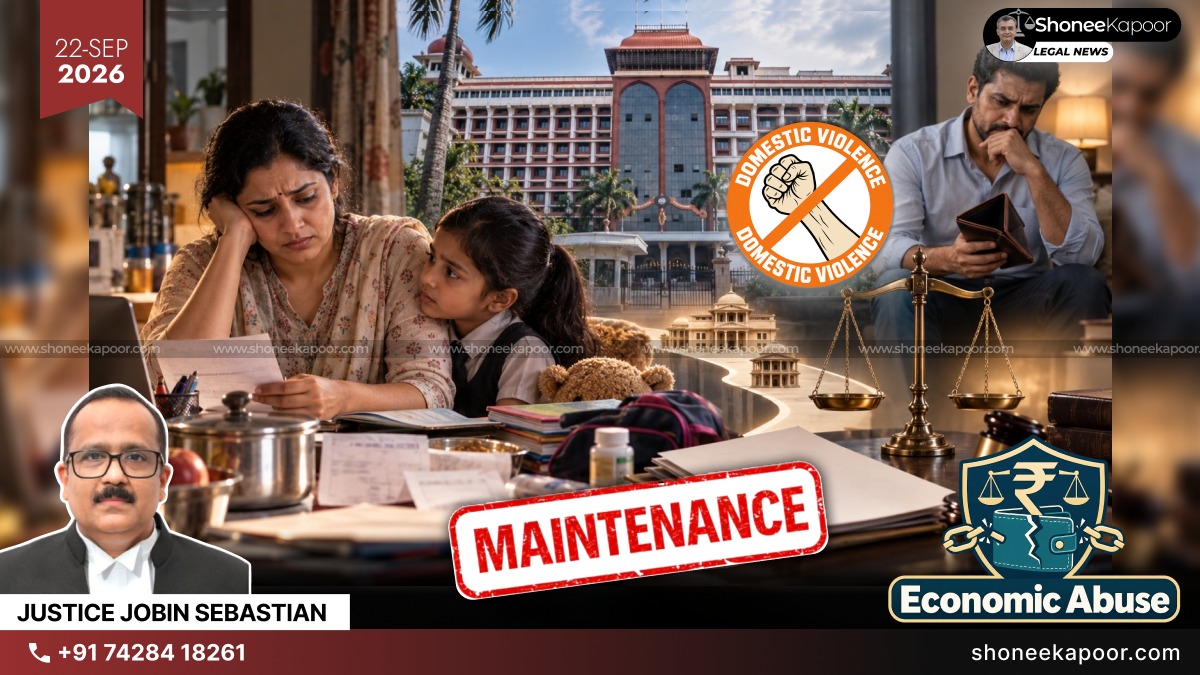
Husband Failing To Pay Maintenance Is Economic Abuse Under Domestic Violence Act: Kerala High Court

Curated by NEWS DESK
Editorial DeskKERALA: The Kerala High Court has held that non-payment of maintenance to a wife and child can itself amount to economic abuse and domestic violence under the Protection of Women from Domestic Violence Act, 2005.
Justice Jobin Sebastian made the observation while dismissing a husband’s criminal revision petition against concurrent orders of the courts below.
The case arose from proceedings filed by the wife under Section 12 of the PWDV Act before the Judicial First Class Magistrate Court, Chittur. The Magistrate directed the husband to pay ₹10,000 per month each to his wife and minor daughter and also awarded ₹2 lakh compensation to the wife for emotional distress. The Sessions Court, Palakkad, later confirmed the order. The husband then approached the High Court.
Before the High Court, the husband argued that the maintenance amount was excessive. His counsel submitted that the wife was educated and had worked as a teacher in a private college. He also questioned the domestic violence allegations and argued that there was no independent evidence supporting the wife’s version.
The wife opposed the revision and argued that the amount was modest considering the present cost of living. Her side also submitted that she had worked in a private institution only for a short period and that this could not take away her claim for maintenance.
While explaining the limited scope of revisional jurisdiction, the High Court relied on the Supreme Court decision in State of Kerala v. Puttumana Illath Jathavedan Namboodiri and quoted:
“In its revisional jurisdiction, the High Court can examine the record to satisfy itself about the correctness, legality or propriety of an order. However, revisional power cannot be equated with appellate jurisdiction, and the High Court should not ordinarily reappreciate evidence already considered by the Magistrate and Sessions Judge, unless a glaring error could result in gross miscarriage of justice.”
On the facts, the Court noted that the wife had deposed about alleged mental and physical cruelty, misappropriation and sale of her gold ornaments for the husband’s business, an alleged illicit relationship and subsequent harassment. She also stated that the husband had not paid any maintenance to her or their child for the previous year. The Court found that her evidence was not discredited during extensive cross-examination.
The High Court further observed that alleged acts of domestic violence generally happen inside the matrimonial home and held that independent corroboration cannot invariably be expected. More significantly for maintenance litigation, the Court noted that even the husband did not claim that he had paid maintenance after the wife left him. It then held that non-payment itself constituted economic abuse and an act of domestic violence.
The husband had also relied on the wife’s previous employment to oppose maintenance. However, evidence from the college principal showed that she had worked there only from June 6, 2019 to February 27, 2020, for around eight months, earning a nominal salary of ₹10,000 per month. The Court held that such short-term employment alone could not justify denying maintenance under the PWDV Act.
The Court further held that maintenance should be just, fair and adequate, keeping in view the status of the parties and the standard of living to which they were accustomed. It found the amount already awarded reasonable in light of the present cost of living.
The Court also observed that the husband had not claimed that he was not able-bodied. It held that a husband has a moral and legal obligation to maintain his wife and child and must provide sufficient maintenance to ensure them a dignified life.
Finding no manifest illegality, perversity or error in the findings of the courts below, the Kerala High Court refused to interfere. It also considered expenses for food, clothing, education, and medical treatment, holding that the maintenance was not excessive. The Criminal Revision Petition was dismissed.
EXPLANATORY TABLE OF LAWS AND SECTIONS
| Law / Provision | What It Means | Application In This Case |
|---|---|---|
| Section 12, Protection of Women from Domestic Violence Act, 2005 | Enables an aggrieved person to approach the Magistrate seeking reliefs available under the PWDV Act. | The wife initiated the proceedings under Section 12 seeking various reliefs. |
| Economic Abuse under PWDV Act | Economic deprivation can fall within domestic violence under the statutory framework. | The High Court held that the husband’s undisputed non-payment of maintenance itself constituted economic abuse and domestic violence in the facts of the case. |
| Revisional Jurisdiction | The High Court ordinarily does not reappreciate evidence like a second appellate court and interferes where findings suffer from illegality, impropriety or perversity. | The Court found no such defect in the concurrent orders and declined interference. |
CASE DETAILS
| Particular | Details |
|---|---|
| Case Title | V v. P & Anr. |
| Neutral Citation | 2026:KER:52406 |
| Case Number | Crl.Rev.Pet. No. 1311 of 2023 |
| CNR | KLHC010963152023 |
| Court | High Court of Kerala at Ernakulam |
| Bench | Justice Jobin Sebastian |
| Decision Date | 15 July 2026 |
| Revision Petitioner Counsel | Jacob Sebastian, Winston K.V., Anu Jacob |
| Respondent Counsel | S. Rajeev, V. Vinay, M.S. Aneer, Prerith Philip Joseph, Anilkumar C.R., K.S. Kiran Krishnan |
| Senior Public Prosecutor | Megha K. Xavier |
| Earlier Proceedings | M.C. No. 76/2018, JFCM Chittur; Criminal Appeal No. 46/2023, Sessions Court, Palakkad |
| Final Result | Revision dismissed. ₹10,000 monthly maintenance each to the wife and daughter, and ₹2 lakh compensation remained undisturbed. |
KEY TAKEAWAYS
- Non-payment became domestic violence: Husband’s failure to pay maintenance was treated as economic abuse and domestic violence.
- Husband’s challenge failed: Kerala High Court dismissed his revision, keeping the financial liability intact.
- ₹20,000 monthly plus ₹2 lakh: Husband must pay ₹10,000 each to wife and daughter, plus compensation.
- Wife worked, still got maintenance: Her short ₹10,000-per-month teaching job did not defeat her maintenance claim.
- Financial difficulty didn’t help: The Court stressed the husband’s obligation to maintain wife and child and noted he was not claimed to be unable-bodied.
Share Your Thoughts
Comments are moderated before publication.