
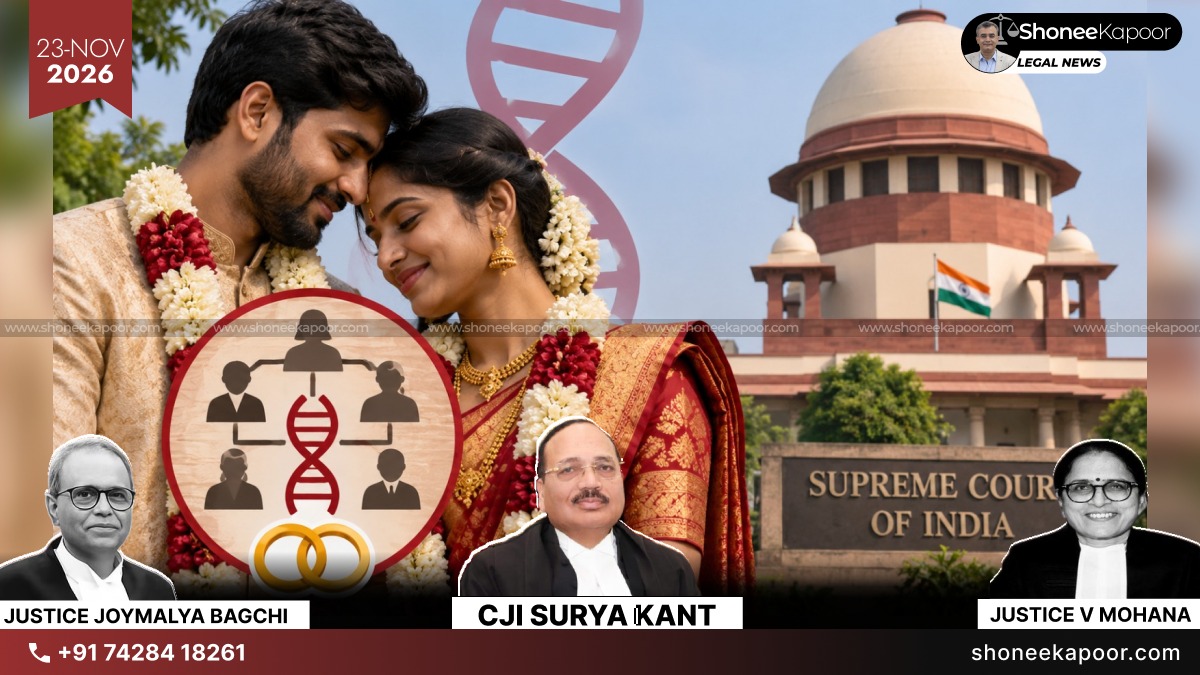
Supreme Court Asks Centre To Consider Law To Curb Marriages Between Close Blood Relatives, Flags Genetic Health Risks To Children

Curated by NEWS DESK
Editorial DeskNEW DELHI: The Supreme Court of India has asked the Central Government to consider introducing legislation to regulate marriages between close blood relatives, amid concerns about genetic disorders and health risks to children born from such marriages.
A three-judge Bench comprising Chief Justice Surya Kant, Justice Joymalya Bagchi and Justice V. Mohana examined a Public Interest Litigation (PIL) challenging legal provisions that permit certain marriages between relatives under recognised customs.
The petition was filed by a 20-year-old law student from the National Law School of India University (NLSIU), Bengaluru, whose parents were first cousins.
The petitioner reportedly suffers from photophobia and cone dystrophy, conditions affecting her vision, and raised concerns about inherited genetic disorders associated with consanguineous marriages.
She questioned the exceptions available under the Hindu Marriage Act, 1955, and the Special Marriage Act, 1954, which allow certain marriages within prohibited relationships where legally recognised customs apply.
The petitioner argued that such practices could expose children to preventable genetic conditions and lifelong medical complications.
Referring to the National Family Health Survey (NFHS), the petition highlighted the prevalence of consanguineous marriages in India, particularly in southern states.
According to the figures cited, approximately 11% of marriages in India involve relatives, while first-cousin marriages account for around 8%.
The petitioner submitted that the health and constitutional rights of children should receive greater consideration when examining customary marriage practices.
The Supreme Court considered whether the issue required legislative intervention rather than an immediate judicial prohibition.
Read Also:- What is Article 21?
The Bench asked the Central Government to examine the possibility of appropriate legislation and educational measures to spread awareness about the genetic risks associated with marriages between close relatives.
EXPLANATORY TABLE OF LAWS AND SECTIONS
| Law / Section | What It Means | Application In This Case |
|---|---|---|
| Section 5(iv), Hindu Marriage Act, 1955 | Prohibits marriages within certain degrees of relationship, subject to valid customary exceptions. | Petitioner challenged the continued recognition of customary exceptions. |
| Section 5(v), Hindu Marriage Act | Restricts marriages between sapindas unless permitted by valid custom. | Relevant to marriages between close relatives. |
| Section 3(f) and 3(g), Hindu Marriage Act | Define sapinda relationships and prohibited degrees of relationship. | Establish the legal meaning of close family relationships. |
| Section 4(d), Special Marriage Act, 1954 | Restricts marriages within prohibited relationships, subject to statutory exceptions. | Petitioner questioned exceptions permitting close-relative marriages. |
| Article 21, Constitution of India | Protects life and personal liberty, including recognised aspects of health. | Relevant to the petitioner's concerns about children's health and genetic disorders. |
CASE DETAILS
| Particular | Details |
|---|---|
| Case Title | Charvi S. v. Union of India & Ors. |
| Court | Supreme Court of India |
| Bench | CJI Surya Kant, Justice Joymalya Bagchi and Justice V. Mohana |
| Hearing Date | 20 November 2026 |
| Diary Number | 23903/2026 |
| Case Category | PIL-W (Public Interest Litigation) |
| Petitioner | 20-year-old NLSIU law student, Bengaluru |
| Respondents | Union of India & Others |
| Senior Advocate for Petitioner | Kaadambari Singh |
| Petitioner's Advocate-on-Record | Anjuman Tripathy |
| Relevant Application | IA No. 348929/2026 – Condonation of Delay in Refiling / Curing Defects |
| Order / Current Status | Limited notice issued to the Centre regarding possible legislation or public awareness measures |
KEY TAKEAWAYS
- Supreme Court Seeks Legal Reform: Centre asked to consider regulating marriages between close blood relatives.
- Customary Marriage Exceptions Questioned: Existing laws permitting certain close-relative marriages face scrutiny.
- Children's Health At Risk: Petition highlights genetic disorders linked to consanguineous marriages.
- Both Parents Bear Responsibility: Children's health must take priority over risky marriage customs.
- Men's Reproductive Rights Matter: Both prospective parents deserve genetic-risk awareness before marriage and parenthood.
Share Your Thoughts
Comments are moderated before publication.