
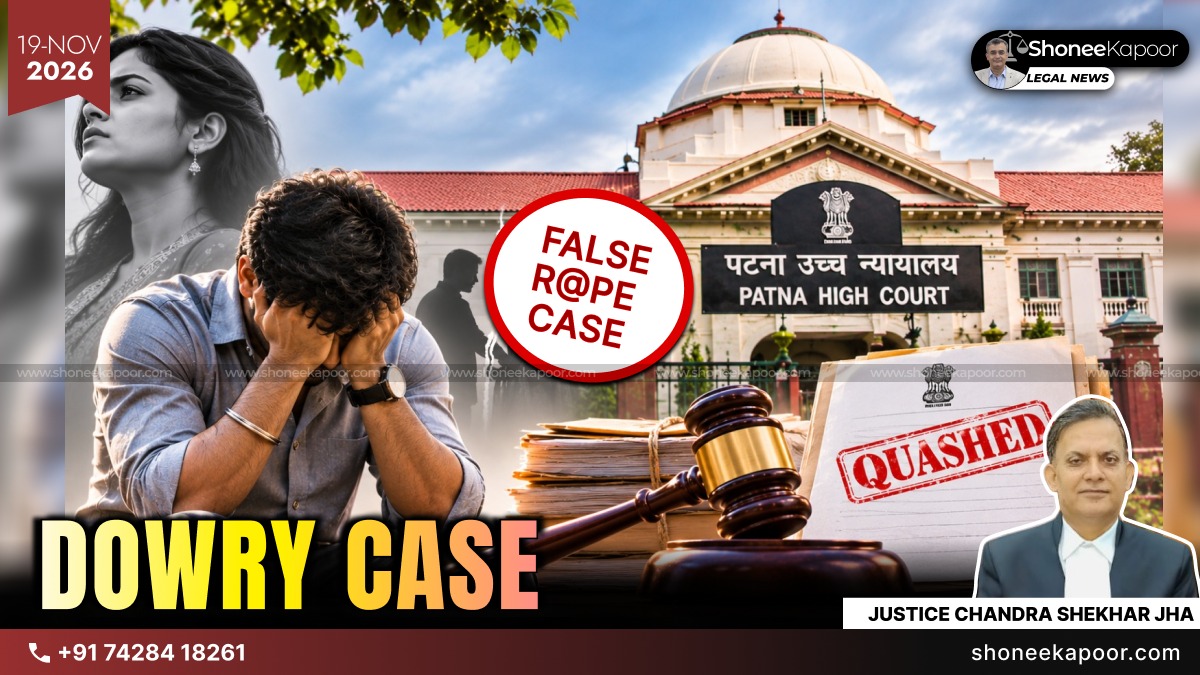
False Rape & Dowry Case Against In-Laws: Patna High Court Quashes Criminal Proceedings After 7 Years Over Unsubstantiated Allegations

Curated by NEWS DESK
Editorial DeskBIHAR: The Patna High Court has quashed criminal proceedings involving allegations of rape and dowry demand against five members of a woman's proposed matrimonial family after taking note of a police investigation that found the allegations to be untrue.
Justice Chandra Shekhar Jha passed the judgment on October 27, 2026, setting aside the cognisance order under Sections 376, 504 and 34 IPC and Sections 3 and 4 of the Dowry Prohibition Act.
Read Also:- How To Remove Name From 498A FIR: An Innocent Husband’s Legal Guide
According to the complaint, the woman's marriage was fixed with a man with the consent of both families. She alleged that the man established physical relations with her on the promise of marriage and raped her on May 2, 2018, with the assistance of another accused.
The woman further alleged that when her mother approached the man's family for marriage, they refused, assaulted her mother and demanded Rs. 2 lakh as dowry.
A panchayat was held on May 5, 2018, but the dispute remained unresolved. Subsequently, an FIR was registered at Mahila Police Station, Madhepura.
Read Also:- Men’s Rights Truth: Sympathy Destroys Innocent Men Trapped in False 498A and Rape Cases
After completing the investigation, the police submitted Final Form No. 5 of 2019 on February 3, 2019, finding the allegations against the petitioners to be untrue.
Despite the police findings, the Sub-Divisional Judicial Magistrate, Madhepura, took cognisance of the offences on March 11, 2019.
The petitioners approached the High Court, arguing that they were innocent and had been falsely implicated in the criminal case.
Their counsel also referred to a compromise petition filed by the woman on October 22, 2018, stating that the dispute had been settled and that the parties did not wish to continue the case.
Read Also:- How to defend a False rape cases in India
The High Court clarified that serious offences like rape cannot be quashed merely because the parties have reached a compromise.
The Court observed:
“It is true that the offences alleged in the present case, particularly the offence under Section 376 of the IPC, are serious in nature and cannot be treated as matters of a purely private dispute merely because the parties have arrived at a compromise.”
The Court further stated:
“The question of quashing, therefore, has to be considered on the basis of the overall facts and circumstances of the case and the materials available on record, and not solely on the ground of settlement between the parties.”
Relying on the Supreme Court judgment in Naushey Ali v. State of U.P. (2025) 4 SCC 78, the High Court considered the police findings, compromise and other material available on record.
The Court observed:
“Having regard to the final form submitted by the police, the subsequent settlement between the parties and the materials available on record, this Court is of the view that continuation of the criminal proceedings against the petitioners, who are proposed in-laws, would not serve the ends of justice.”
Accordingly, the High Court quashed the cognisance order and all consequential criminal proceedings against the petitioners, ending over seven years of litigation following the cognisance order, despite the police finding the allegations untrue in 2019.
EXPLANATORY TABLE OF LAWS AND SECTIONS
| Law / Section | What It Means | Application In This Case |
|---|---|---|
| Section 376 IPC | Provides punishment for rape. | Criminal proceedings against the petitioners were quashed. |
| Section 504 IPC | Punishes intentional insult intended or known to be likely to provoke a breach of peace. | Invoked against the accused family members. |
| Section 34 IPC | Establishes joint criminal liability for acts committed with a common intention. | Invoked to hold the accused jointly liable. |
| Section 3, Dowry Prohibition Act, 1961 | Punishes giving, taking or abetting the giving or taking of dowry. | Proceedings under this provision were quashed. |
| Section 4, Dowry Prohibition Act, 1961 | Punishes demanding dowry. | The woman alleged a dowry demand of Rs. 2 lakh. |
| Section 482 CrPC | Preserves the High Court's inherent powers to prevent abuse of the legal process and secure justice. | Relevant to quashing jurisdiction, though not expressly mentioned in the judgment text. |
CASE DETAILS
| Particular | Details |
|---|---|
| Case Title | Md. Usman & Ors. v. State of Bihar & Anr. |
| Court | High Court of Judicature at Patna |
| Bench | Justice Chandra Shekhar Jha |
| Judgment Date | October 27, 2026 |
| Case Number | Criminal Miscellaneous No. 31199 of 2019 |
| Neutral Citation | Not verified |
| CNR Number | BRHC010463642019 |
| For Petitioners | Mr. Kamal Kishore Singh, Advocate |
| For Opposite Parties | Mr. Tarun Prasad Mandal, APP |
| FIR Number | Mahila P.S. Case No. 24 of 2018 |
| Police Station | Mahila Police Station, Madhepura |
| Final Decision | Petition allowed; cognisance order and consequential proceedings quashed against the petitioners. |
KEY TAKEAWAYS
- No Marriage, Yet Rape & Dowry Case: The woman dragged her proposed in-laws into serious criminal proceedings.
- Police Found Allegations Untrue: Yet the Magistrate initiated criminal proceedings against the family.
- Seven Years Of Life Wasted: The accused fought years of litigation despite favourable police findings.
- Legal Process Became Punishment: The man’s family faced prolonged litigation without conviction.
- Justice Delivered, Accountability Missing: Who will compensate the family for their lost years and legal expenses?
Share Your Thoughts
Comments are moderated before publication.