
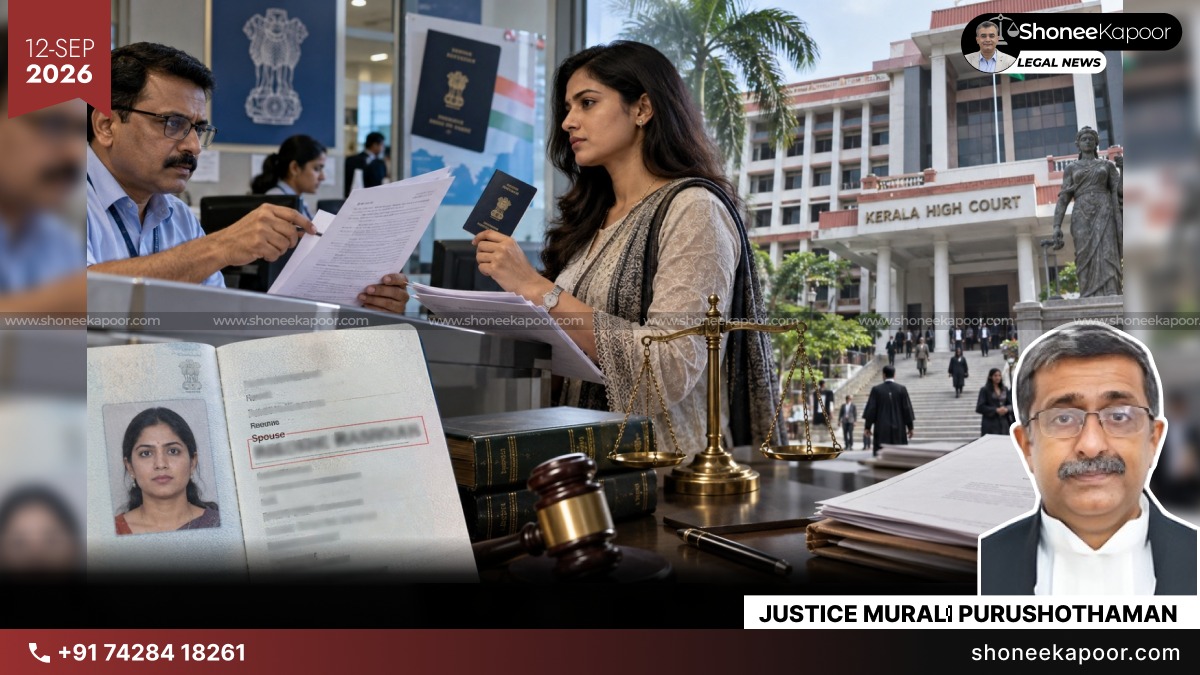
Can Passport Authorities Demand A Divorce Decree For Removing Ex-Spouse’s Name? Kerala High Court Says No

Curated by NEWS DESK
Editorial DeskA divorce is already over, but can passport authorities still demand a court decree before removing the former spouse’s name? The Kerala High Court examined whether an office memorandum could impose a condition that the statutory Passport Rules themselves do not require.
KERALA: The Kerala High Court has held that a divorcee cannot be forced to produce a court divorce decree or judicial separation order merely to change their name or delete the former spouse’s name from an existing passport.
Justice Murali Purushothaman passed the judgment in a petition concerning a woman whose former husband's name continued to appear in the spouse column of her passport. The Court found that the statutory framework under the Passports Rules, 1980 does not require such a divorce decree for this purpose.
The petitioner had married the third respondent on 22 July 2021 according to Muslim religious rites. Their relationship later became strained, and they dissolved the marriage by mutual consent. The parties executed an agreement under which they agreed to pronounce talaq. According to the judgment, the three pronouncements were made on 9 October, 9 November and 9 December 2025.
She thereafter applied for re-issuance of her passport after having her former husband's name deleted. However, the application was not entertained because she had not produced a court divorce order.
The Union authorities relied upon an Office Memorandum dated 6 September 2024. They explained that the passport procedure had earlier been liberalised, but some applicants had allegedly misused the facility by entering another person's name as spouse without that person's knowledge. The memorandum therefore required a divorce order or decree to delete a spouse's name.
The High Court examined the position under Muslim Personal Law and referred to earlier judgments recognising talaq as a legally accepted mode of dissolution of marriage. It relied upon Fathima Abdul Kareem v. State of Kerala and Others, Kanjirathingal Abdul Khader Nissar v. Passport Officer and Ashna Moidu v. Regional Passport Officer. The earlier decisions had recognised that a formal court decree is not the only way to establish dissolution of a Muslim marriage.
More importantly, the Court examined Section IV(B) of the Passport Information Booklet under Schedule III to the Passports Rules, 1980. It specifically covers divorcees applying for a change of name or deletion of a spouse's name from an existing passport.
The statutory provision says “no proof of marriage/dissolution of marriage” is required in the specified categories.
The Court therefore held that divorcees seeking deletion of a former spouse's name need not produce a court order for judicial separation or a decree of divorce. Since the Schedule forms part of the statutory Rules, an administrative direction cannot introduce a documentary condition that the Rules themselves do not require.
The Court emphasised that “office memorandums cannot override” statutory rules.
It also referred to Ayshath Bunayath v. Union of India, where the Kerala High Court had held that passport authorities could not reject a Mubaraat Nama and insist upon a formal divorce decree when Mubaraat constituted a recognised mode of divorce under Muslim Personal Law.
Accordingly, the High Court directed the Regional Passport Officer to reconsider the petitioner's application for re-issuance of her passport and deletion of her former spouse's name without insisting upon a divorce decree from a competent court. The authority was directed to pass appropriate orders in accordance with law within one month of receiving the judgment.
EXPLANATORY TABLE OF LAWS AND SECTIONS
| Law / Provision | What It Means | Application In This Case |
|---|---|---|
| Passports Rules, 1980 | Statutory rules governing passport applications, re-issuance and related documentary requirements. | The Court held that administrative instructions cannot override these Rules. |
| Schedule III, Section IV(B), Passport Information Booklet | Deals with documents for change of name, addition/deletion of spouse's name and related changes following marriage, remarriage or divorce. | The Court found that divorcees seeking deletion of a spouse's name are not required to produce proof of dissolution such as a court divorce decree. |
| Office Memorandum No. VI/401/01/17/2015 dated 06.09.2024 | Administrative instructions requiring specified documents for adding, deleting, or changing a spouse's name in passports. | It required a divorce order/decree to delete a spouse's name. The Court held that this additional requirement could not prevail over the statutory Rules. |
| Muslim Personal Law / Shariat principles | Recognises legally permissible non-court modes of dissolution of Muslim marriages, subject to applicable law. | The Court considered earlier precedents recognising talaq as a mode of divorce and held that a court decree was not indispensable in the circumstances. |
CASE DETAILS
| Particular | Details |
|---|---|
| Case Title | X v. Union of India and Ors. |
| Case Number | WP(C) No. 7305 of 2026 |
| Court | High Court of Kerala at Ernakulam |
| Bench | Justice Murali Purushothaman |
| Counsel for Petitioner | M. Shaju Purushothaman, K.S. Rajesh |
| Counsel appearing for Union authorities | O.M. Shalina, Deputy Solicitor General of India |
| Date of Judgment | 10 August 2026 |
| Neutral Citation | 2026:KER:61152 |
| CNR | KLHC010157442026 |
KEY TAKEAWAYS
- Divorce means the legal link should end too. A man should not be forced to keep carrying his ex-wife’s name on his passport.
- Officials cannot invent extra hurdles. If the Passport Rules do not demand a divorce decree, bureaucracy cannot create one.
- Gender neutrality must work for men too. The same relief available to a divorced woman must equally protect a divorced man.
- An ex-wife’s name is not a harmless entry. It can create problems in remarriage, identity records and personal reputation.
- Men should not remain tied to dead marriages on paper. Once the marriage ends, unnecessary administrative baggage should end with it.
Share Your Thoughts
Comments are moderated before publication.