
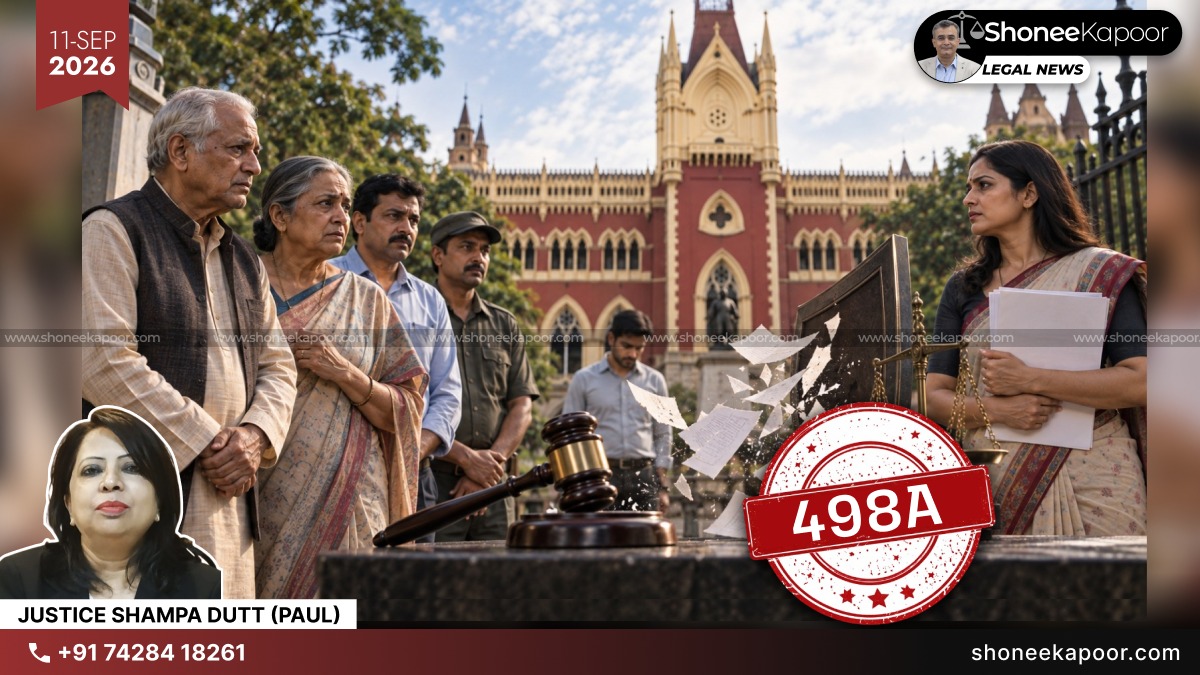
498A Misuse| Wife Accused Husband Of Torture, Parents Dragged In For Not Stopping Him; Calcutta High Court Quashes Case Against In-Laws

Curated by NEWS DESK
Editorial DeskCan parents be prosecuted under Section 498A simply because they allegedly failed to stop their son from mistreating his wife? The Calcutta High Court found the allegations against the in-laws general and held that continuing the criminal case would be an “abuse of the process of law.”
KOLKATA: The Calcutta High Court has quashed criminal proceedings under Sections 498A, 406 and 34 IPC against the parents-in-law of a woman and two other persons after finding that the allegations against them were general and did not contain the ingredients required to constitute the alleged offences.
Justice Shampa Dutt (Paul) was hearing a criminal revision filed by Dr Saibal Adhikari, Sikha Adhikari, Swapna Banerjee and Narayan Chandra Dutta. They sought quashing of proceedings in GR Case No. 5396 of 2021, arising from Belghoria Police Station Case No. 419 of 2021.
The first petitioner was the complainant's father-in-law and the second was her mother-in-law. The third petitioner was a typist working in the pathology laboratory owned by the father-in-law, while the fourth was his driver. The Court noted that petitioners 3 and 4 were not relatives of the husband; therefore, Section 498A IPC did not apply to them.
According to the complaint, the woman alleged that from the second day of her marriage, she was subjected to mental and physical cruelty over dowry demands. She also alleged that her husband, who later died, was addicted to drugs and alcohol and subjected her to mental and physical torture. She further accused him of forcing her to consume alcohol, physically assaulting her and insulting her.
However, as far as the father-in-law and mother-in-law were concerned, the allegation was that they did not take action against their son despite his alleged conduct. After examining the case diary, the High Court found that the principal allegations were actually directed against the deceased husband.
The provision defines “cruelty” to include wilful conduct likely to drive a woman to suicide or cause grave injury or danger to her life, limb or physical or mental health. It also covers harassment intended to force her or her relatives to meet an unlawful demand for property or valuable security.
The High Court relied heavily on the Supreme Court judgment in Dara Lakshmi Narayana & Ors. v. State of Telangana & Anr., which dealt with the growing problem of vague and omnibus allegations against a husband's relatives in matrimonial criminal cases.
The Supreme Court had observed:
“A mere reference to the names of family members in a criminal case arising out of a matrimonial dispute, without specific allegations indicating their active involvement, should be nipped in the bud.”
It further cautioned that there is often a tendency to implicate all members of the husband's family when matrimonial disputes arise, and that general accusations without concrete evidence cannot become the basis for criminal prosecution.
Significantly, the Supreme Court had also observed:
“However, in recent years, as there has been a notable rise in matrimonial disputes across the country, accompanied by growing discord and tension within the institution of marriage, consequently, there has been a growing tendency to misuse provisions like Section 498A of the IPC as a tool for unleashing personal vendetta against the husband and his family by a wife.”
It warned that vague allegations, if not carefully examined, could lead to misuse of criminal proceedings and “arm-twisting tactics” against the husband and his family. At the same time, the Supreme Court clarified that genuine victims of cruelty should not remain silent or be prevented from initiating appropriate criminal proceedings.
The judgment also referred to G.V. Rao v. L.H.V. Prasad, where the Supreme Court had observed:
“There has been an outburst of matrimonial disputes in recent times.”
The Court noted that when elders and relatives are unnecessarily made accused in matrimonial criminal cases, even those who might otherwise help resolve the dispute can become helpless participants in prolonged litigation.
Applying these principles to the present case, the Calcutta High Court found that the material in the case diary disclosed only general allegations against the petitioners and did not establish the essential ingredients of the offences alleged against them.
The Court held:
“As such, permitting the case to proceed against the petitioners herein will clearly be an abuse of the process of law, considering that none of the ingredients required to constitute the offences alleged is present against the petitioners herein.”
Accordingly, the Court allowed CRR 460 of 2023 and quashed the criminal proceedings under Sections 498A, 406 and 34 IPC against Saibal Adhikari, Sikha Adhikari, Swapna Banerjee and Narayan Chandra Dutta.
EXPLANATORY TABLE OF LAWS AND SECTIONS
| Law / Section | What It Means | Application In This Case |
|---|---|---|
| Section 498A IPC | Punishes a husband or his relative for subjecting a married woman to legally defined cruelty. Punishment may extend to three years and fine. | The case was registered under this provision. The Court found general allegations against the petitioners and specifically noted that petitioners 3 and 4 were not relatives of the husband. |
| Section 406 IPC | Deals with punishment for criminal breach of trust. | Proceedings included Section 406, but the High Court found that the ingredients necessary to constitute the alleged offences were absent against the petitioners. |
| Section 34 IPC | Applies where a criminal act is committed by several persons in furtherance of their common intention. | It was invoked along with Sections 498A and 406. The proceedings were ultimately quashed against all four petitioners. |
| Sections 3 & 4, Dowry Prohibition Act, 1961 | Section 3 penalises giving, taking or abetting dowry. Section 4 penalises demanding dowry. | The Supreme Court discussed these provisions in Dara Lakshmi Narayana, which the High Court reproduced and relied upon while examining matrimonial allegations. |
| Section 482 CrPC | Preserves the High Court's inherent powers to prevent abuse of court process and secure the ends of justice. | Discussed in the Supreme Court precedent quoted by the High Court regarding quashing of matrimonial criminal proceedings where prosecution amounts to abuse of process. |
CASE DETAILS
| Particular | Details |
|---|---|
| Case Title | Dr. Saibal Adhikari & Ors. v. The State of West Bengal & Anr. |
| Case Number | CRR 460 of 2023 |
| Court | High Court at Calcutta, Criminal Revisional Jurisdiction, Appellate Side |
| Bench | Justice Shampa Dutt (Paul) |
| Counsel for Petitioners | Mr. Barun Kr. Das, Advocate; Mr. Aritra Bhattacharyya, Advocate; Ms. Priparna Sardar, Advocate; Mr. Rahul Ganguly, Advocate |
| Counsel for State | Mr. Sagar Saha, Advocate; Ms. Nayana Mukhopadhyay, Advocate |
| Judgment Reserved | 31 August 2026 |
| Judgment Delivered | 10 September 2026 |
| Originating Case | GR Case No. 5396 of 2021 arising from Belghoria Police Station Case No. 419 of 2021 |
| Sections Involved | Sections 498A, 406 and 34 IPC |
| Result | Criminal proceedings quashed against all four petitioners |
KEY TAKEAWAYS
- In-laws are not automatic criminals just because their son is accused of cruelty.
- Naming the husband’s entire family is not proof. Vague allegations cannot substitute for specific acts and evidence.
- 498A is not a package deal: accuse the husband and automatically prosecute his parents and relatives too.
- A failed marriage cannot become a licence for family-wide prosecution. Criminal liability must remain individual.
- For innocent family members, the process itself becomes punishment: years of court, legal costs and stigma before vague allegations are finally quashed
Share Your Thoughts
Comments are moderated before publication.