



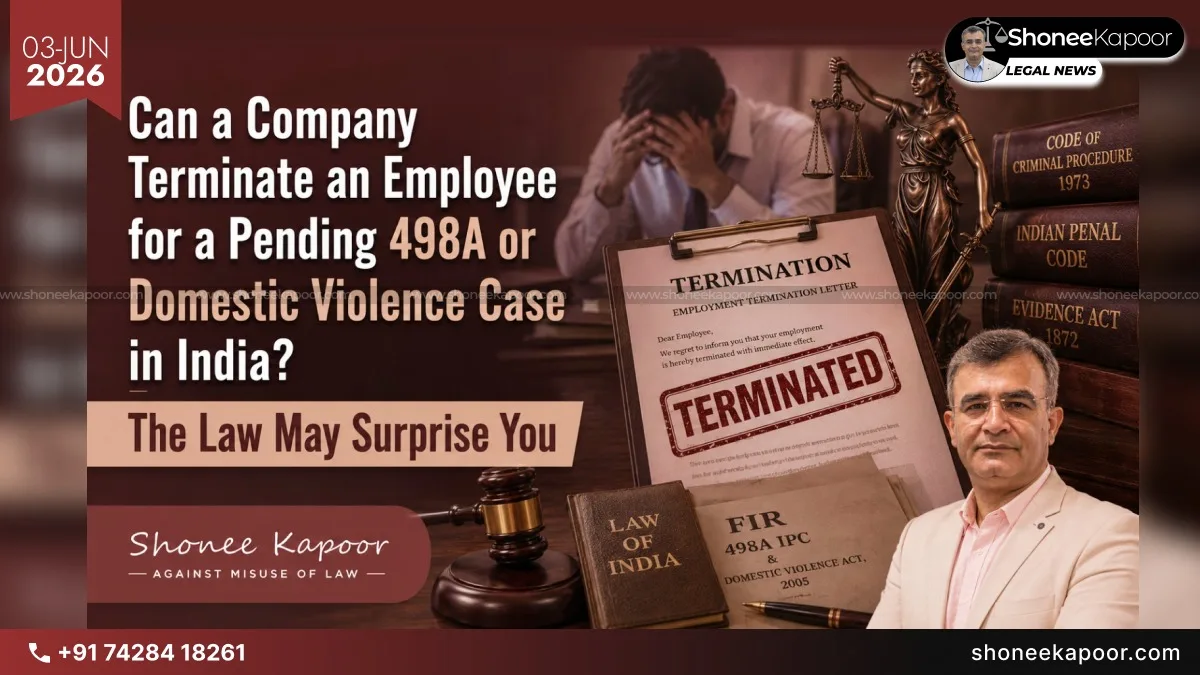
Can a company terminate an employee for a pending 498A or Domestic Violence case in India? Know employee rights, employer powers, case laws and legal remedies.
NEW DELHI: A pending 498A or Domestic Violence case is not a conviction. It is not proof of guilt. It is only an allegation until tested by evidence before a court.
This distinction is where many companies, HR departments and employees go wrong.
In India, a company cannot blindly terminate an employee merely because his wife has filed a 498A case, a Domestic Violence case, or a matrimonial complaint against him. At the same time, an employee cannot assume that employment is completely unaffected in every situation.
The correct legal answer depends on the appointment letter, service rules, nature of employment, disclosure obligations, role sensitivity, arrest, custody, conviction, and whether the allegation has any connection with workplace discipline.
The law is not emotional. The law is evidence-based.
498A, BNS SECTION 85 AND DOMESTIC VIOLENCE: WHAT IS THE LEGAL POSITION?
For offences committed before 1 July 2024, cruelty by husband or relatives was generally prosecuted under Section 498A of the Indian Penal Code. After the new criminal laws came into force, the corresponding provision is Section 85 of the Bharatiya Nyaya Sanhita, 2023, read with Section 86, which defines cruelty.
Section 85 BNS provides punishment for cruelty by husband or relatives of husband. Section 86 explains cruelty as wilful conduct likely to drive a woman to suicide or cause grave injury or danger to life, limb or health, or harassment connected with unlawful demand for property or valuable security.
A Domestic Violence Act case is different. Proceedings under the Protection of Women from Domestic Violence Act, 2005 are largely civil in nature, involving protection, residence, monetary relief, custody and compensation orders. However, breach of a protection order under Section 31 of the DV Act is a criminal offence.
This difference matters.
A mere DV complaint is not the same as a criminal conviction. A pending 498A FIR is also not conviction. Employment cannot be destroyed merely because matrimonial litigation has started.
CAN A PRIVATE COMPANY TERMINATE AN EMPLOYEE BECAUSE A 498A CASE IS PENDING?
Generally, no company should terminate an employee only because a 498A or DV case is pending.
A pending case is only an accusation. Indian criminal law follows presumption of innocence. Unless the employee is convicted, or unless the company proves independent misconduct under employment rules, termination merely due to a matrimonial case can be arbitrary, unfair and legally challengeable.
But there are exceptions.
A company may take action if:
- The employee suppressed a pending criminal case despite being specifically required to disclose it.
- The employment contract or HR policy permits action for criminal proceedings affecting integrity or suitability.
- The employee is arrested and remains absent without authorization.
- The employee is convicted.
- The facts of the case directly affect the employee’s role, trust, safety, compliance or reputation-sensitive position.
- The employee misuses company resources, threatens colleagues, falsifies records or creates workplace misconduct connected to the case.
The key point is simple: termination must be based on contract, policy, misconduct, concealment, conviction or role-related risk — not merely on the wife’s allegation.
SUPREME COURT ON CRIMINAL CASE DISCLOSURE: AVTAR SINGH V. UNION OF INDIA
In Avtar Singh v. Union of India, the Supreme Court laid down important principles on employment and criminal cases. The Court held that information given by a candidate or employee regarding conviction, acquittal, arrest or pendency of a criminal case must be true. Suppression or false disclosure may allow the employer to take action, depending on the facts.
But the Court also made it clear that the employer must consider the nature of the case, seriousness of offence, role involved, and surrounding circumstances.
This means one thing: honesty matters.
If the employment form asks, “Is any criminal case pending against you?” and the employee hides a 498A FIR, the issue becomes not only the 498A case but also suppression of material information.
However, if there was no requirement to disclose, or the case is matrimonial, stale, false, closed, compromised, or unrelated to employment, automatic termination may not stand.
SUPREME COURT IN PAWAN KUMAR: EMPLOYERS MUST NOT ACT MECHANICALLY
In Pawan Kumar v. Union of India, the Supreme Court again emphasized that employers cannot mechanically destroy employment prospects without applying their mind to the nature of the case and surrounding facts.
The Court’s approach was clear: every criminal case is not the same. A petty, compromised, false, matrimonial or irrelevant case cannot be treated like a grave offence involving moral turpitude, violence, corruption or official misconduct.
This principle is very important for men facing matrimonial litigation.
A 498A case is serious on paper. But many 498A cases involve omnibus allegations, entire families, pressure tactics, and exaggerated claims. Courts have repeatedly noticed misuse, though misuse cannot be a ground to strike down the law itself.
Therefore, HR departments must not become punishment departments for matrimonial disputes.
DELHI HIGH COURT IN NIDHI KAUSHIK: DV CASE IS NO BAR TO PROMOTION
In Nidhi Kaushik v. Union of India, the Delhi High Court dealt with an employment-related issue where Domestic Violence proceedings were used against an employee. The legal point noted was that Domestic Violence proceedings are not automatically a criminal offence, except where Section 31 of the DV Act applies for breach of protection order.
This is extremely important.
A DV case by itself should not become a career death sentence. If there is no conviction, no breach of protection order, no workplace misconduct, and no service-rule violation, denying promotion or employment benefit merely because a DV case exists may be legally unsustainable.
CAN GOVERNMENT EMPLOYEES BE TERMINATED FOR PENDING 498A?
Government employment is stricter than private employment because service rules, conduct rules, verification forms and Article 311 protections apply.
A government employee may face:
- Suspension after arrest or custody depending on service rules.
- Departmental inquiry if alleged conduct violates conduct rules.
- Termination or dismissal after conviction.
- Cancellation of candidature for suppression of criminal case.
- Verification-related rejection if the case affects suitability.
But even in government service, pendency alone is not always enough. The employer must follow service rules, principles of natural justice, and binding precedents.
A confirmed government employee generally cannot be removed without due process. A probationer or candidate has fewer protections, but even then the employer must not act mechanically.
CAN DEPARTMENTAL INQUIRY CONTINUE DURING CRIMINAL TRIAL?
Yes, departmental proceedings and criminal proceedings can run simultaneously.
In M. Paul Anthony v. Bharat Gold Mines, the Supreme Court discussed when departmental proceedings may be stayed if the criminal case and departmental case are based on identical facts and the criminal charge is grave. But there is no absolute rule that departmental proceedings must always stop.
In SBI v. Neelam Nag, the Supreme Court held that disciplinary proceedings cannot be kept pending indefinitely merely because a criminal trial is pending.
For a private company, this means the employer may conduct an internal inquiry if workplace misconduct is alleged. But if the case is purely matrimonial and unrelated to work, disciplinary action becomes weak.
WHAT IF THE WIFE SENDS COMPLAINT TO EMPLOYER?
This happens frequently.
A wife or her relatives send emails to HR, directors, company clients, foreign employers, embassies or compliance teams. The intention is often not justice but pressure.
The company should not act as a matrimonial court.
If the complaint only says that a 498A or DV case is pending, the employer should ask for documents, evaluate policy obligations, and give the employee a fair opportunity to respond. Termination without hearing can be challenged.
For the employee, the response should be calm, documented and legal. Do not abuse, threaten or emotionally react.
Submit a short written clarification:
“The matter is a pending matrimonial dispute. There is no conviction against me. I am cooperating with legal process. The allegations are denied and will be contested before the competent court. The matter has no connection with my employment duties.”
That is how a man protects his job without damaging his case.
CAN ARREST LEAD TO TERMINATION?
Arrest is not conviction.
But arrest can create employment consequences if the employee remains absent, is in custody, violates reporting obligations, or the service rules provide for suspension after custody for a specified period.
In 498A matters, the Supreme Court in Arnesh Kumar v. State of Bihar warned against automatic arrests in offences punishable up to seven years and emphasized safeguards before arrest.
This protection is crucial because arrest is often used as a pressure weapon in matrimonial disputes.
If arrested or summoned, the employee should immediately inform his lawyer, seek bail, maintain employer communication through proper channel, and avoid unauthorized absence.
WHAT IF THE EMPLOYEE IS CONVICTED?
Conviction changes everything.
Once an employee is convicted in a criminal case, the employer may have stronger grounds to terminate, especially where the offence involves moral turpitude, violence, cruelty, dishonesty, or conduct incompatible with employment.
But even then, the employer must follow the applicable employment contract, standing orders, service rules or statutory procedure.
If conviction is later stayed or reversed, the employee may seek legal remedies, but reinstatement and back wages are not automatic in every case.
WHAT IF THE EMPLOYEE IS ACQUITTED?
Acquittal strengthens the employee’s case, especially if the acquittal is clean or honourable.
If termination was based only on allegations and the employee is later acquitted, he may challenge the termination, seek reinstatement, compensation or damages depending on employment type and facts.
But acquittal does not automatically erase every employment consequence if the termination was independently based on suppression, misconduct, unauthorized absence or violation of company policy.
PRIVATE COMPANY VS GOVERNMENT JOB: KEY DIFFERENCE
In a private company, the relationship is mainly governed by appointment letter, HR policy, Shops and Establishments law, Industrial Disputes Act where applicable, standing orders if applicable, and contract law.
In government service, constitutional protections, service rules, verification rules, conduct rules and departmental inquiry procedure become more important.
Therefore, the same 498A case may have different employment consequences in:
- A private IT company.
- A bank.
- A police job.
- A defence or paramilitary post.
- A government teaching post.
- A contractual job.
- A probationary appointment.
- A senior compliance or finance role.
The law looks at facts, not slogans.
WHAT SHOULD AN EMPLOYEE DO IF HR ISSUES NOTICE?
If HR issues a notice because of 498A or DV proceedings, the employee should not panic.
He should:
- Ask for the specific policy or clause being invoked.
- Submit a written response.
- State that the matter is pending and allegations are denied.
- Clarify that there is no conviction.
- Attach bail order, court order, closure report, quashing petition status, or relevant documents if helpful.
- Avoid discussing detailed matrimonial facts in HR emails.
- Ask for confidentiality.
- Request that no adverse action be taken without due process.
- Consult a lawyer before signing resignation or settlement.
Never resign under pressure without written legal advice. Many men lose their job not because the company had a strong case, but because they panicked and signed papers.
WHAT SHOULD A COMPANY DO?
A responsible company should not terminate mechanically.
It should:
- Check the appointment letter and policy.
- Verify whether disclosure was required.
- Distinguish between FIR, complaint, charge-sheet, trial, conviction and acquittal.
- Give employee an opportunity to respond.
- Consider whether the case affects the employee’s role.
- Maintain confidentiality.
- Avoid becoming a recovery tool in matrimonial litigation.
- Act only through legally sustainable procedure.
HR is not a family court. HR is not a police station. HR should not punish a man merely because a complaint has been filed.
FINAL LEGAL POSITION
A company cannot automatically terminate an employee merely because a 498A or Domestic Violence case is pending in India.
Termination may be legally sustainable only where there is suppression of material information, conviction, serious role-related risk, unauthorized absence, breach of service rules, or independent misconduct proved through due process.
For men facing matrimonial litigation, the law is clear: allegation is not guilt. FIR is not conviction. DV complaint is not a criminal conviction. Career destruction cannot become an unofficial punishment before trial.
The correct response is not fear. The correct response is documentation, legal strategy and disciplined communication.
A false or exaggerated matrimonial case can damage a man’s peace, reputation and employment. But if handled properly, it need not destroy his career.
FAQs
No. A pending 498A case is not conviction. Termination only on allegation can be challenged.
DV proceedings are largely civil, but breach of a protection order under Section 31 DV Act is a criminal offence.
If your employment form, policy or HR notice requires disclosure, give truthful and limited disclosure.
Arrest is not conviction, but custody, absence or service-rule breach can create employment issues.
Acquittal helps, but reinstatement or compensation depends on why termination happened and what rules applied.

Leave A Comment