
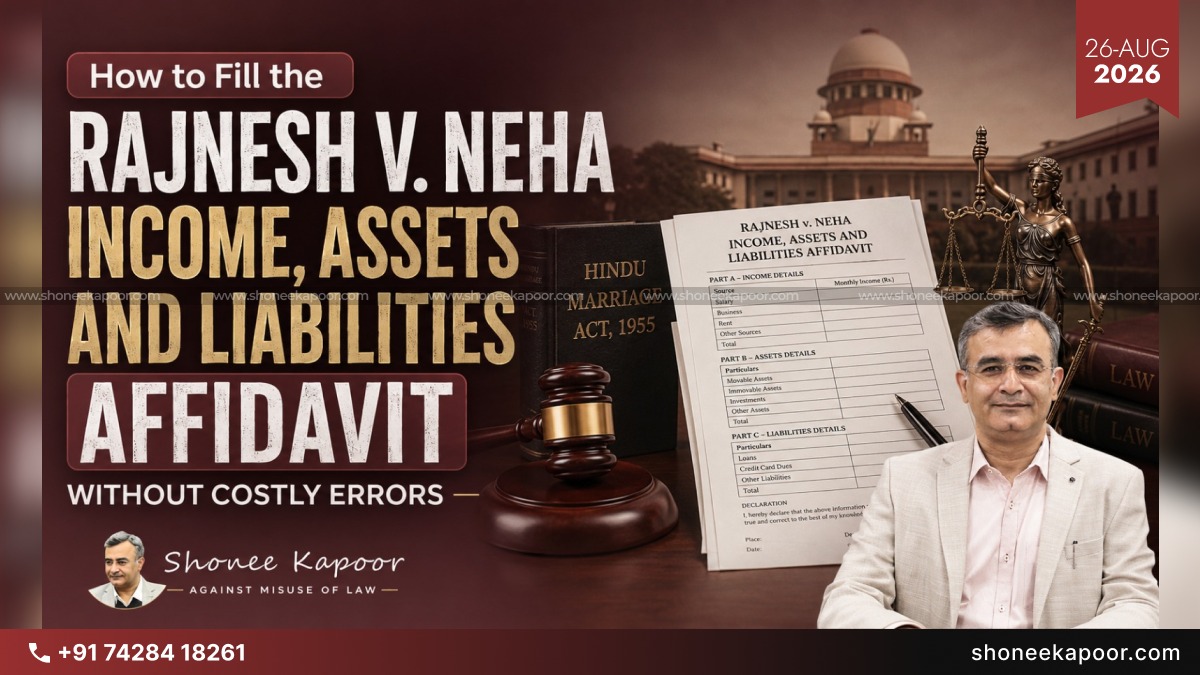
How to Fill the Rajnesh v. Neha Income, Assets and Liabilities Affidavit Without Costly Errors

Written and analysed by Vaibhav Ojha
Head Of Legal CommunicationsFiling a Rajnesh v Neha income affidavit? Learn how to correctly disclose salary, bank accounts, assets, EMIs, liabilities and expenses under the latest 2026 maintenance law. One omitted bank account, unexplained credit or badly disclosed EMI can change the financial picture before the court. Here is how to fill the Rajnesh v. Neha affidavit correctly.
NEW DELHI: Let me say this clearly.
The Rajnesh v. Neha affidavit is not routine paperwork. It is a sworn financial disclosure.
If your affidavit says one thing, your salary records say another and your bank statements tell a third story, you have created a credibility problem for yourself before the maintenance case has even reached final evidence.
And this applies to both sides.
For husbands facing inflated income allegations, Rajnesh v. Neha is equally important because it gives them the right to insist that financial transparency cannot remain one-sided.
WHAT DID THE SUPREME COURT ORDER IN RAJNESH v. NEHA?
In Rajnesh v. Neha, (2021) 2 SCC 324, decided on 4 November 2020, the Supreme Court prescribed a uniform Affidavit of Disclosure of Assets and Liabilities for maintenance proceedings across India.
The applicant must ordinarily file the maintenance application with the disclosure affidavit. The respondent is required to file the reply with the affidavit within a maximum of four weeks. The Court said ordinarily not more than two opportunities should be granted, and wilful, contumacious delay can even lead the Court to consider striking off the respondent's defence.
The Supreme Court reaffirmed the importance of this framework in Aditi Alias Mithi v. Jitesh Sharma, 2023 INSC 981. High Courts have subsequently set aside maintenance orders passed without proper compliance with the disclosure requirement.
WHAT MUST YOU ACTUALLY DISCLOSE?
| Part | What Should Be Disclosed |
|---|---|
| Income | Employment, designation, salary, business/professional income, rent, interest and other income |
| Bank Accounts | All relevant bank accounts with statements required by the prescribed format |
| Tax Records | ITRs, Form 16 and salary documents, wherever applicable |
| Assets | Property, investments, shares, mutual funds, deposits, jewellery and relevant ownership interests |
| Loans & EMIs | Creditor, amount borrowed, EMI, date and purpose of loan, amount repaid |
| Expenses | Rent, household, transport, medical and other genuine recurring expenses |
| Dependants | Children, parents and other genuinely dependent family members |
| Children | School fees, medical expenses, extracurricular and other child-related expenditure |
| Other Cases | Existing maintenance proceedings, orders, amounts paid and arrears |
| Business/NRI Details | Business structure, net income, overseas income, foreign taxes and expenses where applicable |
The prescribed non-agrarian affidavit requires detailed disclosure rather than a one-line assertion of “salary” or “expenses”. The courts can also call for further information where necessary.
9 COSTLY MISTAKES TO AVOID
- Filing selective bank statements: The Rajnesh framework requires extensive banking disclosure. In Rakesh Ray v. Priti Ray, the Delhi High Court record specifically noted the requirement of preceding three years' bank statements and examined whether the disclosure was complete. Do not conveniently choose only the months that suit your case.
- Treating your take-home salary as your entire financial story: Salary slips, employer records, Form 16, ITRs, allowances and benefits should reconcile. A number without the document behind it is vulnerable.
- Leaving large bank credits unexplained: A ₹2 lakh credit may be salary, a loan, a transfer between your own accounts or sale proceeds. The entry alone does not explain itself. Identify unusual transactions and preserve supporting documents. In Rakesh Ray, the Delhi High Court closely examined bank entries allegedly connected with Lakme and found that the transactions being relied upon did not establish income in the manner suggested.
- Forgetting income beyond salary: Rent, interest, dividends, investments, business receipts and other sources matter. Concealing one source can damage the credibility of the rest of your affidavit.
- Writing “loan” or “EMI” without explaining it: Mention the lender, original amount, date, purpose, EMI and outstanding balance. Attach the loan statement wherever possible.
- Assuming every EMI will reduce maintenance: This became even more important in 2026. In Deepa Joshi v. Gaurav Joshi, 2026 INSC 370, the Supreme Court held that loan repayments which create or acquire assets cannot be equated with necessary expenditure so as to substantially reduce maintenance liability. The Court said: “The liability to maintain a spouse is a primary obligation.”
- Ignoring dependent parents or genuine liabilities: If you actually maintain aged parents, children from another legally recognised obligation, or meet substantial medical expenditure, disclose the liability accurately and support it with evidence. Do not merely write a round monthly figure.
- Hiding previous maintenance orders or payments: Rajnesh v. Neha specifically deals with overlapping maintenance proceedings. Previous orders must be disclosed so the later court can consider adjustment or set-off rather than creating duplicate recovery. The Delhi High Court applied that principle again in Rakesh Ray v. Priti Ray in 2026.
- Filing once and forgetting about it: The declaration itself requires the deponent to inform the Court of any material change in employment, income, assets or expenses. If your job changes, salary rises, business closes or a major liability disappears, update the Court rather than allowing an outdated affidavit to remain on record.
THE MOST IMPORTANT HUSBAND-SIDE RULE: DOCUMENT, DON'T JUST DENY
If the wife alleges:
“Husband earns ₹3 lakh per month.”
A reply saying:
“Wrong. I earn much less.”
is weak.
Your affidavit should make the financial trail capable of verification:
Salary → Salary Slip → Bank Credit → Form 16 → ITR → Necessary Deductions → Genuine Liabilities → Actual Disposable Position.
Similarly, if the claimant says she has “no income”, the answer should not merely be “she is lying”.
Bring whatever legally obtainable material exists—employment records, professional profile, business records, property documents, disclosed investments or relevant bank material—and seek appropriate production through the Court.
Rajnesh v. Neha expressly permits the aggrieved party, in case of disputed disclosures, to seek the Court's permission for interrogatories and production of relevant documents under Order XI CPC. Courts can also require further information.
That is evidence. Anger is not.
WHAT THE ACTUAL RAJNESH COURTROOM RECORD TELLS US
There is an interesting reason this judgment matters so much.
During the proceedings before the Supreme Court, the husband personally stated that he did not have the financial means to comply with the maintenance order and had borrowed from his father.
The Court was therefore dealing with the recurring practical problem of one side alleging financial capacity and the other pleading inability to pay.
The eventual response was not guesswork.
It was structured financial disclosure from both parties.
That is the real significance of Rajnesh v. Neha.
2026 LEGAL UPDATE: BNSS, BNS AND BSA NOW APPLY
One point many online formats miss:
Rajnesh v. Neha was decided in 2020, so its original affidavit naturally refers to the IPC, CrPC and Indian Evidence Act.
The new criminal laws came into force on 1 July 2024.
For fresh summary-maintenance proceedings, Section 144 of the Bharatiya Nagarik Suraksha Sanhita, 2023 (BNSS) now contains the provision corresponding to the old Section 125 CrPC. Maintenance under Section 24 of the Hindu Marriage Act and monetary/interim relief under the Domestic Violence Act continue under their respective statutes.
The 2020 affidavit's references to false evidence and false declarations are therefore legacy statutory references. Under the present framework, relevant subject matter is now found in provisions including Sections 227, 229, 236 and 246 BNS, while the procedure concerning offences affecting administration of justice is dealt with under Section 379 BNSS.
However, do not alter a court-prescribed affidavit yourself merely to replace old section numbers. File the format directed by the concerned Court and deal with the applicable statutory provisions separately.
Also remember: under Section 532 BNSS, specified proceedings already pending when BNSS came into force continue under the old CrPC framework.
BEFORE YOU SIGN THE AFFIDAVIT
Do one final exercise:
Put your affidavit, bank statements, ITRs, salary slips, loan statements and earlier court pleadings next to each other.Now ask:
Does every important number tell the same story?
Because the opposite party will eventually do exactly that comparison.
A maintenance affidavit should never be prepared as a document you merely want to file.
Prepare it as a document you are ready to defend line by line in Court.
For men facing exaggerated income claims, the strongest answer is usually not another allegation.
It is a cleaner financial record.
FAQ’s
1. Is the Rajnesh v. Neha affidavit mandatory in maintenance cases?
Yes. The Supreme Court directed disclosure affidavits to be filed by parties in maintenance proceedings across the country, although the concerned Court may modify the format where the facts require it.
2. How many years of bank statements are required under Rajnesh v. Neha?
For non-agrarian deponents, the prescribed framework requires bank statements for the preceding three years. Courts may seek additional financial material when necessary.
3. Can a husband deduct home-loan or other EMIs while calculating maintenance?
The liability must be disclosed, but not every EMI will automatically reduce maintenance capacity. In Deepa Joshi v. Gaurav Joshi, the Supreme Court held that asset-generating loan repayments cannot be treated like essential expenditure so as to substantially dilute maintenance liability.
4. What can a husband do if the wife conceals her income or assets?
Place the available evidence before the Court and seek appropriate discovery or production. Rajnesh v. Neha permits a party disputing the affidavit to seek interrogatories and production of relevant documents through the Court.
5. What if my income changes after filing the Rajnesh affidavit?
Inform the Court and file the appropriate updated or supplementary disclosure. The prescribed declaration requires immediate disclosure of material changes in employment, income, assets or expenses.
DISCLAIMER: This article is for general legal information and does not substitute case-specific professional advice. Court procedures and prescribed formats may vary depending on the proceeding and judicial directions.
Related Articles

What Legal Remedies Are Available For Men In India? 498A, Divorce, Maintenance, Custody & False Cases
Know the legal remedies available for men in India against false 498A, maintenance, domestic violence, custody battle...
Can Maintenance Be Reduced Or Cancelled Later? Indian Law Every Husband Must Know
Can a husband reduce or cancel maintenance later in India? Know Section 146 BNSS, Section 127 CrPC, HMA Section 25, D...

What To Do If Wife Takes Child Away Illegally? Father’s Legal Remedies In India
If your wife has taken your child away without consent, do not panic, threaten, or file emotional complaints. Indian ...







Share Your Thoughts
Comments are moderated before publication.