
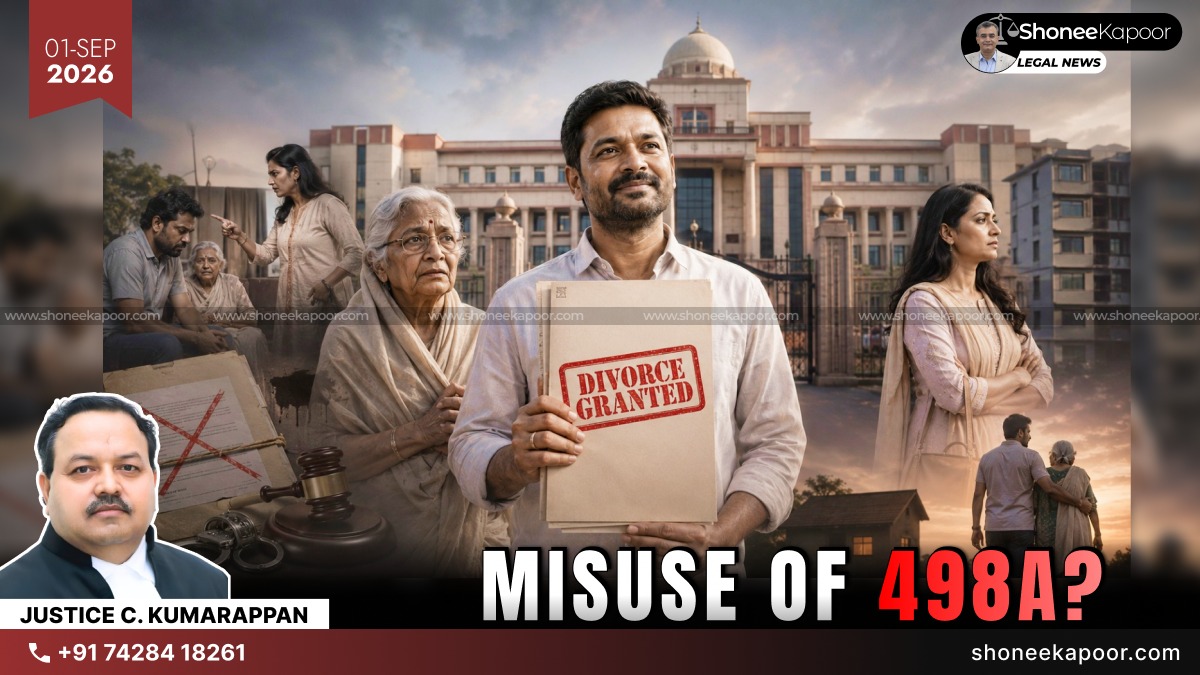
Wife Pressured Husband To Leave His Ailing Mother, Then Filed False 498A Case? Chhattisgarh High Court Grants Him Divorce

Curated by NEWS DESK
Editorial DeskCan a wife repeatedly pressure her husband to live away from his old and ailing mother, and later prosecute him in a false dowry harassment case? The Chhattisgarh High Court examined the entire matrimonial conduct and granted the husband divorce on the ground of mental cruelty.
BILASPUR: The Chhattisgarh High Court has granted divorce to a husband after holding that his wife’s conduct, when seen as a whole, caused him mental cruelty and made continuation of the marriage difficult.
Justice Naresh Kumar Chandravanshi was hearing an appeal filed by husband Vivek Agrawal against a February 2025 order of the District Judge, Pendra Road, which had rejected his divorce petition.
The couple married on 12 December 2014 and had a son in December 2015. The husband alleged that after marriage, the wife frequently quarrelled with him and his family and repeatedly pressured him to live separately from his mother. He also alleged inappropriate communications between his wife and another man and claimed that she later implicated him in a false dowry harassment case.
The wife denied these allegations. She claimed that the husband was suspicious about her character and subjected her to mental and physical harassment. She also denied having an illicit relationship and disputed the allegations concerning assault, jewellery, cash and desertion.
During cross-examination, however, the wife admitted that her aged parents-in-law required considerable care and that she wanted her husband to shift to a larger house on the main road while he was unwilling to leave his parents.
The wife’s mother also admitted that after the husband sent a divorce notice, the family became angry and legal proceedings were started. Importantly, she admitted that if the husband had not sent the divorce notice, they would not have initiated those cases.
The High Court found that some allegations made by the husband, including physical assault, strangulation, theft and neglect of the child, were not supported by strong independent evidence. It therefore did not blindly accept every allegation made against the wife.
However, another major factor was the criminal case filed against the husband. The husband had been prosecuted in Criminal Case No. 372/2021 over allegations of dowry harassment but was acquitted on 17 March 2026.
The Court made it clear that merely filing a criminal complaint, or merely securing an acquittal, does not automatically establish matrimonial cruelty. A spouse has every right to approach the police where there is a genuine grievance.
But after examining the circumstances of this case and Supreme Court precedents, the High Court concluded that the false accusation under Sections 498A/34 IPC amounted to mental cruelty and caused agony, pain and suffering to the husband.
On the demand for separate residence, the Court also drew an important distinction. Simply asking for a separate matrimonial home is not automatically cruelty. Such a demand may be justified where the matrimonial home is oppressive or unsafe.
But here, the husband’s mother was admittedly very old and ailing, and his refusal to distance himself from her was neither unnatural nor unreasonable.
The Court observed:
“A matrimonial relationship does not confer upon either spouse an unfettered right to compel the other to renounce or abandon pre-existing familial responsibilities.”
It further said:
“Marriage creates a new family, but it does not, by itself, extinguish the moral and legal responsibilities which a person may owe towards aged or infirm parents.”
The Court also explained that mental cruelty cannot normally be decided by taking one incident in isolation. The Court must consider the complete matrimonial relationship, the continuity of conduct, and its impact on the spouse.
The parties had been living separately since 2019. The Court found that the wife repeatedly pressured the husband to live separately, that matrimonial disputes continued, that she had inappropriate communication with another man, and that she had received some support from her mother’s evidence; the husband had also faced a false criminal prosecution.
Considering these circumstances cumulatively, the High Court held that the husband had successfully proved mental cruelty. The Court therefore set aside the District Judge’s order and granted the husband a decree of divorce, dissolving the marriage.
EXPLANATORY TABLE OF LAWS AND SECTIONS
| Law / Section | What It Provides | Relevance In This Case |
|---|---|---|
| Section 13, Hindu Marriage Act, 1955 | Provides statutory grounds on which a Hindu marriage may be dissolved by divorce. | The husband sought dissolution of his marriage on the ground of cruelty. |
| Section 28, Hindu Marriage Act, 1955 | Provides for appeals against decrees and certain orders passed under the Act. | The husband approached the High Court against dismissal of his divorce petition. |
| Section 498A IPC | Punishes legally defined cruelty by a husband or his relatives towards a married woman. | The wife had prosecuted the husband for dowry-related cruelty; he was subsequently acquitted. |
| Section 34 IPC | Deals with acts done by several persons in furtherance of common intention. | The criminal accusations referred to by the High Court were under Sections 498A/34 IPC. |
| Section 125 CrPC | Provides a summary remedy for maintenance to eligible wives, children and parents. | The wife initiated proceedings under this provision after the matrimonial dispute escalated. |
CASE DETAILS
| Particulars | Details |
|---|---|
| Case Title | Vivek Agrawal v. Sarita Agrawal & Anr. |
| Court | High Court of Chhattisgarh at Bilaspur |
| Case Number | FA(MAT) No. 156 of 2025 |
| Neutral Citation | 2026:CGHC:38262 |
| Bench | Hon’ble Shri Justice Naresh Kumar Chandravanshi |
| Appellant | Vivek Agrawal |
| Respondents | Sarita Agrawal and Narayan Prasad Mishra |
| Counsel for Appellant/Husband | Mr Pritam Singh, Advocate |
| Counsel for Respondent No. 1/Wife | Mr Vijay Shankar Mishra, Advocate |
| Original Case | Civil Suit No. 50A/2022 |
KEY TAKEAWAYS
- False 498A Allegations Have Consequences: A husband cannot be expected to quietly absorb the trauma of a false criminal prosecution.
- Marriage Does Not Mean Abandoning Parents: A wife cannot treat an old and ailing mother as an obstacle that the husband must remove from his life.
- Men’s Family Duties Also Matter: A husband’s responsibility towards aged parents does not disappear after marriage.
- Acquittal Alone Is Not Enough, But False Prosecution Matters: The Court examined the entire conduct before treating the criminal case as part of mental cruelty.
- Mental Cruelty Against Husbands Is Real: Repeated pressure, prolonged conflict and false criminal accusations can collectively destroy a marriage and legally justify divorce.
Share Your Thoughts
Comments are moderated before publication.